ノーザン・マーキュリー
Northern Mercury
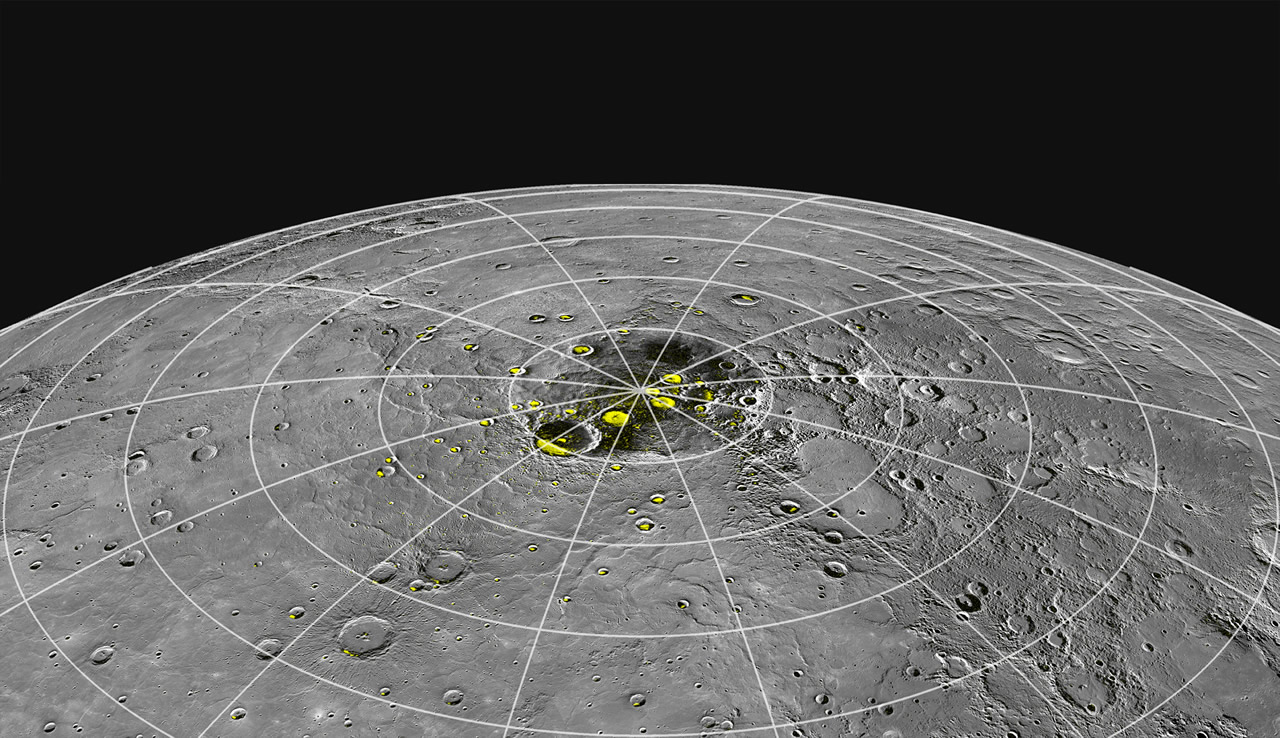
最も内側の惑星である水星は、惑星間冬季オリンピックの開催地としてはおそらく適さないだろう。しかし、水星を周回するMESSENGER探査機からのデータに基づく新たな結果によると、水星の北極付近のクレーター内の永久影領域には相当量の水氷が存在することが示唆されている。水星に氷が存在する可能性は、北極付近のレーダー反射率の高い領域が発見されたことから、長年検討されてきた。MESSENGERの投影画像に基づくこの地図で黄色で強調されているレーダー反射率の高い領域は、北極衝突クレーターの底面と壁に対応していることがわかる。極から遠ざかるにつれて、これらの領域は北向きのクレーター壁に集中している。MESSENGERの中性子分光法とクレーターの熱モデルによると、これらの領域の物質はほぼ純粋な水氷と一致する水素含有量を持ち、100ケルビン(-280°F、-173°C)以下の温度の領域に閉じ込められている。月のクレーターに永久影ができるのと同様の状況で、彗星の衝突による破片が水星の氷の起源であると考えられている。
原文(English)
Innermost planet Mercury would probably not be a good location for an interplanetary winter olympics. But new results based on data from the Mercury orbiting MESSENGER spacecraft indicate that it does have substantial water ice in permanently shadowed regions within craters near its north pole. The possibility of ice on Mercury has been entertained for years, inspired by the discovery of radar bright, hence highly reflective, regions near the north pole. Highlighted in yellow in this map based on projected MESSENGER images, radar bright regions are seen to correspond with floors and walls of north polar impact craters. Farther from the pole the regions are concentrated on the north facing crater walls. MESSENGER's neutron spectroscopy and thermal models for the craters indicate material in these regions has a hydrogen content consistent with nearly pure water ice and is trapped in an area with temperatures that remain below 100 kelvins (-280 deg.F, -173 deg.C). In circumstances similar to permanent shadows in craters of the Moon, debris from comet impacts is thought to be the source of ice on Mercury.
\ この感動を宇宙仲間にシェア /
宇宙をXでシェア
© NASA / APOD