チリ上空の対空鏡
The Gegenschein Over Chile
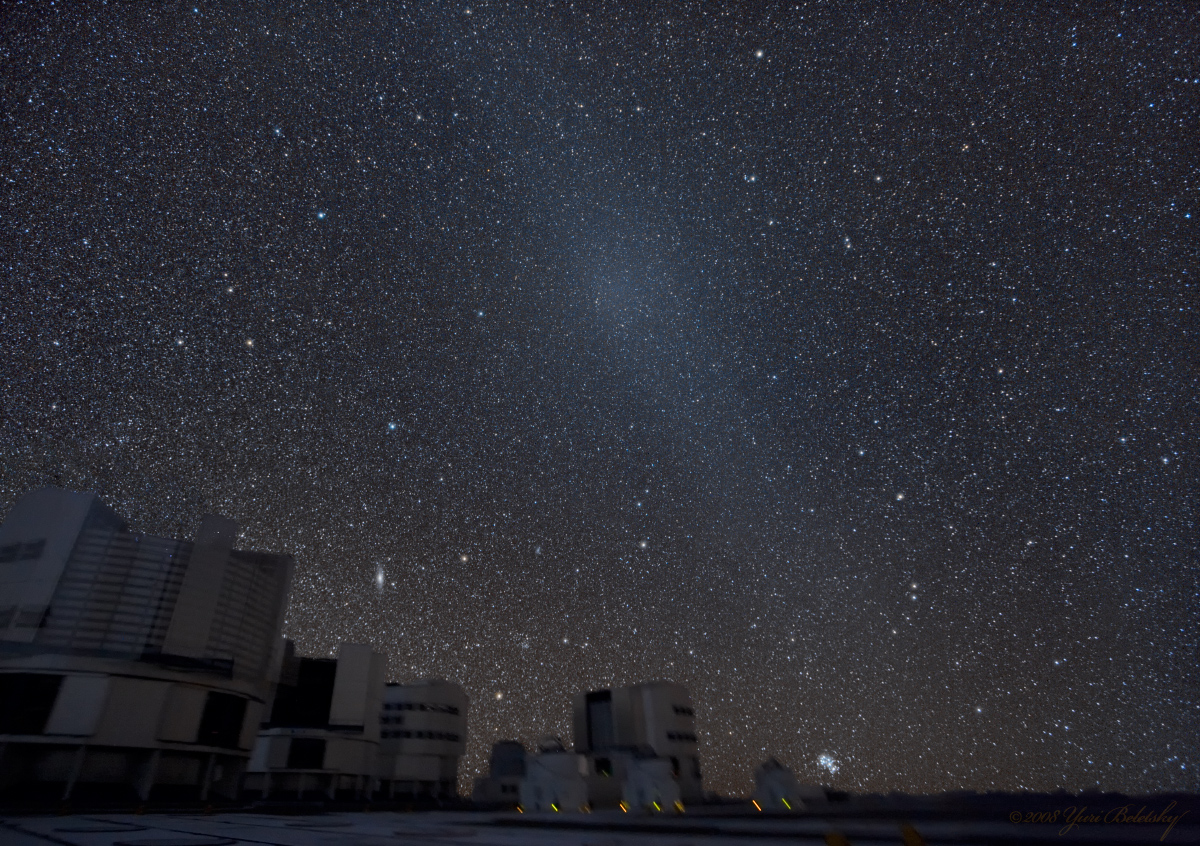
夜空は太陽の反対方向が最も暗いのでしょうか?いいえ。実際には、極めて暗い空では、太陽から180度離れた方向に、めったに見分けられないかすかな光、すなわち「反光」と呼ばれる現象が見られます。反光は、小さな惑星間塵粒子によって太陽光が後方散乱されたものです。これらの塵粒子は、小惑星から生じたミリメートルサイズの破片で、惑星の黄道面を公転しています。上の写真は2008年10月に撮影されたもので、これまでに撮影された反光の中でも特に素晴らしい写真の一つです。チリのパラナル天文台上空の極めて暗い空を長時間露光で撮影したこの写真では、反光が非常に鮮明に写っており、周囲の光まで見ることができます。前景にはヨーロッパ南天天文台の超大型望遠鏡がいくつか写っており、背景には左下方向にアンドロメダ銀河、地平線のすぐ上にプレアデス星団が見られます。対日光は、太陽付近の黄道光とは反射角が大きい点で区別されます。日中には、飛行機から太陽の反対側の空気や雲が反射することで、対日光に似た現象である「光輝」が見られることがあります。
原文(English)
Is the night sky darkest in the direction opposite the Sun? No. In fact, a rarely discernable faint glow known as the gegenschein (German for "counter glow") can be seen 180 degrees around from the Sun in an extremely dark sky. The gegenschein is sunlight back-scattered off small interplanetary dust particles. These dust particles are millimeter sized splinters from asteroids and orbit in the ecliptic plane of the planets. Pictured above from 2008 October is one of the more spectacular pictures of the gegenschein yet taken. Here a deep exposure of an extremely dark sky over Paranal Observatory in Chile shows the gegenschein so clearly that even a surrounding glow is visible. In the foreground are several of the European Southern Observatory's Very Large Telescopes, while notable background objects include the Andromeda galaxy toward the lower left and the Pleiades star cluster just above the horizon. The gegenschein is distinguished from zodiacal light near the Sun by the high angle of reflection. During the day, a phenomenon similar to the gegenschein called the glory can be seen in reflecting air or clouds opposite the Sun from an airplane.
\ この感動を宇宙仲間にシェア /
宇宙をXでシェア
© Yuri Beletsky
(ESO) / APOD