NGC 5189:非常に複雑な惑星状星雲
NGC 5189: An Unusually Complex Planetary Nebula
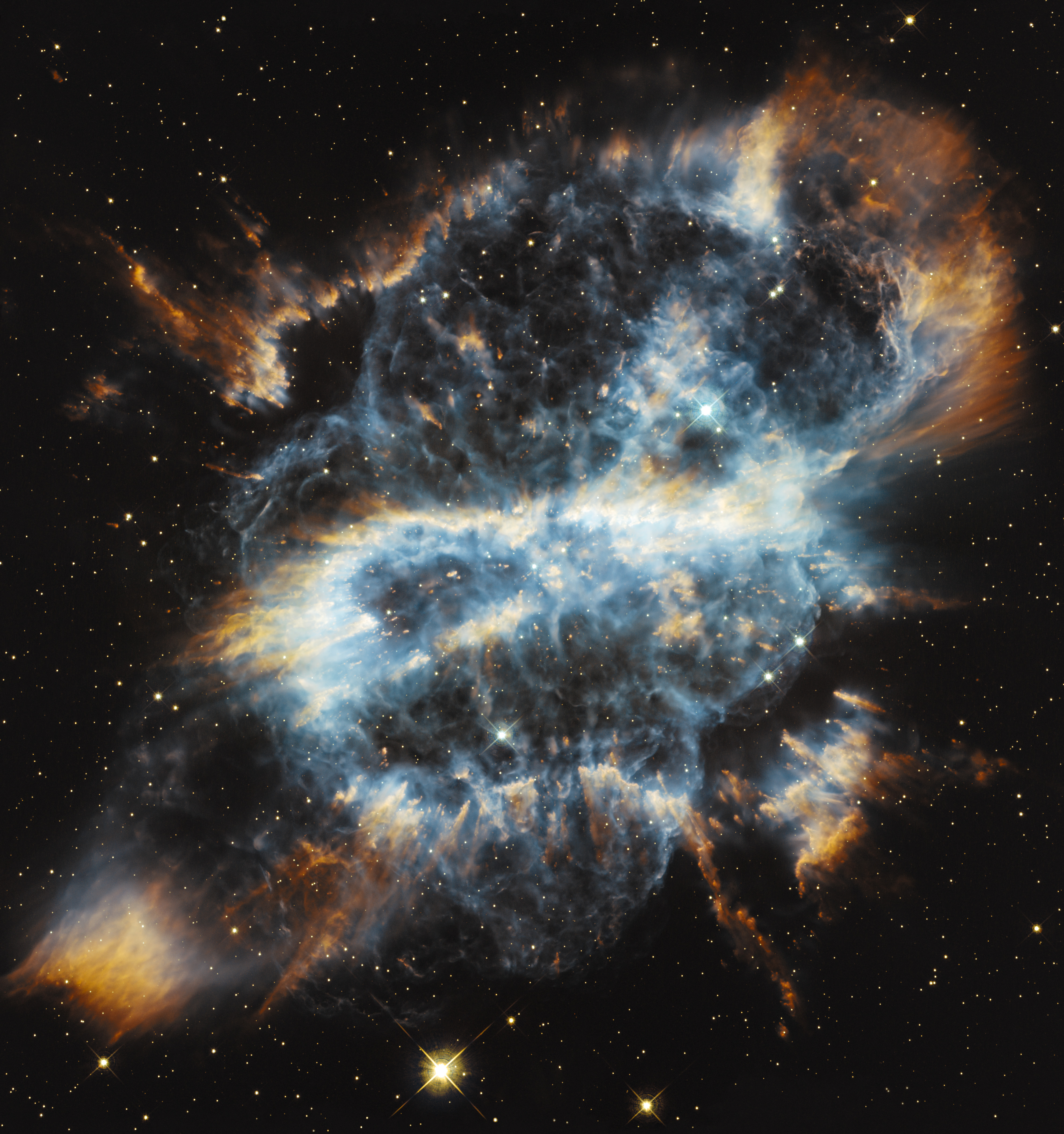
なぜこの星雲はこんなに複雑なのでしょうか?太陽のような恒星が死を迎えるとき、通常は単純な全体的な形状に外層を放出します。その形状は球形の場合もあれば、二重ローブの場合、あるいは環状やらせん状の場合もあります。しかし、惑星状星雲NGC 5189の場合、そのような単純な構造は現れていません。その理由を解明するために、地球周回ハッブル宇宙望遠鏡は最近、NGC 5189を詳細に観測しました。これまでの研究結果は、物質流出が複数回発生したことを示しており、最近の流出では、画像の中心を水平方向に横切る明るく歪んだトーラスが形成されました。これらの結果は、死にゆく恒星が歳差運動する対称軸を持つ連星系の一部であるという仮説と一致しているようです。しかし、この新しいデータに基づいて、研究は今後も続けられるでしょう。NGC 5189は、約3光年にわたって広がり、南天のハエ座(Musca)の方向に約3,000光年離れたところに位置しています。 APOD編集者が講演:RJNは1月3日にフィラデルフィアで、JTBは1月4日にニューヨーク市で講演
原文(English)
Why is this nebula so complex? When a star like our Sun is dying, it will cast off its outer layers, usually into a simple overall shape. Sometimes this shape is a sphere, sometimes a double lobe, and sometimes a ring or a helix. In the case of planetary nebula NGC 5189, however, no such simple structure has emerged. To help find out why, the Earth-orbiting Hubble Space Telescope recently observed NGC 5189 in great detail. Previous findings indicated the existence of multiple epochs of material outflow, including a recent one that created a bright but distorted torus running horizontally across image center. Results appear consistent with a hypothesis that the dying star is part of a binary star system with a precessing symmetry axis. Given this new data, though, research is sure to continue. NGC 5189 spans about three light years and lies about 3,000 light years away toward the southern constellation of the Fly (Musca). APOD Editors to Speak: RJN in Philadelphia on Jan. 3 & JTB in New York City on Jan. 4
\ この感動を宇宙仲間にシェア /
宇宙をXでシェア
© NASA / APOD