ろ座銀河団
The Fornax Cluster of Galaxies
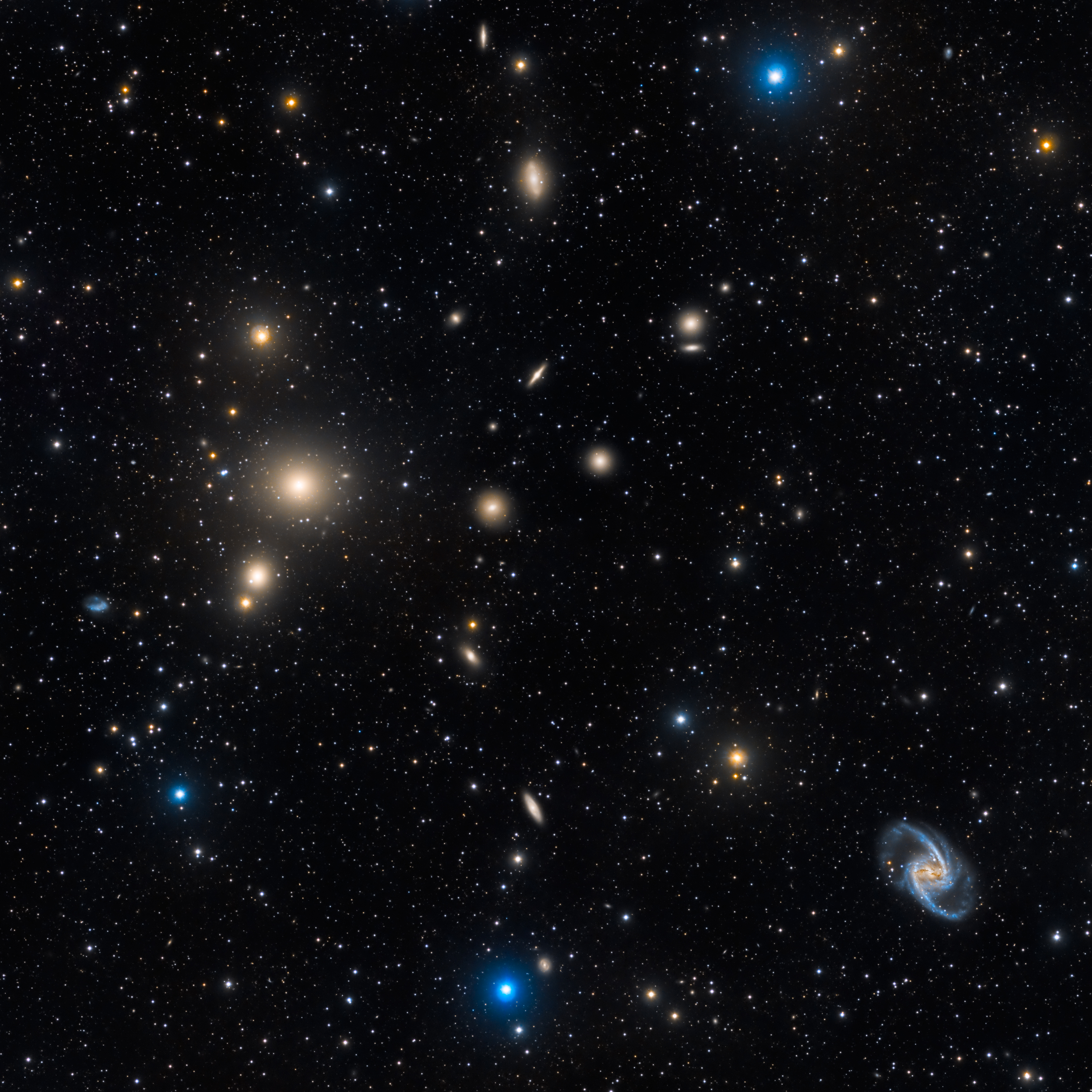
銀河団はどのように形成され、進化するのでしょうか?その解明のため、天文学者たちは地球から2番目に近い銀河団であるフォーナックス銀河団の研究を続けています。フォーナックス銀河団は、その銀河のほとんどが南の星座であるフォーナックスの方向にあることからその名が付けられました。フォーナックス銀河団は、隣接するアンドロメダ銀河よりも約20倍遠いものの、より有名で銀河の数も多いおとめ座銀河団よりはわずか10パーセントほど遠いだけです。フォーナックス銀河団には、多くの銀河を含む明確な中心領域がありますが、まだ進化の途上にあります。また、まだ合体していない、別個のように見える他の銀河群も存在します。ここに示されている画像では、ほぼすべての黄色っぽい斑点がフォーナックス銀河団の楕円銀河です。右下に見える美しい棒渦巻銀河NGC 1365も、フォーナックス銀河団の代表的なメンバーです。 APODをフォローするには、Facebook(毎日更新)(Sky)(スペイン語)またはGoogle Plus(毎日更新)(River)をご覧ください。
原文(English)
How do clusters of galaxies form and evolve? To help find out, astronomers continue to study the second closest cluster of galaxies to Earth: the Fornax cluster, named for the southern constellation toward which most of its galaxies can be found. Although almost 20 times more distant than our neighboring Andromeda galaxy, Fornax is only about 10 percent further that the better known and more populated Virgo cluster of galaxies. Fornax has a well-defined central region that contains many galaxies, but is still evolving. It has other galaxy groupings that appear distinct and have yet to merge. Seen here, almost every yellowish splotch on the image is an elliptical galaxy in the Fornax cluster. The picturesque barred spiral galaxy NGC 1365 visible on the lower right is also a prominent Fornax cluster member. Follow APOD on: Facebook (Daily) (Sky) (Spanish) or Google Plus (Daily) (River)
\ この感動を宇宙仲間にシェア /
宇宙をXでシェア
© Marco Lorenzi / APOD