ラブジョイ彗星の尾
Comet Lovejoy's Tail
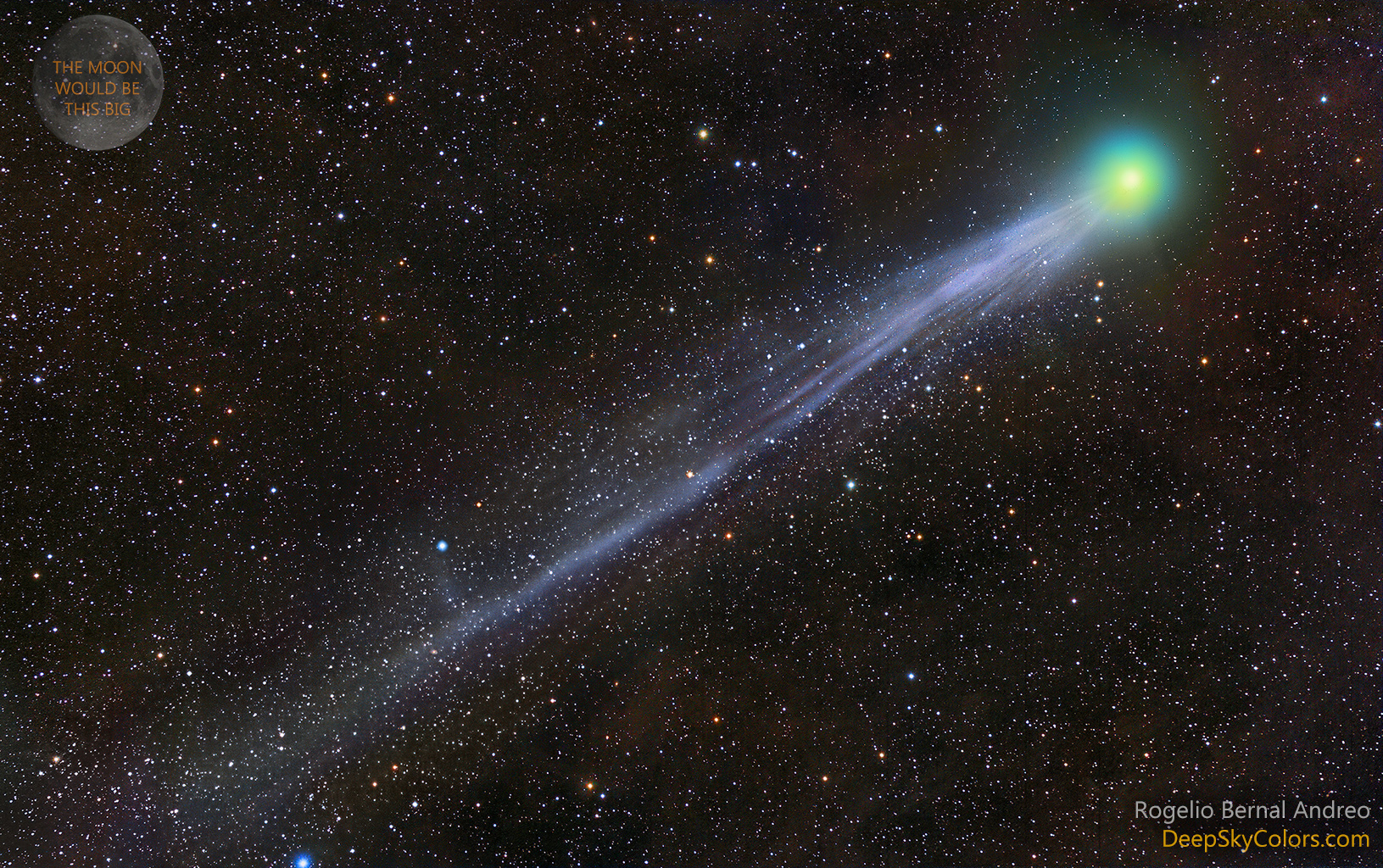
1月13日、地球の空を北へと横切るラブジョイ彗星の緑がかったコマと青みがかったイオンの尾が、おうし座の星空に広がっていた。左上の挿入図は、比較のために満月の視角0.5度を示している。そのため、ラブジョイ彗星のコマは、空に映る満月よりわずかに小さい(ただし、はるかに暗い)程度で、尾は画面全体で4度以上にわたって見える。これは、地球から推定7500万キロメートルの距離にある彗星から見て、500万キロメートル以上にも相当する。太陽風に吹かれて、彗星の繊細で構造化されたイオンの尾は太陽から遠ざかり、1月30日に太陽に最も接近する近日点に向かうにつれて成長します。二原子炭素(C2)ガスが太陽光で蛍光を発してコマの緑色を生み出し、より淡い青みがかった尾は電離した一酸化炭素(CO+)の放出によって色づいています。
原文(English)
Sweeping north in planet Earth's sky, Comet Lovejoy's greenish coma and blue tinted ion tail stretched across this field of stars in the constellation Taurus on January 13. The inset at the upper left shows the 1/2 degree angular size of the full moon for scale. So Lovejoy's coma appears only a little smaller (but much fainter) than a full moon on the sky, and its tail is visible for over 4 degrees across the frame. That corresponds to over 5 million kilometers at the comet's estimated distance of 75 million kilometers from Earth. Blown by the solar wind, the comet's tenuous, structured ion tail streams away from the Sun, growing as this Comet Lovejoy heads toward perihelion, its closest approach to the Sun, on January 30. While diatomic carbon (C2) gas fluorescing in sunlight produces the coma's green color, the fainter bluish tail is tinted by emission from ionized carbon monoxide (CO+).
\ この感動を宇宙仲間にシェア /
宇宙をXでシェア
© Rogelio Bernal
Andreo / APOD