惑星状星雲Mz3:アリ星雲
Planetary Nebula Mz3: The Ant Nebula
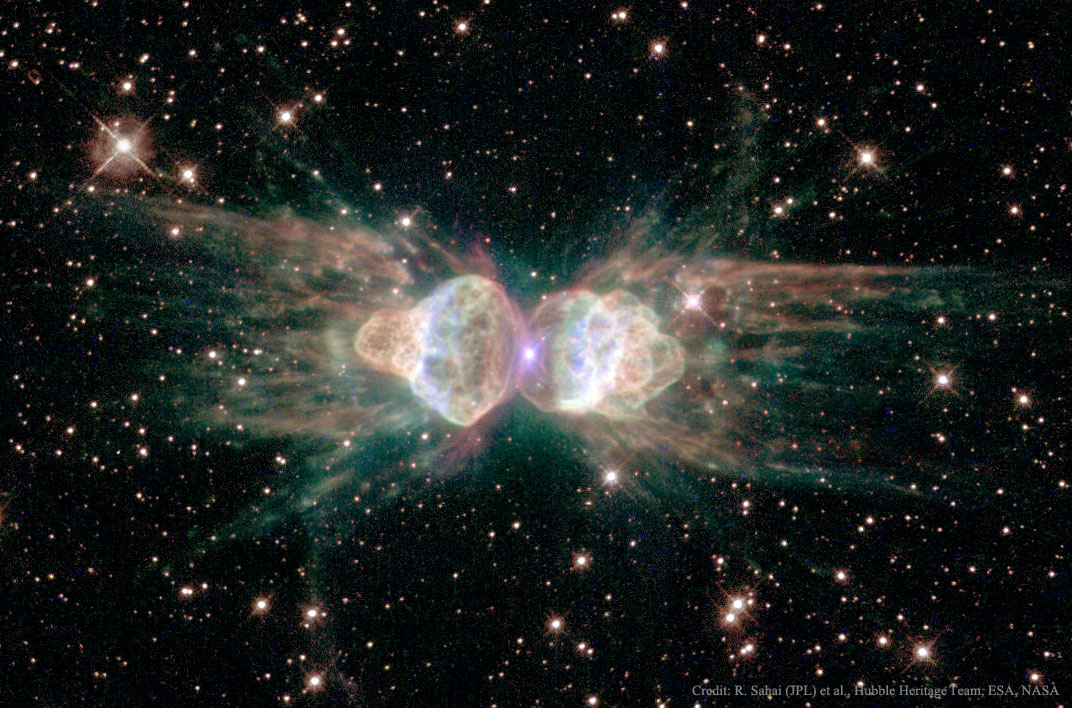
なぜこのアリは大きな球体ではないのでしょうか?惑星状星雲Mz3は、私たちの太陽に似た、明らかに球形の恒星から放出されています。では、なぜ放出されたガスは、明らかに球形ではないアリの形をした星雲を形成するのでしょうか?手がかりとしては、放出されたガスの毎秒1000キロメートルという高速、構造の長さが光年にも及ぶこと、そして星雲の中心上空に見える恒星の磁場などが挙げられます。考えられる答えの一つは、Mz3が明るい恒星の近くを公転する、より暗い第二の恒星を隠しているというものです。対立する仮説としては、中心星自身の自転と磁場がガスを誘導しているというものがあります。中心星が私たちの太陽に非常によく似ていることから、天文学者たちはこの巨大な宇宙アリの歴史をより深く理解することで、私たちの太陽と地球の将来について有益な洞察が得られることを期待しています。記念:ハッブル宇宙望遠鏡25周年
原文(English)
Why isn't this ant a big sphere? Planetary nebula Mz3 is being cast off by a star similar to our Sun that is, surely, round. Why then would the gas that is streaming away create an ant-shaped nebula that is distinctly not round? Clues might include the high 1000-kilometer per second speed of the expelled gas, the light-year long length of the structure, and the magnetism of the star visible above at the nebula's center. One possible answer is that Mz3 is hiding a second, dimmer star that orbits close in to the bright star. A competing hypothesis holds that the central star's own spin and magnetic field are channeling the gas. Since the central star appears to be so similar to our own Sun, astronomers hope that increased understanding of the history of this giant space ant can provide useful insight into the likely future of our own Sun and Earth. Celebration: 25 Years of the Hubble Space Telescope
\ この感動を宇宙仲間にシェア /
宇宙をXでシェア
© NASA / APOD