コメット・カタリーナ・テイルズ
Comet Catalina Tails
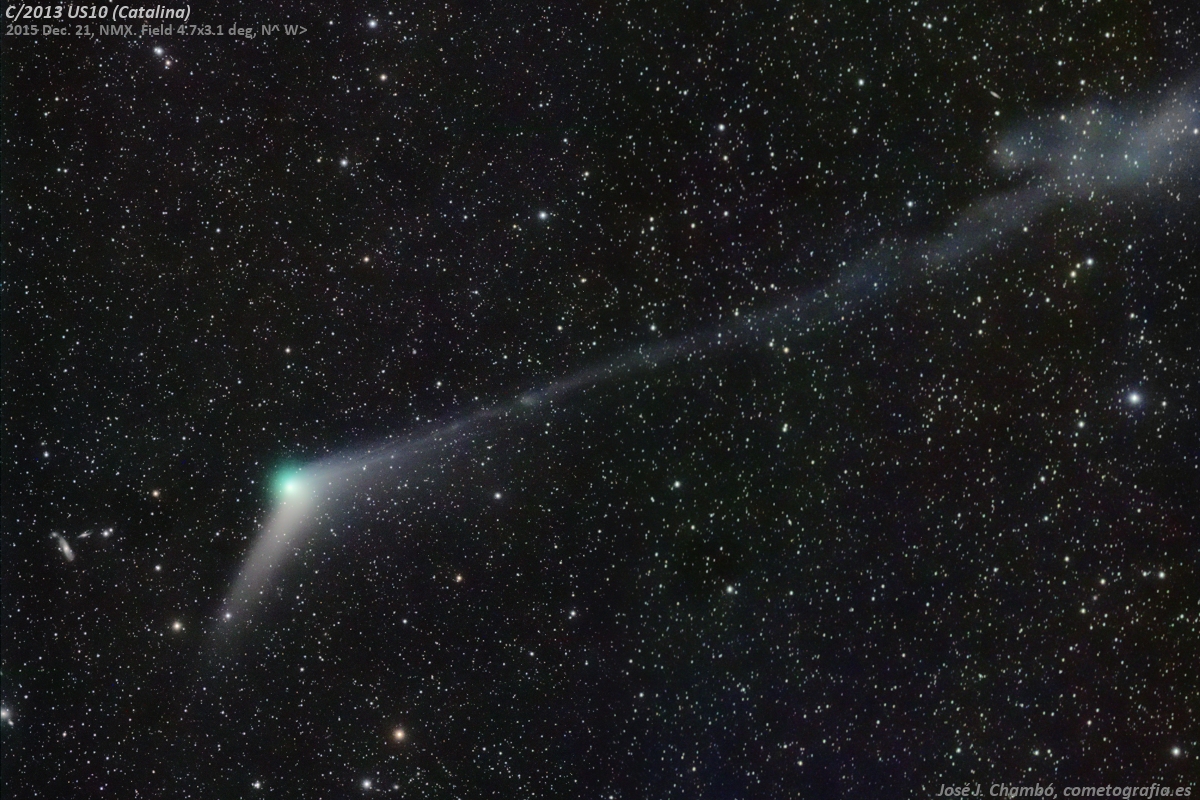
2016年が始まった今、双眼鏡で新年の贈り物として、カタリナ彗星(C/2013 US10)が、うしかい座のアルファ星である明るいアークトゥルスの近くで、地球の夜明け前の空を横切っています。しかし、12月21日に撮影されたこの望遠鏡モザイクは、満月10個分ほどの視野を横切る彗星の美しい尾を追っています。背景にある遠くの銀河やかすかな星は、おとめ座にあります。彗星の軌道の後ろに、カタリナの塵の尾はフレームの下と左に扇状に広がっています。そのイオンの尾は、太陽から離れて右上に傾いており、太陽風に吹きさらされています。1月17日、オールトの雲から外向きに旅するこの彗星は、北斗七星の柄に沿った明るい星の近くで、わずか1億1000万キロメートルの距離で地球に最も接近します。
原文(English)
A new year's treat for binoculars, as 2016 begins Comet Catalina (C/2013 US10) now sweeps through planet Earth's predawn skies near bright Arcturus, alpha star of Bootes. But this telescopic mosaic from December 21 follows the pretty tails of the comet across a field of view as wide as 10 full moons. The smattering of distant galaxies and faint stars in the background are in the constellation Virgo. Trailing behind the comet's orbit, Catalina's dust tail fans out below and left in the frame. Its ion tail is angled toward the top right, away from the Sun and buffeted by the solar wind. On January 17, the outward bound visitor from the Oort Cloud will make its closest approach to Earth, a mere 110 million kilometers away, seen near bright stars along the handle of the Big Dipper.
\ この感動を宇宙仲間にシェア /
宇宙をXでシェア
© José J. Chambó / APOD