サロス145年の皆既日食
A Total Solar Eclipse of Saros 145
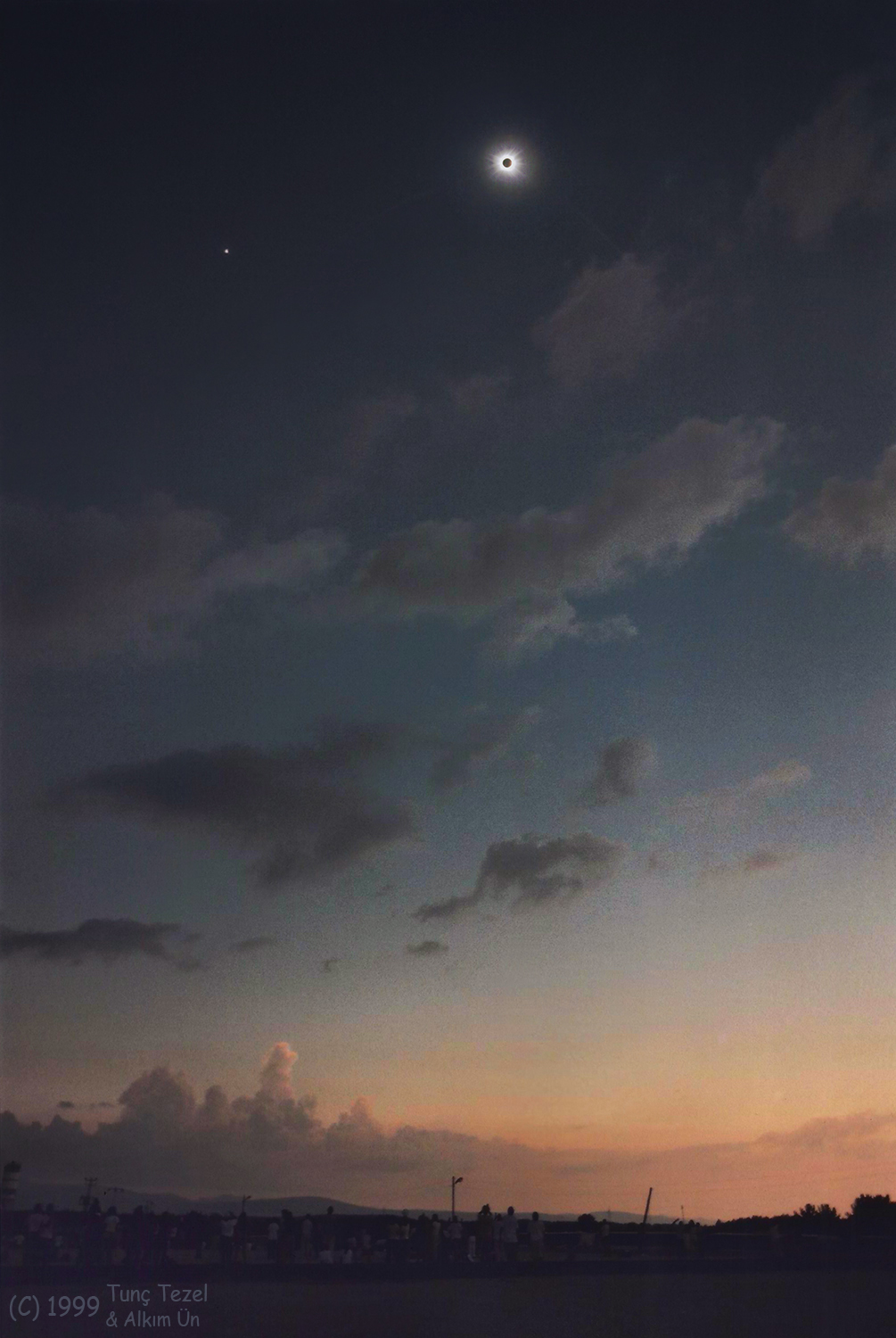
皆既日食のこの画像では、暗くなった空に明るい金星、シルエットになった新月、そして太陽のきらめくコロナが写っています。望遠レンズと広角レンズで同時に撮影された画像を合成したもので、18年前の1999年8月11日、トルコのカスタモヌ近郊で皆既帯で撮影されました。この日食はサロス周期145に属します。歴史的に月の軌道の観測から知られているサロス周期は、太陽、地球、月が日食(または月食)のために同じ幾何学的配置に戻る時期を予測します。サロス周期は18年11日と3分の1日です。1サロス周期で隔てられた日食は同じ番号のサロス系列に属し、非常によく似ています。しかし、同じサロス周期内の連続する日食の皆既帯は、周期の1日の間に地球がさらに8時間自転するため、地球上を移動します。したがって、サロス周期145回目の皆既日食も皆既日食となり、2017年8月21日には、狭い皆既帯がアメリカ合衆国を横断するでしょう。
原文(English)
A darkened sky holds bright planet Venus, the New Moon in silhouette, and the shimmering corona of the Sun in this image of a total solar eclipse. A composite of simultaneous telephoto and wide angle frames it was taken in the path of totality 18 years ago, August 11, 1999, near Kastamonu, Turkey. That particular solar eclipse is a member of Saros 145. Known historically from observations of the Moon's orbit, the Saros cycle predicts when the Sun, Earth, and Moon will return to the same geometry for a solar (or lunar) eclipse. The Saros has a period of 18 years, 11 and 1/3 days. Eclipses separated by one Saros period belong to the same numbered Saros series and are very similar. But the path of totality for consecutive solar eclipses in the same Saros shifts across the Earth because the planet rotates for an additional 8 hours during the cycle's fractional day. So the next solar eclipse of Saros 145 will also be a total eclipse, and the narrow path of totality will track coast to coast across the United States on August 21, 2017.
\ この感動を宇宙仲間にシェア /
宇宙をXでシェア
© Tunç Tezel / APOD