青と金色の土星
Saturn in Blue and Gold
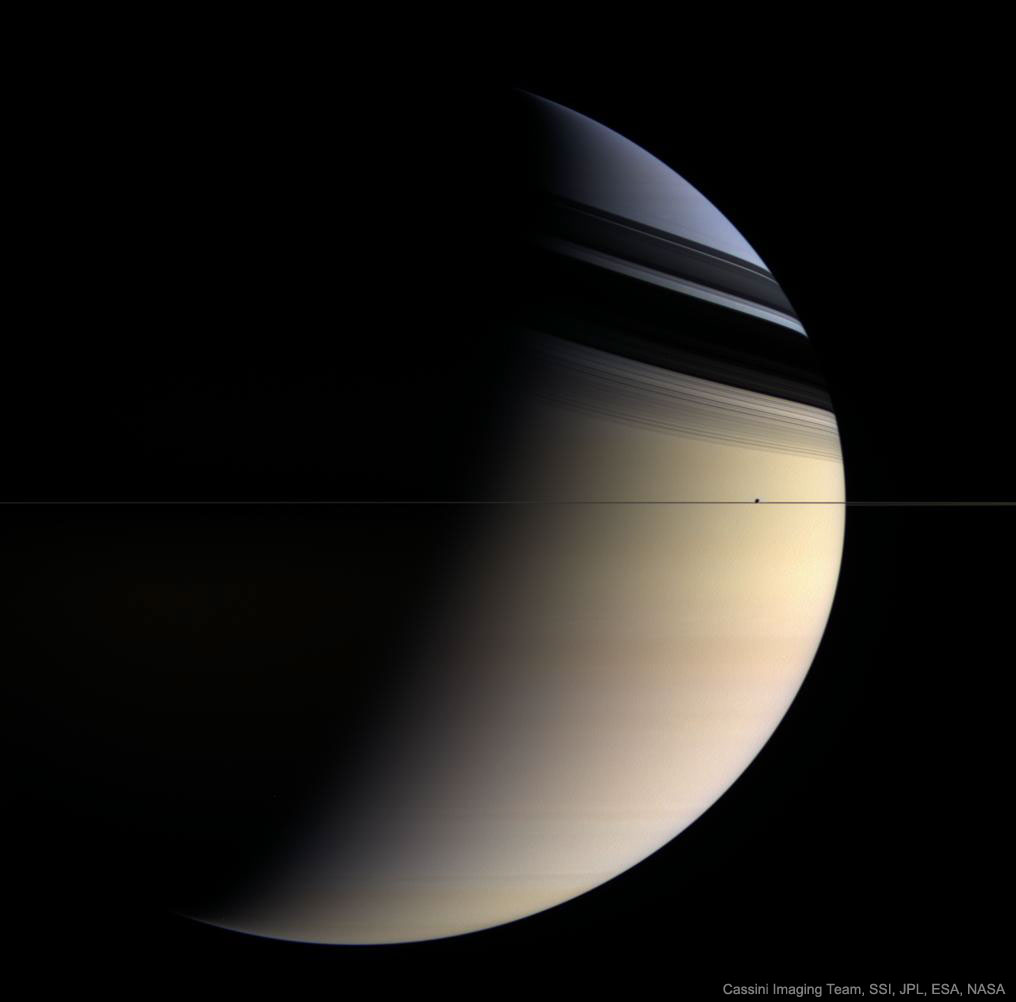
土星が部分的に青く見えるのはなぜでしょうか?掲載されている土星の画像は、巨大な環を持つ惑星の近くをホバリングしている人間が見るであろう光景を近似的に再現したものです。この画像は、現在土星を周回している探査機カッシーニによって2006年3月に撮影されました。ここでは、土星の壮大な環は細い垂直線としてのみ直接的に見えています。環は、画像の左側に作り出す暗い影の中に、その複雑な構造を示しています。土星の噴水衛星エンケラドゥスは、直径わずか約500キロメートルで、環の平面上の隆起として見えます。土星の北半球が部分的に青く見えるのは、地球の空が青く見えるのと同じ理由です。両惑星の大気の雲のない部分の分子は、赤い光よりも青い光を散乱させる能力が高いためです。しかし、土星の雲の奥深くを見ると、土星の雲の自然な金色が支配的になります。なぜ土星の南半球が同じ青色を示さないのかは不明です。一つの仮説は、南半球の雲はより高い位置にあるというものです。土星の雲が金色に見える理由もまだ分かっていません。来月、カッシーニ探査機は土星の大気圏への最後の劇的な突入をもってミッションを終えます。2017年の日食:APODに投稿された印象的な画像 ― お気に入りの画像に「いいね!」をお願いします。
原文(English)
Why is Saturn partly blue? The featured picture of Saturn approximates what a human would see if hovering close to the giant ringed world. The image was taken in 2006 March by the robot Cassini spacecraft now orbiting Saturn. Here Saturn's majestic rings appear directly only as a thin vertical line. The rings show their complex structure in the dark shadows they create on the image left. Saturn's fountain moon Enceladus, only about 500 kilometers across, is seen as the bump in the plane of the rings. The northern hemisphere of Saturn can appear partly blue for the same reason that Earth's skies can appear blue -- molecules in the cloudless portions of both planet's atmospheres are better at scattering blue light than red. When looking deep into Saturn's clouds, however, the natural gold hue of Saturn's clouds becomes dominant. It is not known why southern Saturn does not show the same blue hue -- one hypothesis holds that clouds are higher there. It is also not known why Saturn's clouds are colored gold. Next month, Cassini will end its mission with a final dramatic dive into Saturn's atmosphere. Eclipses 2017: Memorable images submitted to APOD -- please "Like" your favorites.
\ この感動を宇宙仲間にシェア /
宇宙をXでシェア
© NASA / APOD