エアグロー・ボレアリス
Airglow Borealis
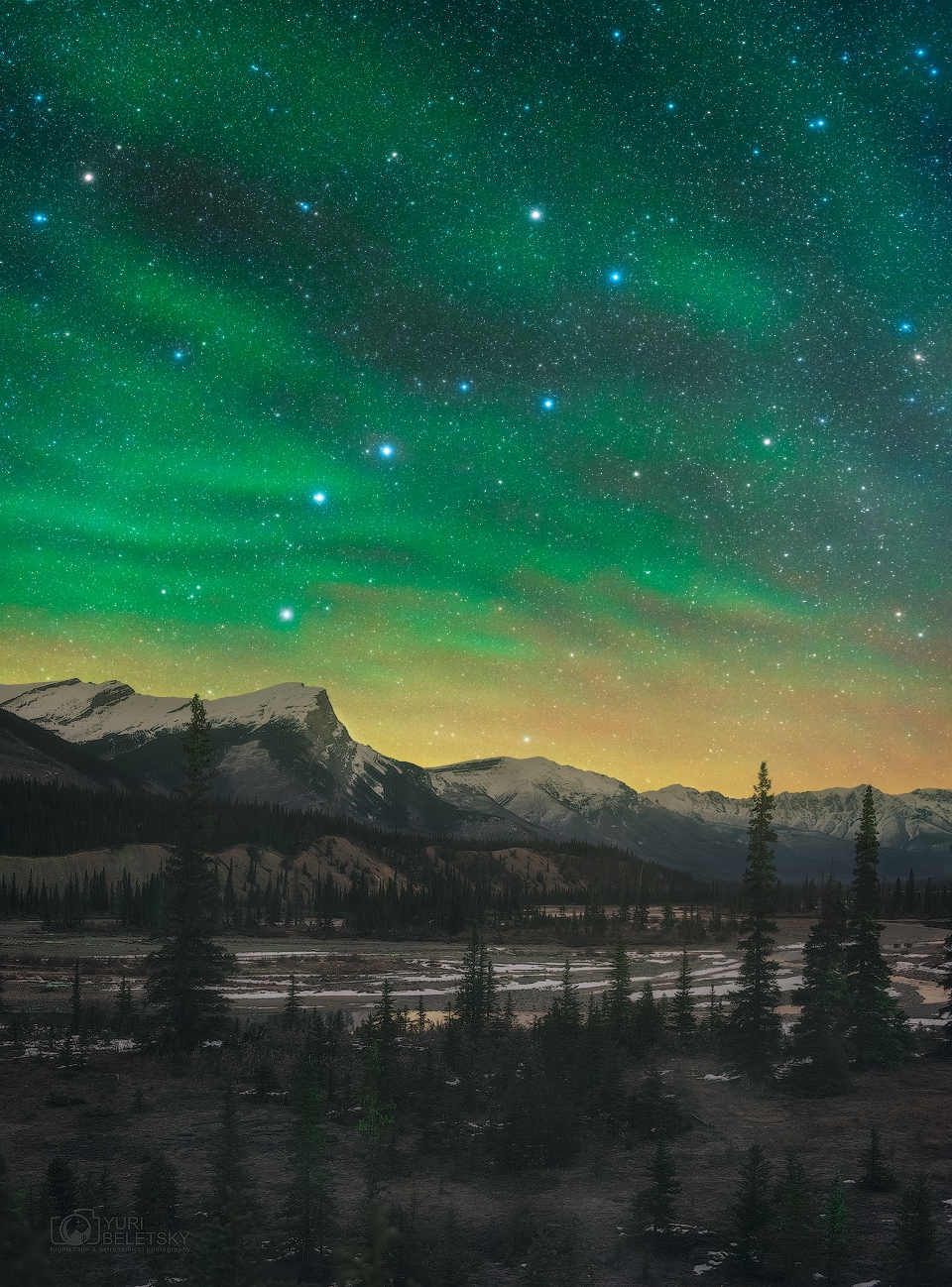
北の空で最もよく知られている星群が、先週バンフ国立公園で撮影されたこの山と夜空の風景写真のカナディアンロッキーの上に浮かんでいます。しかし、最も注目すべきは、驚くほど緑がかった大気光です。大気光は肉眼で見えますが、色はついていないため、このシーンは1台のカメラで2回撮影されました。1回は星を追尾しながら撮影し、もう1回は三脚に固定して撮影しました。大気光の発光は、主に極めて低密度の大気中の酸素原子によるものです。感度の高いデジタルカメラでカラーで記録されることが多いこの不気味で拡散した光は、ここでは北の夜空に波のように広がっています。オーロラと同程度の高度で発生するこの明るい大気光は、化学発光、つまり化学励起と放射崩壊による光の生成によるものです。化学励起のためのエネルギーは、日中は太陽の極端紫外線によって供給されます。高緯度に限られるオーロラとは異なり、大気光は世界中で見られます。
原文(English)
The best known asterism in northern skies hangs over the Canadian Rockies in this mountain and night skyscape taken last week from Banff National Park. But most remarkable is the amazing greenish airglow. With airglow visible to the eye, but not in color, the scene was captured in two exposures with a single camera, one exposure made while tracking the stars and one fixed to a tripod. Airglow emission is predominately from atmospheric oxygen atoms at extremely low densities. Commonly recorded in color by sensitive digital cameras the eerie, diffuse light is seen here in waves across the northern night. Originating at an altitude similar to aurorae, the luminous airglow is due to chemiluminescence, the production of light through chemical excitation and radiative decay. Energy for the chemical excitation is provided during daytime by the Sun's extreme ultraviolet radiation. Unlike aurorae which are limited to high latitudes, airglow can be found around the globe.
\ この感動を宇宙仲間にシェア /
宇宙をXでシェア
© Yuri Beletsky / APOD