岩本彗星とソンブレロ銀河
Comet Iwamoto and the Sombrero Galaxy
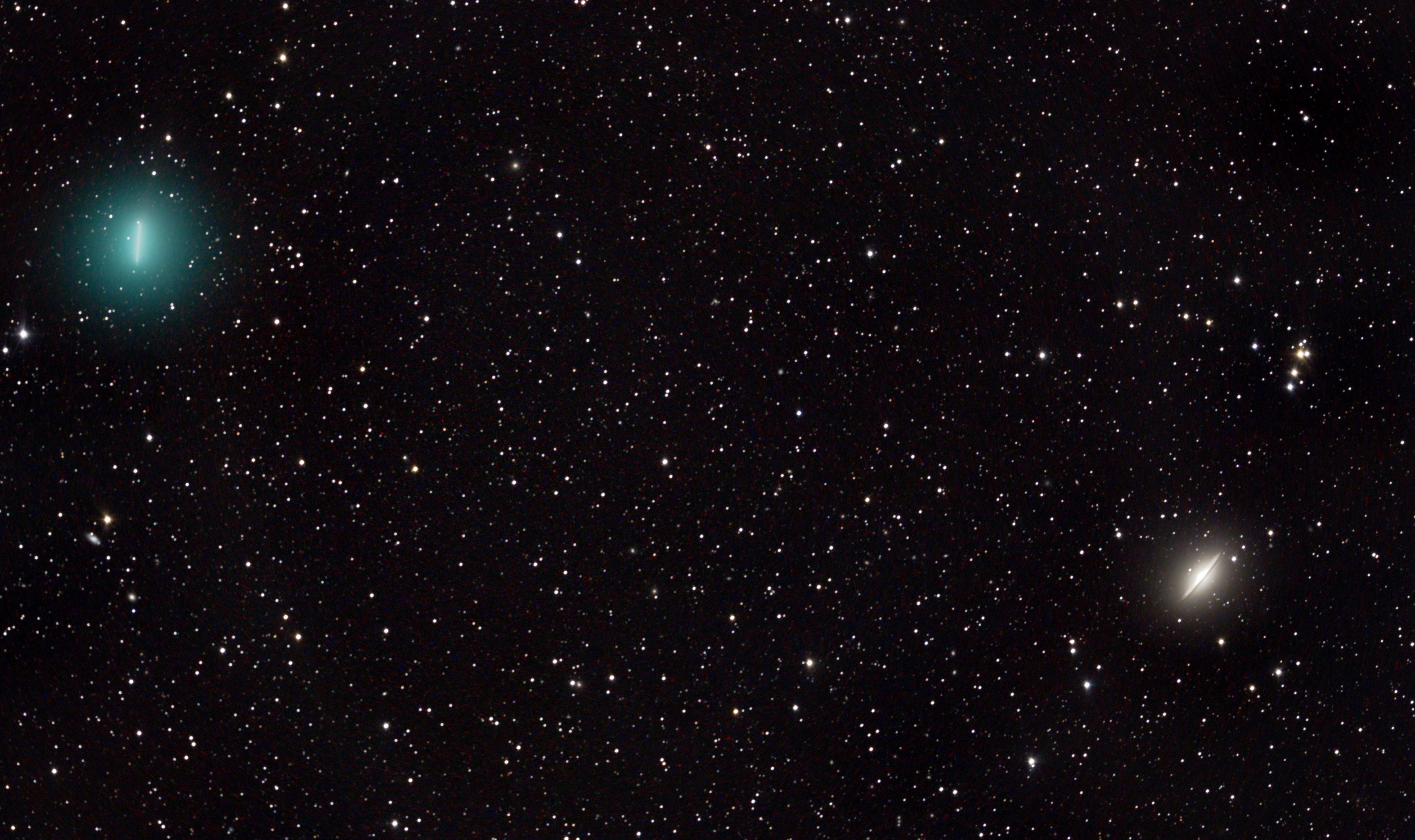
岩本彗星(C/2018 Y1)は、この望遠鏡視野の左上に、美しい緑がかったコマを見せています。カンタベリー大学マウント・ジョン天文台で2月4日に撮影されたこの画像は、合計30分の露光時間で、おとめ座の星々や遠方の銀河を背景に彗星が高速で横切っていく様子を捉えています。長時間露光と、星や銀河に対する岩本彗星の高速な動きにより、彗星の明るい内側のコマをなぞるぼやけた筋が目立ちます。実際、この筋状のコマは、右下にあるメシエ104(通称ソンブレロ銀河)と驚くほどよく似た外観をしています。太陽系内側を訪れたこの彗星はわずか4光分しか離れていませんが、壮大な渦巻銀河であるメシエ104は、3000万光年も離れています。 2019年最初の双眼鏡で観測可能な彗星、岩本彗星は、2月12日に地球に最接近します。この彗星は、太陽を周回する非常に楕円形の軌道を描き、その軌道はカイパーベルトの外側まで伸びており、公転周期は約1,371年と推定されています。そのため、西暦3390年には再び太陽系内側に戻ってくると予想されています。
原文(English)
Comet Iwamoto (C/2018 Y1), shows off a pretty, greenish coma at the upper left in this telescopic field of view. Taken on February 4 from the Mount John Observatory, University of Canterbury, the 30 minute long total exposure time shows the comet sweeping quickly across a background of stars and distant galaxies in the constellation Virgo. The long exposure and Iwamoto's rapid motion relative to the stars and galaxies results in the noticeable blurred streak tracing the the comet's bright inner coma. In fact, the streaked coma gives the comet a remarkably similar appearance to Messier 104 at lower right, popularly known as the Sombrero Galaxy. The comet, a visitor to the inner Solar System, is a mere 4 light-minutes away though, while majestic Messier 104, a spiral galaxy posing edge-on, is 30 million light-years distant. The first binocular comet of 2019, Iwamoto will pass closest to Earth on February 12. This comet's highly elliptical orbit around the Sun stretches beyond the Kuiper belt with an estimated 1,371 year orbital period. That should bring it back to the inner Solar System in 3390 AD.
\ この感動を宇宙仲間にシェア /
宇宙をXでシェア
© Ian Griffin / APOD