新データ:ウルティマ・トゥーレは驚くほど平ら
New Data: Ultima Thule Surprisingly Flat
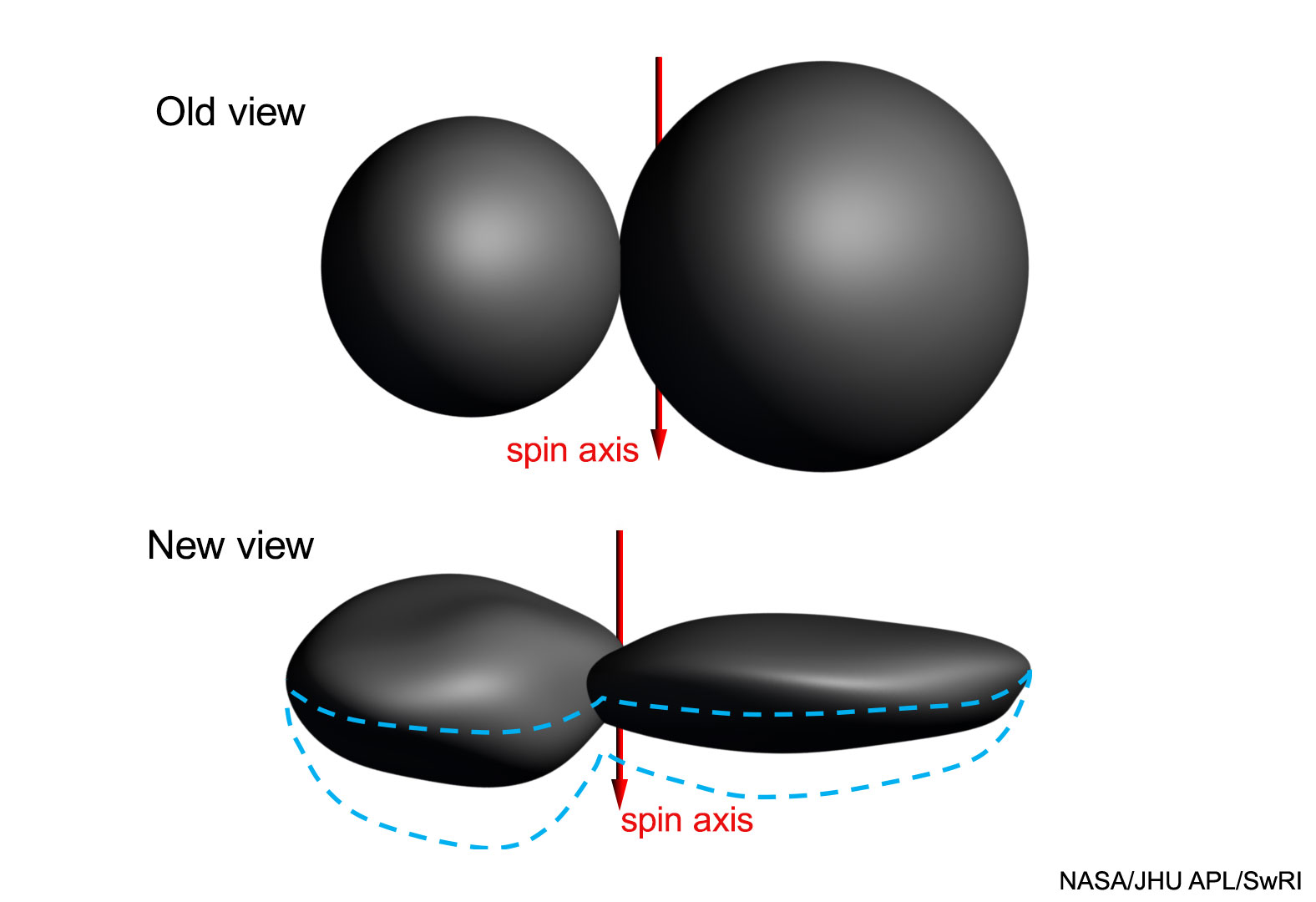
ウルティマ・トゥーレは、先月人類が考えていたような天体ではありませんでした。1月初旬、ロボット探査機ニュー・ホライズンズが遠方の小惑星ウルティマ・トゥーレ(正式名称2014 MU69)を通過した際、初期の画像には2つの円形のローブが写っており、単純に3Dに外挿すると、おおよそ球形だと考えられていました。しかし、新たに送信された画像(最接近直後に撮影されたものも多数含む)の分析によると、食を起こしていた星が予想よりも早く再び現れています。考えられる唯一の説明は、この長さ30kmのカイパーベルト天体が、わずか数週間前に考えられていたものとは異なる3D形状をしているということです。具体的には、掲載されている図に示すように、現在では、より大きなローブ(ウルティマ)は球形というよりふわふわのパンケーキに似ており、より小さなローブ(トゥーレ)はへこんだクルミに似ているようです。輪郭の残りの不確実性は、青い破線で示されています。新たな形状情報によると、重力(より質量の大きい天体を球状に収縮させる力)は、ウルティマ・トゥーレのローブの形状形成において、これまで考えられていたほど大きな役割を果たしていなかった可能性がある。ニュー・ホライズンズ探査機は、2015年半ばに冥王星を通過した後、ウルティマ・トゥーレへと向かった。新たなデータと画像は現在も受信されている。
原文(English)
Ultima Thule is not the object humanity thought that it was last month. When the robotic New Horizons spacecraft zoomed past the distant asteroid Ultima Thule (officially 2014 MU69) in early January, early images showed two circular lobes that when most simply extrapolated to 3D were thought to be, roughly, spheres. However, analyses of newly beamed-back images -- including many taken soon after closest approach -- shows eclipsed stars re-appearing sooner than expected. The only explanation possible is that this 30-km long Kuiper belt object has a different 3D shape than believed only a few weeks ago. Specifically, as shown in the featured illustration, it now appears that the larger lobe -- Ultima -- is more similar to a fluffy pancake than a sphere, while the smaller lobe -- Thule -- resembles a dented walnut. The remaining uncertainty in the outlines are shown by the dashed blue lines. The new shape information indicates that gravity -- which contracts more massive bodies into spheres -- played perhaps less of a role in contouring the lobes of Ultima Thule than previously thought. The New Horizons spacecraft continued on to Ultima Thule after passing Pluto in mid-2015. New data and images are still being received.
\ この感動を宇宙仲間にシェア /
宇宙をXでシェア
© NASA / APOD