太陽系ファミリーポートレート
Solar System Family Portait
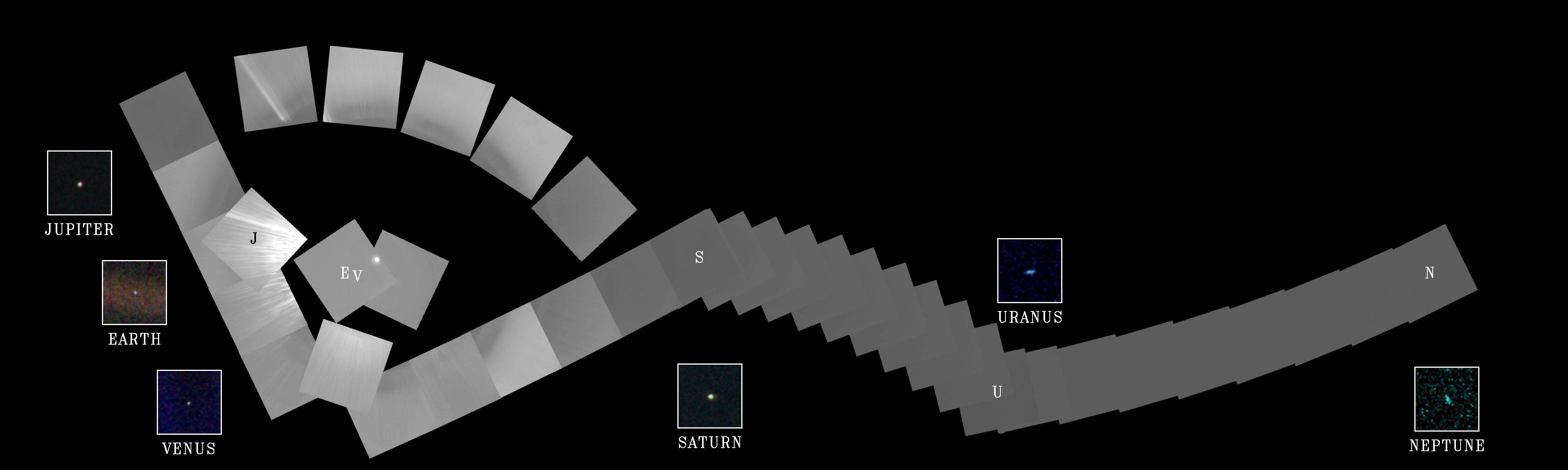
1990年のバレンタインデー、太陽から40億マイル離れた場所を航行していたボイジャー1号は、最後に一度だけ振り返り、史上初の太陽系ファミリーポートレートを撮影しました。完成したポートレートは、黄道面から32度上方の視点から撮影された60枚のフレームからなるモザイク画像です。画像では、ボイジャーの広角カメラのフレームが左側の太陽系内側を横切り、右端で太陽系最外惑星である巨大ガス惑星海王星へと繋がっています。金星、地球、木星、土星、天王星、海王星の位置は文字で示され、太陽はフレームの円の中心付近にある明るい点です。各惑星の挿入フレームは、ボイジャーの狭視野カメラで撮影されたものです。このポートレートには、太陽に近すぎて検出できなかった水星と、カメラの光学系で散乱した太陽光によって隠されてしまった火星は写っていません。当時、海王星よりも太陽に近い位置にあった小さく暗い冥王星の位置は、観測対象には含まれていなかった。
原文(English)
On Valentine's Day in 1990, cruising four billion miles from the Sun, the Voyager 1 spacecraft looked back one last time to make this first ever Solar System family portrait. The complete portrait is a 60 frame mosaic made from a vantage point 32 degrees above the ecliptic plane. In it, Voyager's wide angle camera frames sweep through the inner Solar System at the left, linking up with gas giant Neptune, the Solar System's outermost planet, at the far right. Positions for Venus, Earth, Jupiter, Saturn, Uranus, and Neptune are indicated by letters, while the Sun is the bright spot near the center of the circle of frames. The inset frames for each of the planets are from Voyager's narrow field camera. Unseen in the portrait are Mercury, too close to the Sun to be detected, and Mars, unfortunately hidden by sunlight scattered in the camera's optical system. Closer to the Sun than Neptune at the time, small, faint Pluto's position was not covered.
\ この感動を宇宙仲間にシェア /
宇宙をXでシェア
© NASA / APOD