水素と酸素で見たらせん星雲
The Helix Nebula in Hydrogen and Oxygen
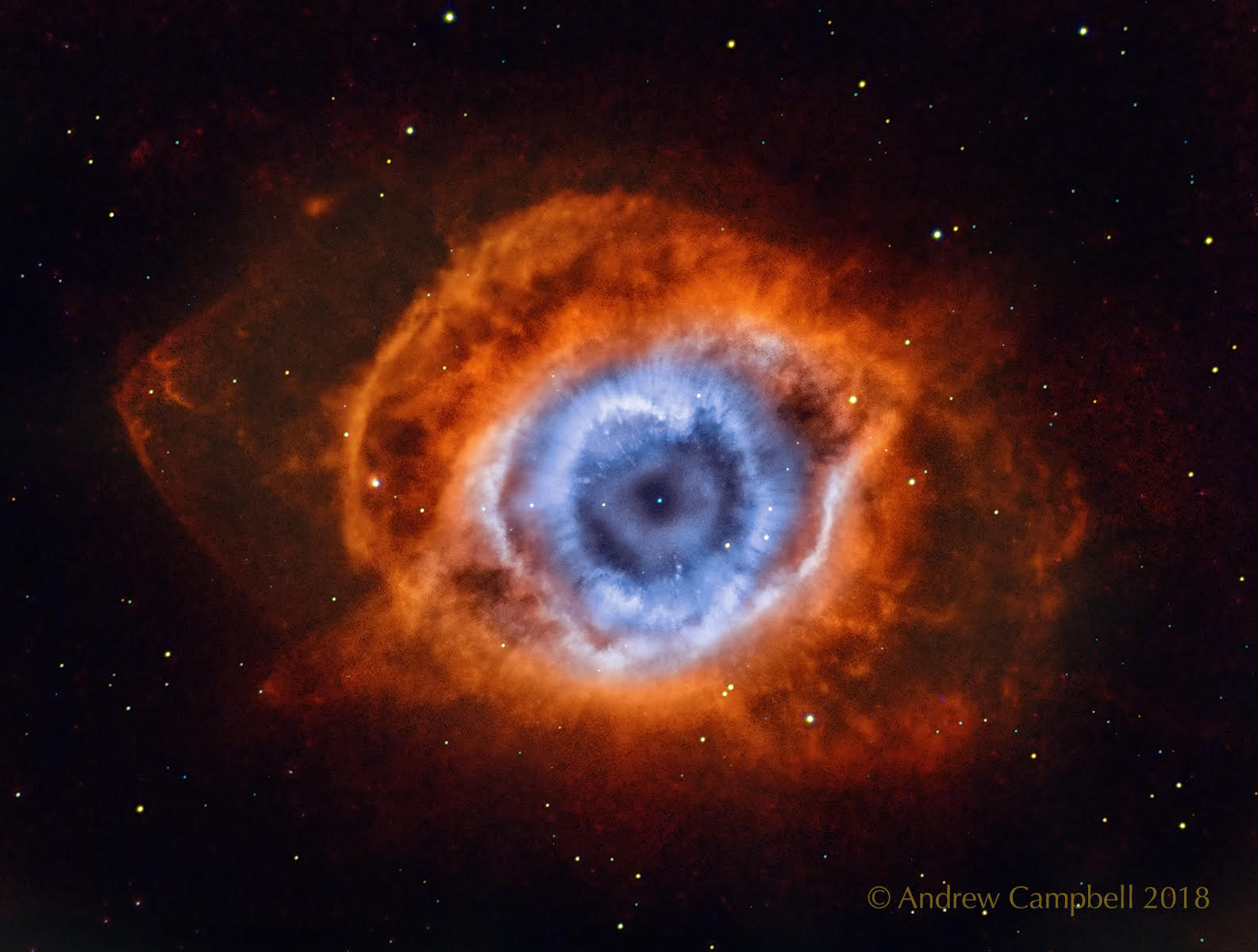
ヘリックス星雲はあなたを見つめているのでしょうか?いいえ、生物学的な意味ではそうではありませんが、確かに目のように見えます。ヘリックス星雲という名前は、あなたが螺旋の軸に沿って見ているように見えることから付けられました。実際には、放射状のフィラメントや外側に広がったループなど、驚くほど複雑な形状をしていることが現在では分かっています。ヘリックス星雲(別名NGC 7293)は、太陽のような恒星の生涯の終わりに生成されるガス雲である惑星状星雲の最も明るく最も近い例の1つです。白色矮星になる運命にある中心の恒星の残骸は、以前に放出されたガスを蛍光させるほどのエネルギーを持つ光を放っています。掲載されている写真は、酸素(青で表示)と水素(赤で表示)から放出される光で撮影されたもので、オーストラリアのメルボルン郊外の裏庭にある小型望遠鏡で3か月にわたって74時間露光して作成されました。らせん星雲の内縁部のクローズアップ画像には、起源不明の複雑なガスの塊が写っている。
原文(English)
Is the Helix Nebula looking at you? No, not in any biological sense, but it does look quite like an eye. The Helix Nebula is so named because it also appears that you are looking down the axis of a helix. In actuality, it is now understood to have a surprisingly complex geometry, including radial filaments and extended outer loops. The Helix Nebula (aka NGC 7293) is one of brightest and closest examples of a planetary nebula, a gas cloud created at the end of the life of a Sun-like star. The remnant central stellar core, destined to become a white dwarf star, glows in light so energetic it causes the previously expelled gas to fluoresce. The featured picture, taken in the light emitted by oxygen (shown in blue) and hydrogen (shown in red), was created from 74 hours of exposure over three months from a small telescope in a backyard of suburban Melbourne, Australia. A close-up of the inner edge of the Helix Nebula shows complex gas knots of unknown origin.
\ この感動を宇宙仲間にシェア /
宇宙をXでシェア
© Andrew Campbell / APOD