NGC 6302:蝶星雲
NGC 6302: The Butterfly Nebula
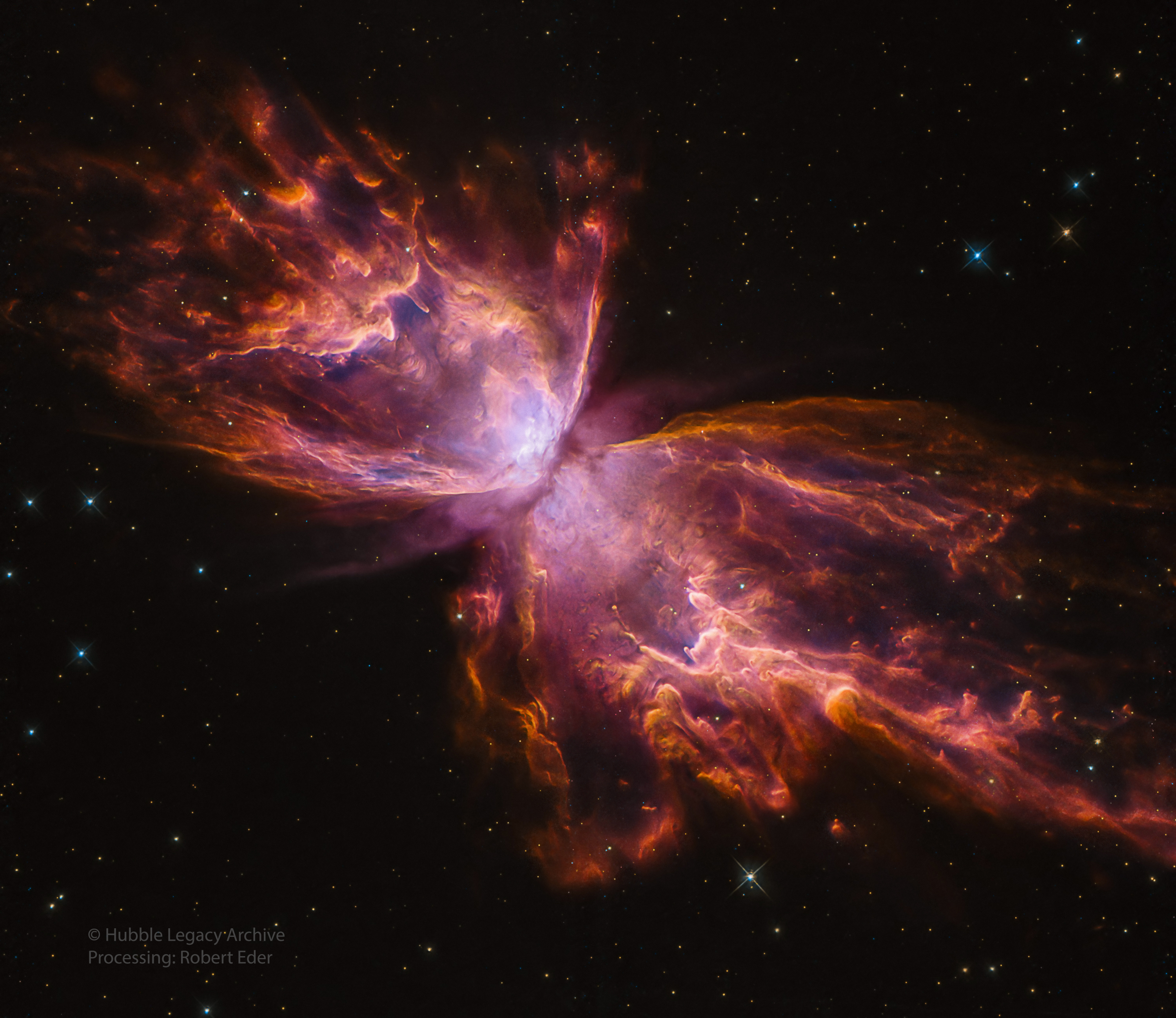
地球の夜空に輝く星団や星雲は、しばしば花や昆虫にちなんで名付けられています。翼幅が3光年以上にも及ぶNGC 6302も例外ではありません。表面温度が約25万℃と推定されるこの惑星状星雲の中心星は、死にゆく星として非常に高温になり、紫外線で明るく輝いていますが、濃密な塵のトーラスによって直接見ることができません。この鮮明なクローズアップ画像は、2009年にハッブル宇宙望遠鏡によって撮影されました。ハッブルの画像データはここで再処理され、複雑な惑星状星雲の驚くべき詳細を示しています。電離ガスの明るい空洞を横切るように、中心星を取り囲む塵のトーラスは、この画像の中心付近にあり、視線に対してほぼ真横を向いています。高温の星の塵の宇宙の覆いの中で分子水素が検出されています。 NGC 6302は、さそり座(Scorpius)という、クモの形態的に正しい星座の方向に、約4000光年離れた場所に位置しています。
原文(English)
The bright clusters and nebulae of planet Earth's night sky are often named for flowers or insects. Though its wingspan covers over 3 light-years, NGC 6302 is no exception. With an estimated surface temperature of about 250,000 degrees C, the dying central star of this particular planetary nebula has become exceptionally hot, shining brightly in ultraviolet light but hidden from direct view by a dense torus of dust. This sharp close-up was recorded by the Hubble Space Telescope in 2009. The Hubble image data is reprocessed here, showing off the remarkable details of the complex planetary nebula. Cutting across a bright cavity of ionized gas, the dust torus surrounding the central star is near the center of this view, almost edge-on to the line-of-sight. Molecular hydrogen has been detected in the hot star's dusty cosmic shroud. NGC 6302 lies about 4,000 light-years away in the arachnologically correct constellation of the Scorpion (Scorpius).
\ この感動を宇宙仲間にシェア /
宇宙をXでシェア
© Robert Eder / APOD