戦車乗りの彗星
A Charioteer's Comet
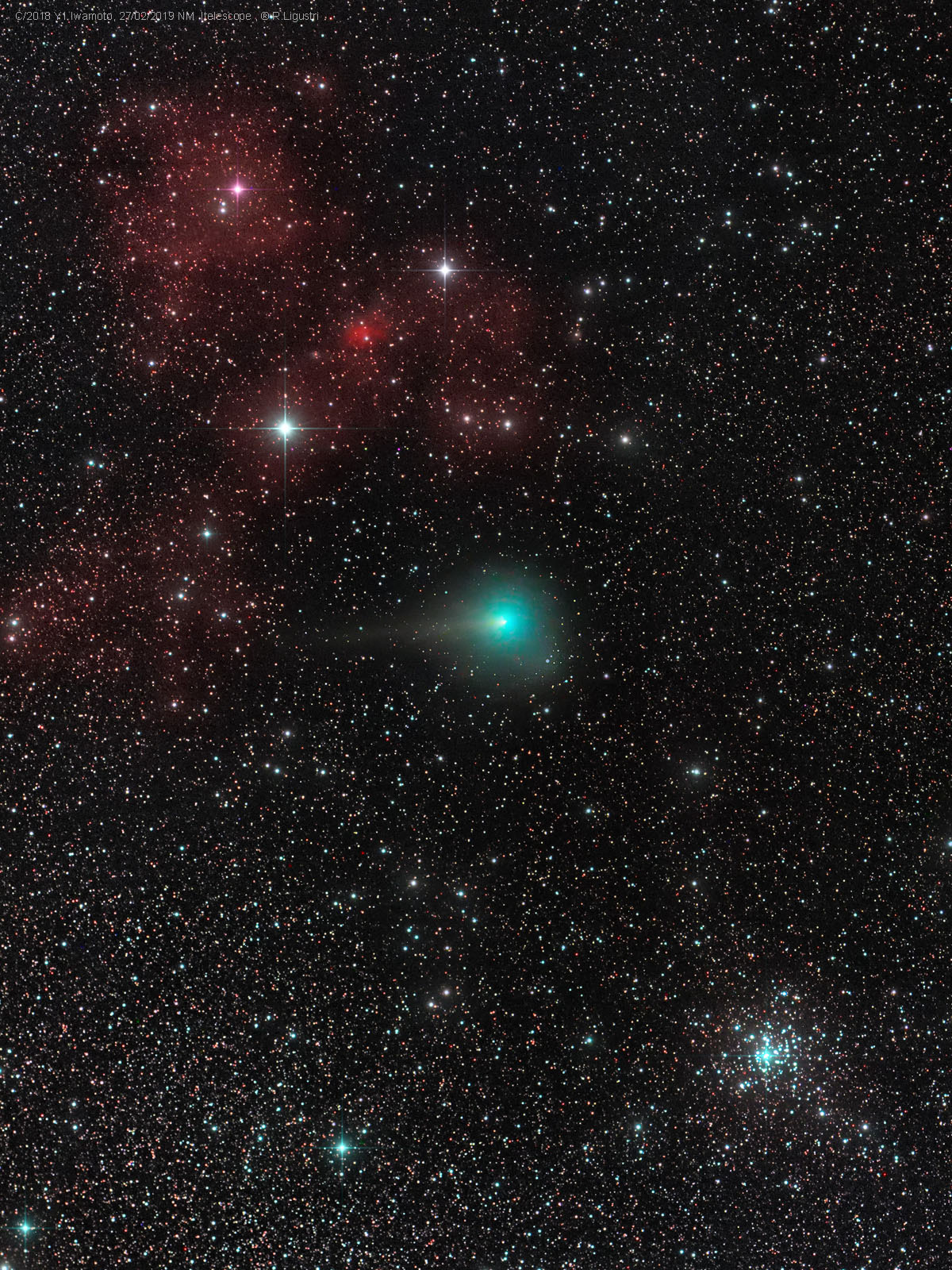
地球の夜空を駆け抜ける岩本彗星(C/2018 Y1)は、北天のぎょしゃ座の星や星雲とともに、この美しい望遠鏡の視野を共有しています。2月27日に撮影されたこの画像では、岩本彗星の緑がかったコマと淡い尾が、赤みがかった輝線星雲群と散開星団M36(右下)の間に見えています。赤みがかった輝線は、約6,000光年離れた巨大分子雲付近の高温の星からの紫外線によって電離された水素ガスからの光です。5光分未満の距離にある彗星からの緑がかった輝きは、主に太陽光で蛍光を発する二原子炭素分子からの放射です。ぎょしゃ座のより馴染み深い星団の1つであるM36は、太陽系のはるか彼方、約4,000光年離れた背景天体でもあります。岩本彗星は2月12日に地球に最接近し、その後、非常に楕円形の軌道を描いて外向きに進み、カイパーベルトの外側へと向かっています。推定公転周期は1317年で、西暦3390年に太陽系内側へ戻ってくると予想されています。
原文(English)
Still racing across planet Earth's night skies, Comet Iwamoto (C/2018 Y1) shares this pretty telescopic field of view with stars and nebulae of northern constellation Auriga, the Charioteer. Captured on February 27, Iwamoto's greenish coma and faint tail appear between a complex of reddish emission nebulae and open star cluster M36 (bottom right). The reddish emission is light from hydrogen gas ionized by ultraviolet radiation from hot stars near the region's giant molecular cloud some 6,000 light-years distant. The greenish glow from the comet, less than 5 light-minutes away, is predominantly emission from diatomic carbon molecules fluorescing in sunlight. M36, one of Auriga's more familiar star clusters, is also a background object far beyond the Solar System, about 4,000 light-years away. Comet Iwamoto passed closest to Earth on February 12 and is outward bound in a highly elliptical orbit that will carry it beyond the Kuiper belt. With an estimated orbital period of 1,317 years it should return to the inner Solar System in 3390 AD.
\ この感動を宇宙仲間にシェア /
宇宙をXでシェア
© CARA Project / APOD