北の春の空の見どころ
Highlights of the North Spring Sky
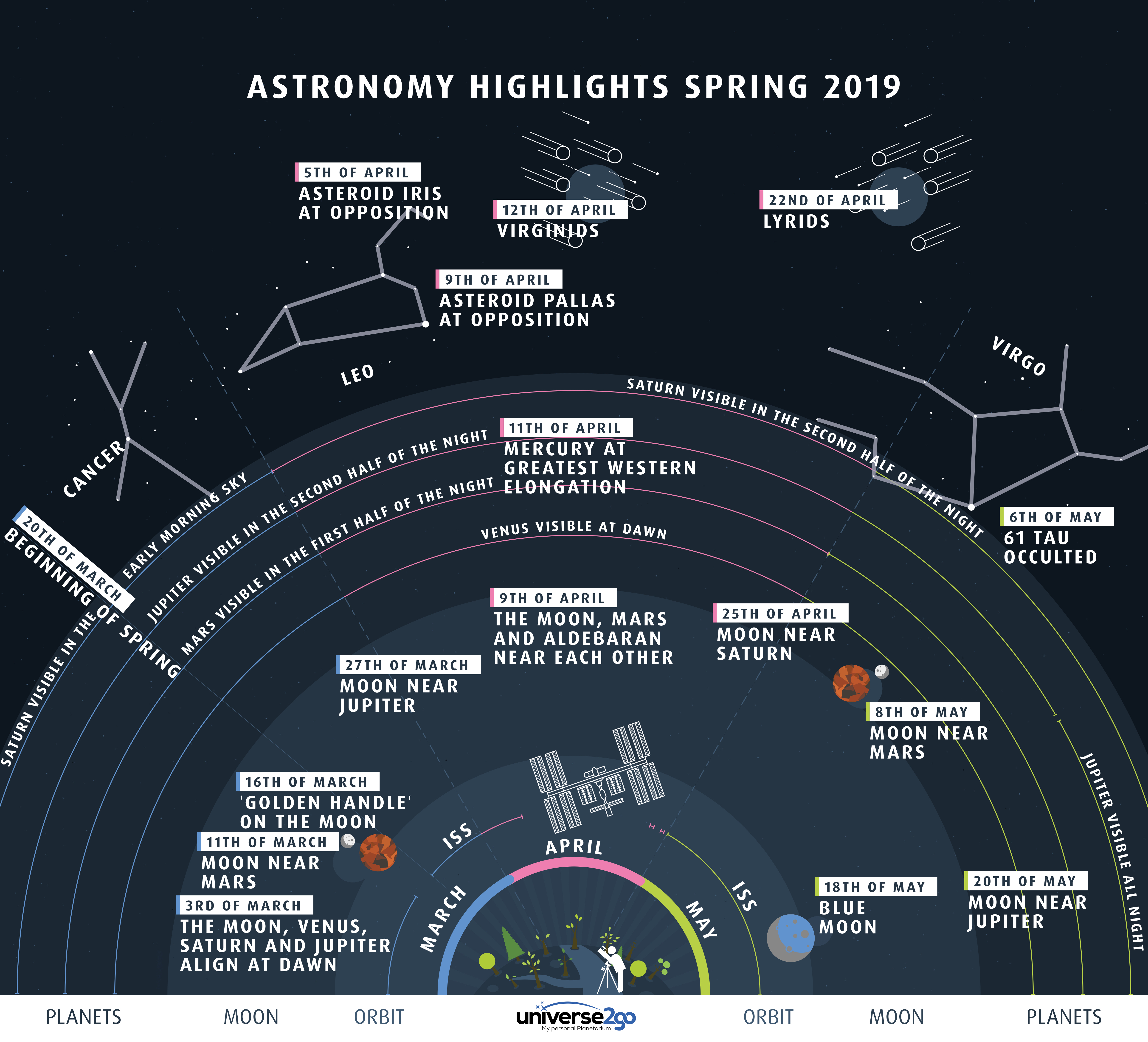
今シーズンの夜空には何が見えるでしょうか?掲載されている図は、地球の北半球におけるいくつかの見どころを示しています。下部に時計盤を中央として見た場合、春の初め(北半球)の天文現象は左に向かって広がり、春の終わりの天文現象は右に向かって投影されます。地球に比較的近い天体は、一般的に、下部中央にある望遠鏡を持った漫画の人物に近い位置で描かれていますが、描かれているもののほとんどは望遠鏡を使わなくても見ることができます。どの季節でもそうであるように、星座は毎年同じように見え、例年通り、こと座流星群は4月中旬にピークを迎えます。また例年通り、国際宇宙ステーション(ISS)は、日没後に空を横切る明るい点として見られることがあります。来週の春分点以降、地球の北半球では昼の長さが夜の長さよりも長くなり、春が進むにつれてその差は拡大していきます。また、春が進むにつれて、木星は夜のうちにますます早く見えるようになります。春が終わりに近づくにつれ、5月には春の4回の満月のうち3回目となる満月が現れます。これはブルームーンの定義の一つです。
原文(English)
What can you see in the night sky this season? The featured graphic gives a few highlights for Earth's northern hemisphere. Viewed as a clock face centered at the bottom, early (northern) spring sky events fan out toward the left, while late spring events are projected toward the right. Objects relatively close to Earth are illustrated, in general, as nearer to the cartoon figure with the telescope at the bottom center -- although almost everything pictured can be seen without a telescope. As happens during any season, constellations appear the same year to year, and, as usual, the Lyrids meteor shower will peak in mid-April. Also as usual, the International Space Station (ISS) can be seen, at times, as a bright spot drifting across the sky after sunset. After the Vernal Equinox next week, the length of daytime will be greater than the length of nighttime in Earth's northern hemisphere, an inequality that will escalate as the spring season develops. Also as spring ages, Jupiter becomes visible increasingly earlier in the night. As spring draws to a close, the month of May will feature the third of four full moons of the season, one of the definiitions of a Blue Moon.
\ この感動を宇宙仲間にシェア /
宇宙をXでシェア
© Universe2go.com / APOD