大マゼラン雲の雲
Clouds of the Large Magellanic Cloud
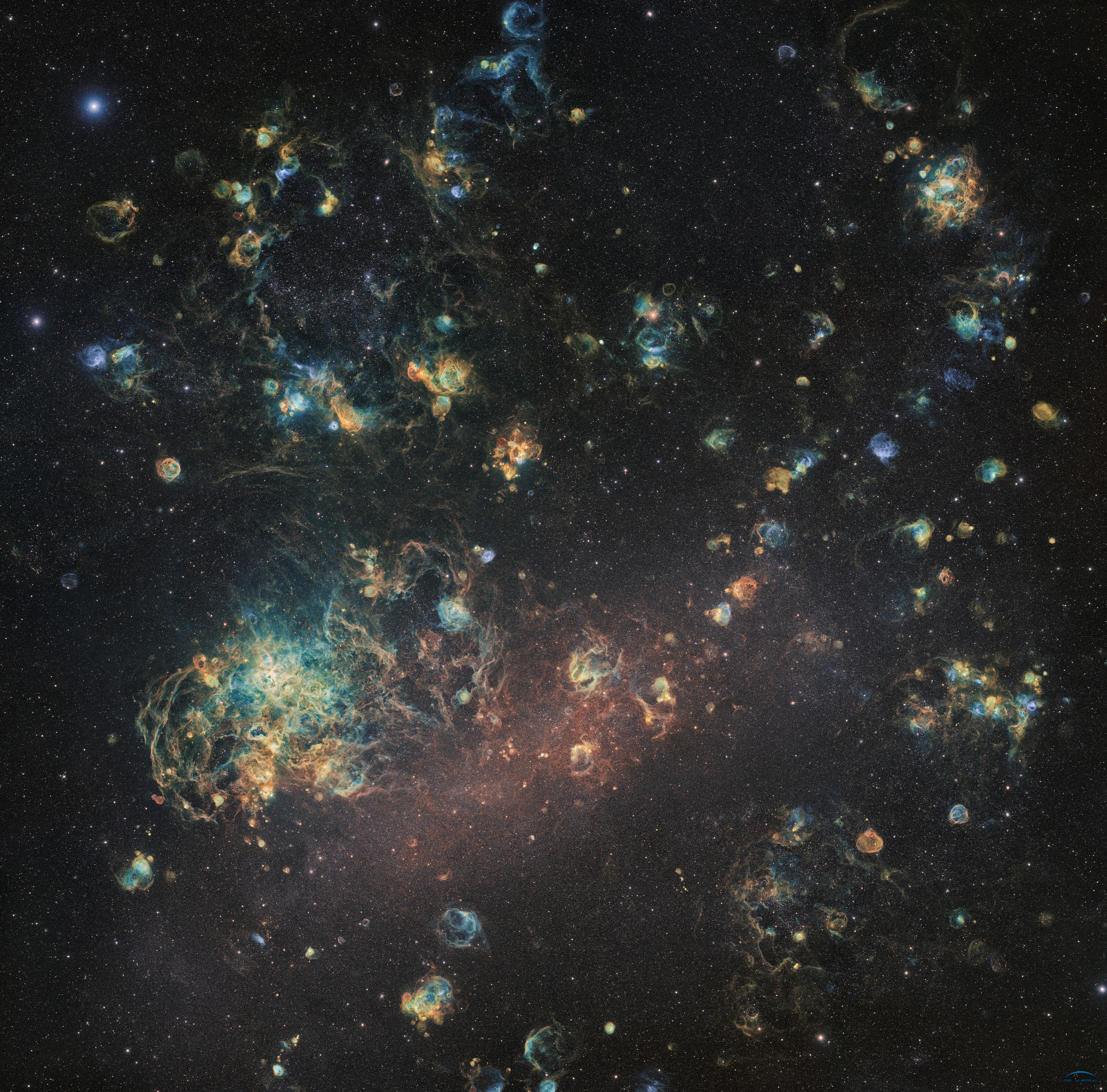
大マゼラン雲(LMC)は南の空に浮かぶ魅惑的な光景です。しかし、10か月以上かけて撮影されたこの深く詳細な望遠鏡画像は、地球を一周するほとんどの人が見ることのできる範囲を超えています。5度、つまり満月10回分に及ぶ4×4パネルのモザイク画像は、広帯域フィルターと狭帯域フィルターの両方で合計1,060時間の露光時間で撮影された3,900枚のフレームから構成されています。狭帯域フィルターは、硫黄、水素、酸素原子から放出される光のみを透過するように設計されています。高エネルギーの星光によって電離された原子は、電子が再捕獲され、原子がより低いエネルギー状態に遷移する際に、それぞれの特徴的な光を放出します。その結果、この画像では、LMCは巨大な若い星々を取り囲む電離ガスの雲で覆われているように見えます。強い恒星風と紫外線によって形作られた、水素からの放射が支配的な輝く雲は、H II(電離水素)領域として知られています。タランチュラ星雲は、重なり合う多数のH II領域から構成されており、左側に写っている大きな星形成領域です。天の川銀河最大の衛星である大マゼラン雲は、直径約1万5000光年で、かじき座の方向にわずか16万光年離れたところに位置しています。
原文(English)
The Large Magellanic Cloud (LMC) is an alluring sight in southern skies. But this deep and detailed telescopic view, over 10 months in the making, goes beyond what is visible to most circumnavigators of planet Earth. Spanning over 5 degrees or 10 full moons, the 4x4 panel mosaic was constructed from 3900 frames with a total of 1,060 hours of exposure time in both broadband and narrowband filters. The narrowband filters are designed to transmit only light emitted by sulfur, hydrogen, and oxygen atoms. Ionized by energetic starlight, the atoms emit their characteristic light as electrons are recaptured and the atoms transition to a lower energy state. As a result, in this image the LMC seems covered with its own clouds of ionized gas surrounding its massive, young stars. Sculpted by the strong stellar winds and ultraviolet radiation, the glowing clouds, dominated by emission from hydrogen, are known as H II (ionized hydrogen) regions. Itself composed of many overlapping H II regions, the Tarantula Nebula is the large star forming region at the left. The largest satellite of our Milky Way Galaxy, the LMC is about 15,000 light-years across and lies a mere 160,000 light-years away toward the constellation Dorado.
\ この感動を宇宙仲間にシェア /
宇宙をXでシェア
© Team Ciel Austral / APOD