2021年の満月
The Full Moon of 2021
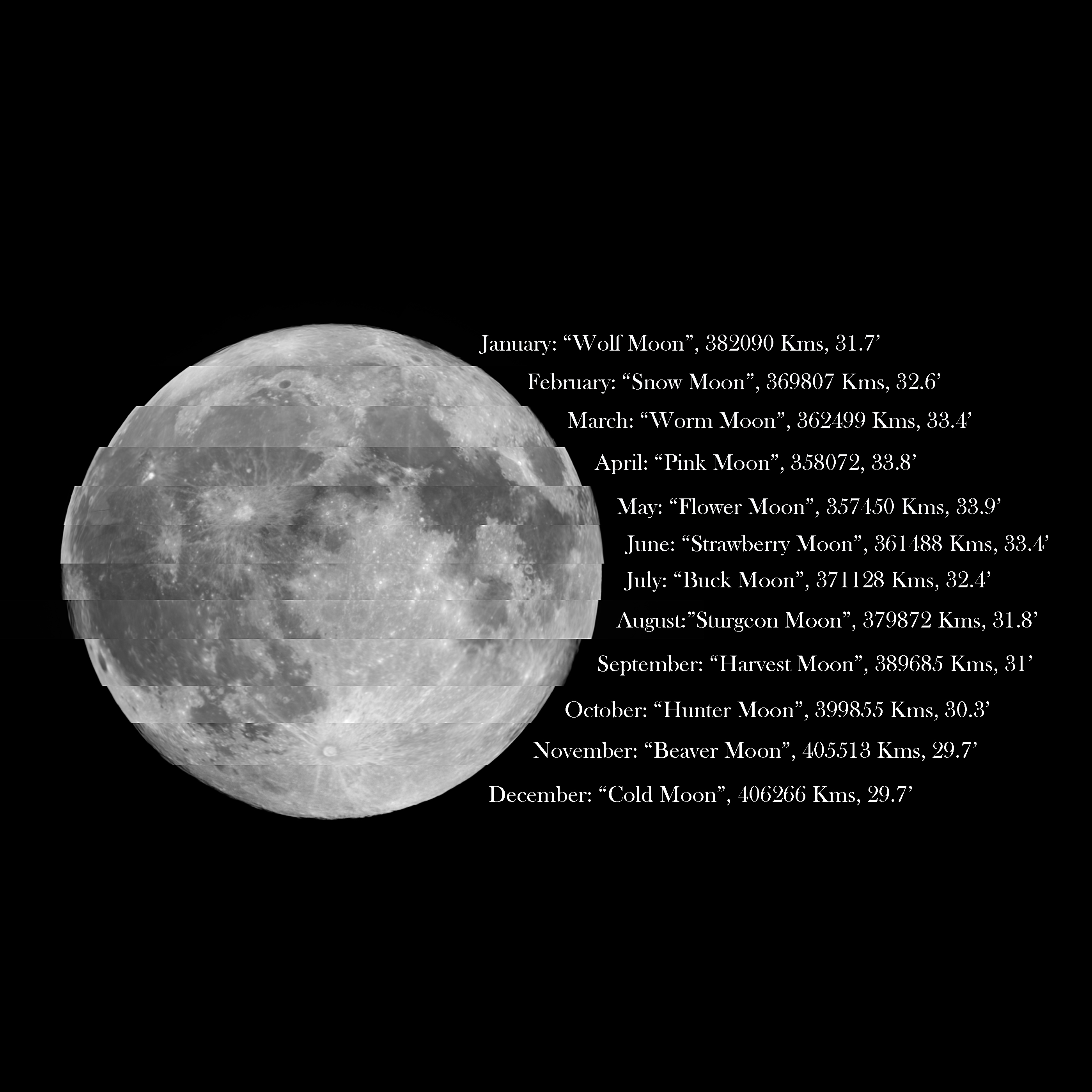
2021年の満月は、この1年間にわたる天体写真プロジェクトで輝きを放ちます。これは、最も明るい月の位相ごとに、おなじみの月の表側を合成したポートレートです。月の順に並べられ、上から始まるストライプで1年が進みます。同じカメラとレンズで撮影されたストライプは、すべて同じピクセルスケールで合成された満月の画像です。ストライプはまだ不一致に見えますが、満月の視角が地球(インドのコルカタ)からの距離に応じて1年を通して変化することを示しています。各ストライプには、暦月、満月の名前、キロメートル単位の距離、および視角が示されています。視角は、1/60度に相当する分角で示されています。最大の満月は、5月の近地点または最も接近する満月です。最小の満月は、12月の遠地点、最も遠い満月です。もちろん、5月と11月の満月は、2021年の2回の月食の間、地球の影に入りました。
原文(English)
very Full Moon of 2021 shines in this year-spanning astrophoto project, a composite portrait of the familiar lunar nearside at each brightest lunar phase. Arranged by moonth, the year progresses in stripes beginning at the top. Taken with the same camera and lens the stripes are from Full Moon images all combined at the same pixel scale. The stripes still look mismatched, but they show that the Full Moon's angular size changes throughout the year depending on its distance from Kolkata, India, planet Earth. The calendar month, a full moon name, distance in kilometers, and angular size is indicated for each stripe. Angular size is given in minutes of arc corresponding to 1/60th of a degree. The largest Full Moon is near a perigee or closest approach in May. The smallest is near an apogee, the most distant Full Moon in December. Of course the full moons of May and November also slid into Earth's shadow during 2021's two lunar eclipses.
\ この感動を宇宙仲間にシェア /
宇宙をXでシェア
© Soumyadeep Mukherjee / APOD