北方のクアドラント科の魚類
Quadrantids of the North
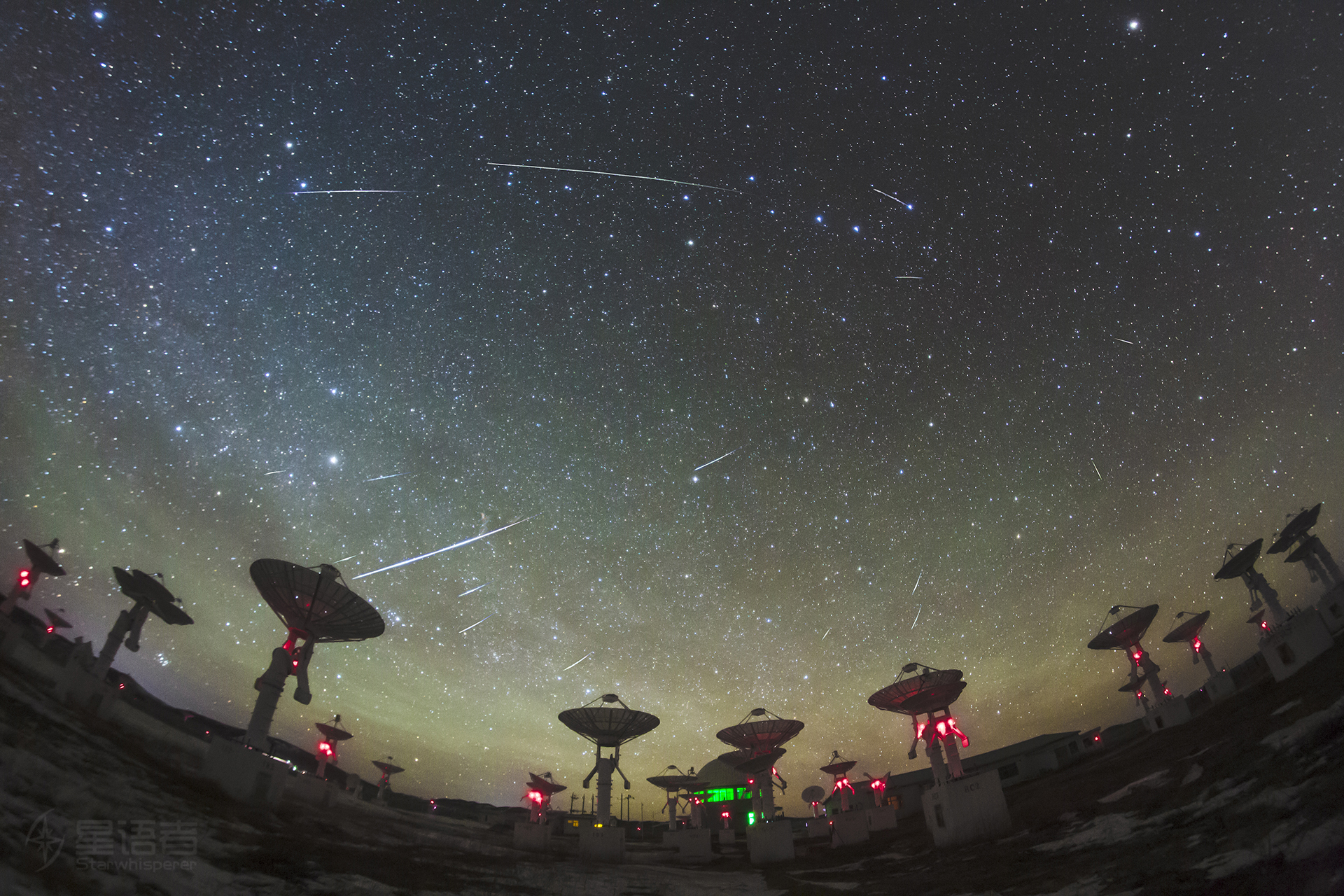
忘れ去られた星座にちなんで名付けられたしぶんぎ座流星群は、地球の北半球の天文愛好家のために毎年ショーを繰り広げます。流星群の放射点は、天文学的に廃止された古い星座である壁面四分儀座の中にあります。その場所は北斗七星からそう遠くなく、現代の星座であるうしかい座とりゅう座の境界にあります。実際、このフレームでは北極星が中央のすぐ下にあり、北斗七星(一部の人には鋤として知られています)がその上にあり、流星群の放射点は右側にあります。放射点に向かって、しぶんぎ座流星群の流星が夜空を横切るパノラマの空を駆け抜けます。これは、2022年1月4日の流星群のピーク前後の数時間に撮影された画像を合成したものです。前景には、中国内モンゴル自治区の明安図観測所にある中国スペクトル電波望遠鏡が並んでいます。しぶんぎ座流星群を生み出す塵の流れの発生源として、2003年に小惑星が特定された。最新情報:ジェームズ・ウェッブ宇宙望遠鏡の展開
原文(English)
Named for a forgotten constellation, the Quadrantid Meteor Shower puts on an annual show for planet Earth's northern hemisphere skygazers. The shower's radiant on the sky lies within the old, astronomically obsolete constellation Quadrans Muralis. That location is not far from the Big Dipper, at the boundaries of the modern constellations Bootes and Draco. In fact north star Polaris is just below center in this frame and the Big Dipper asterism (known to some as the Plough) is above it, with the meteor shower radiant to the right. Pointing back toward the radiant, Quadrantid meteors streak through the night in the panoramic skyscape, a composite of images taken in the hours around the shower's peak on January 4, 2022. Arrayed in the foreground are radio telescopes of the Chinese Spectral Radioheliograph, Mingantu Observing Station, Inner Mongolia, China. A likely source of the dust stream that produces Quadrantid meteors was identified in 2003 as an asteroid. Status Updates: Deploying the James Webb Space Telescope
\ この感動を宇宙仲間にシェア /
宇宙をXでシェア
© Cheng Luo / APOD