オリオン座の南
South of Orion
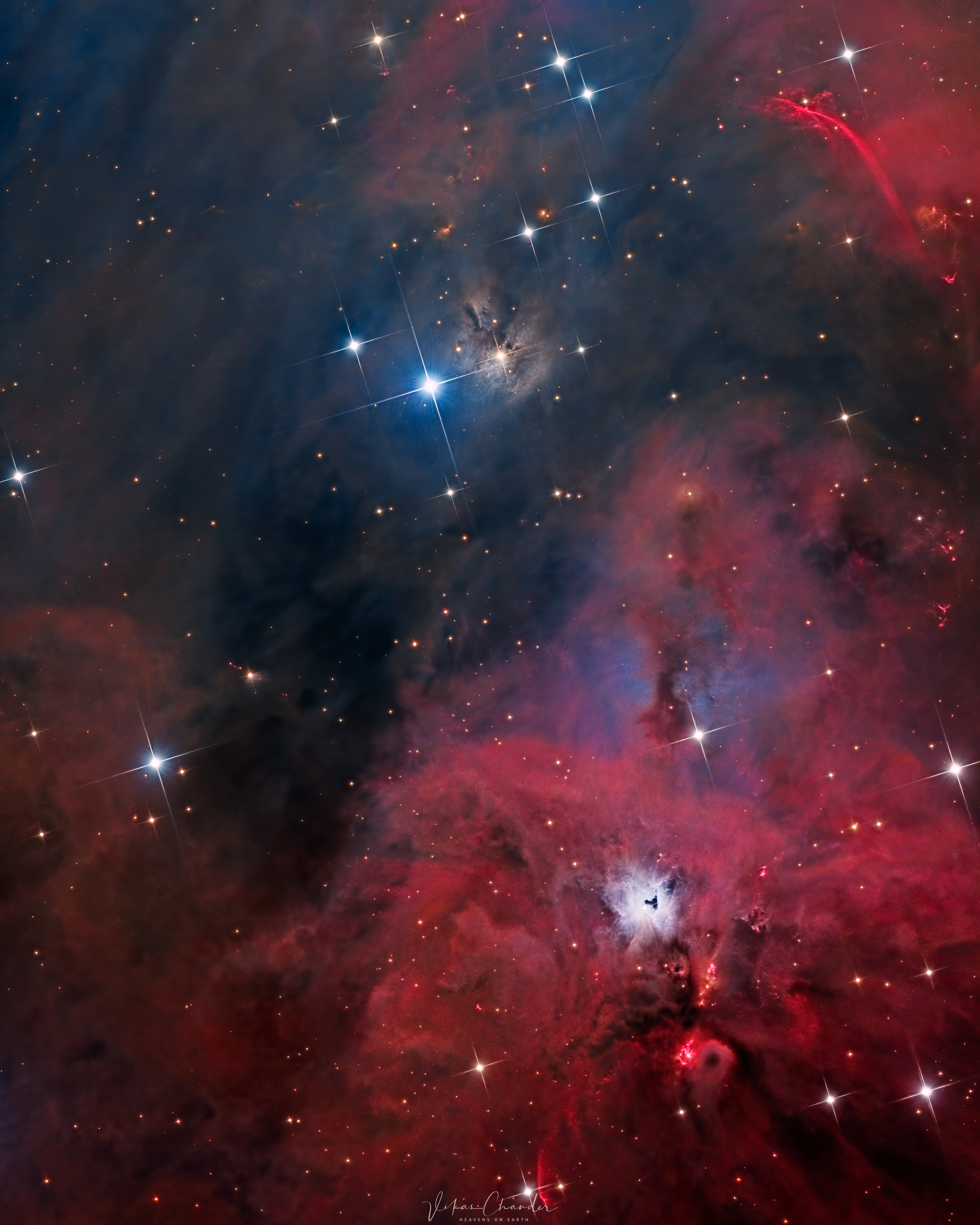
オリオン星雲として知られる巨大な星形成領域の南には、明るい青色の反射星雲NGC 1999があります。約1,500光年離れたオリオン分子雲複合体の端にあるNGC 1999は、埋め込まれた変光星V380 Orionisによって照らされています。この星雲は、空で満月2つ分ほどの大きさの望遠鏡視野の中央右に、横向きのT字型の暗い形をしています。かつては、この暗い形はシルエットに見える塵の雲だと考えられていました。しかし、赤外線データによると、この形はエネルギーの高い若い星によって星雲自体に吹き込まれた穴である可能性が高いことが示唆されています。実際、この領域には、光り輝く衝撃波を伴うジェットやアウトフローを生成するエネルギーの高い若い星が数多く存在します。天文学者のジョージ・ハービッグとギレルモ・ハロにちなんでハービッグ・ハロ(HH)天体としてカタログ化されているこれらの衝撃波は、強烈な赤みを帯びています。 HH1とHH2はNGC 1999のすぐ下、右側に位置しています。滝星雲としても知られるHH222は、画面右上付近に赤い裂け目のように見えます。これらの衝撃波は、恒星のジェットが周囲の物質を毎秒数百キロメートルの速度で突き進むことによって生じます。
原文(English)
South of the large star-forming region known as the Orion Nebula, lies bright blue reflection nebula NGC 1999. At the edge of the Orion molecular cloud complex some 1,500 light-years distant, NGC 1999's illumination is provided by the embedded variable star V380 Orionis. The nebula is marked with a dark sideways T-shape at center right in this telescopic vista that spans about two full moons on the sky. Its dark shape was once assumed to be an obscuring dust cloud seen in silhouette. But infrared data suggest the shape is likely a hole blown through the nebula itself by energetic young stars. In fact, this region abounds with energetic young stars producing jets and outflows with luminous shock waves. Cataloged as Herbig-Haro (HH) objects, named for astronomers George Herbig and Guillermo Haro, the shocks have intense reddish hues. HH1 and HH2 are just below and right of NGC 1999. HH222, also known as the Waterfall nebula, looks like a red gash near top right in the frame. To create the shocks stellar jets push through the surrounding material at speeds of hundreds of kilometers per second.
\ この感動を宇宙仲間にシェア /
宇宙をXでシェア
© Vikas Chander / APOD