薄明かりの月
Moons at Twilight
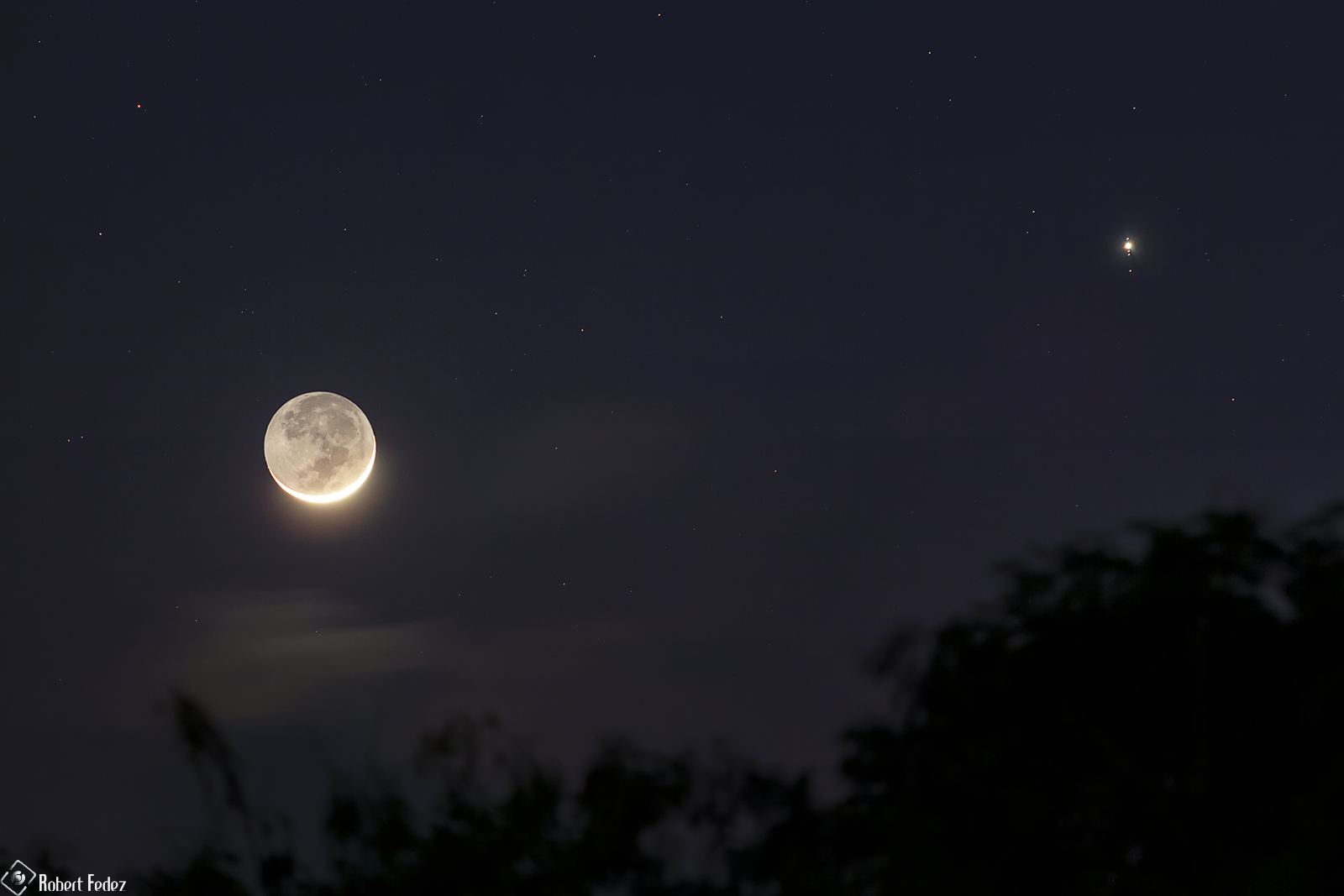
2月2日の夕方の空で見えた惑星は木星だけだったが、西の地平線上の薄明を太陽系の最も明るい衛星たちと共有していた。日没直後に撮影された一枚の写真では、太陽系の支配的な巨大ガス惑星が、メキシコのカンクンから望遠レンズで撮影されたこの視野の右上に写っている。この写真には、私たちの美しい惑星の自然衛星である月も、若い三日月形で捉えられている。月の円盤は大きく見え、その見慣れた面は主に地球照によって照らされている。しかし、木星と一直線に並んだ4つの光点は、木星の大きなガリレオ衛星である。上から順に、ガニメデ、[木星]、イオ、エウロパ、カリストである。ガニメデ、イオ、カリストは地球の月よりも物理的に大きく、水の惑星エウロパはわずかに小さいだけである。
原文(English)
ven though Jupiter was the only planet visible in the evening sky on February 2, it shared the twilight above the western horizon with the Solar System's brightest moons. In a single exposure made just after sunset, the Solar System's ruling gas giant is at the upper right in this telephoto field-of-view from Cancun, Mexico. The snapshot also captures our fair planet's own natural satellite in its young crescent phase. The Moon's disk looms large, its familiar face illuminated mostly by earthshine. But the four points of light lined-up with Jupiter are Jupiter's own large Galilean moons. Top to bottom are Ganymede, [Jupiter], Io, Europa, and Callisto. Ganymede, Io, and Callisto are physically larger than Earth's Moon while water world Europa is only slightly smaller.
\ この感動を宇宙仲間にシェア /
宇宙をXでシェア
© Robert Fedez / APOD