2021年の空
The Sky in 2021
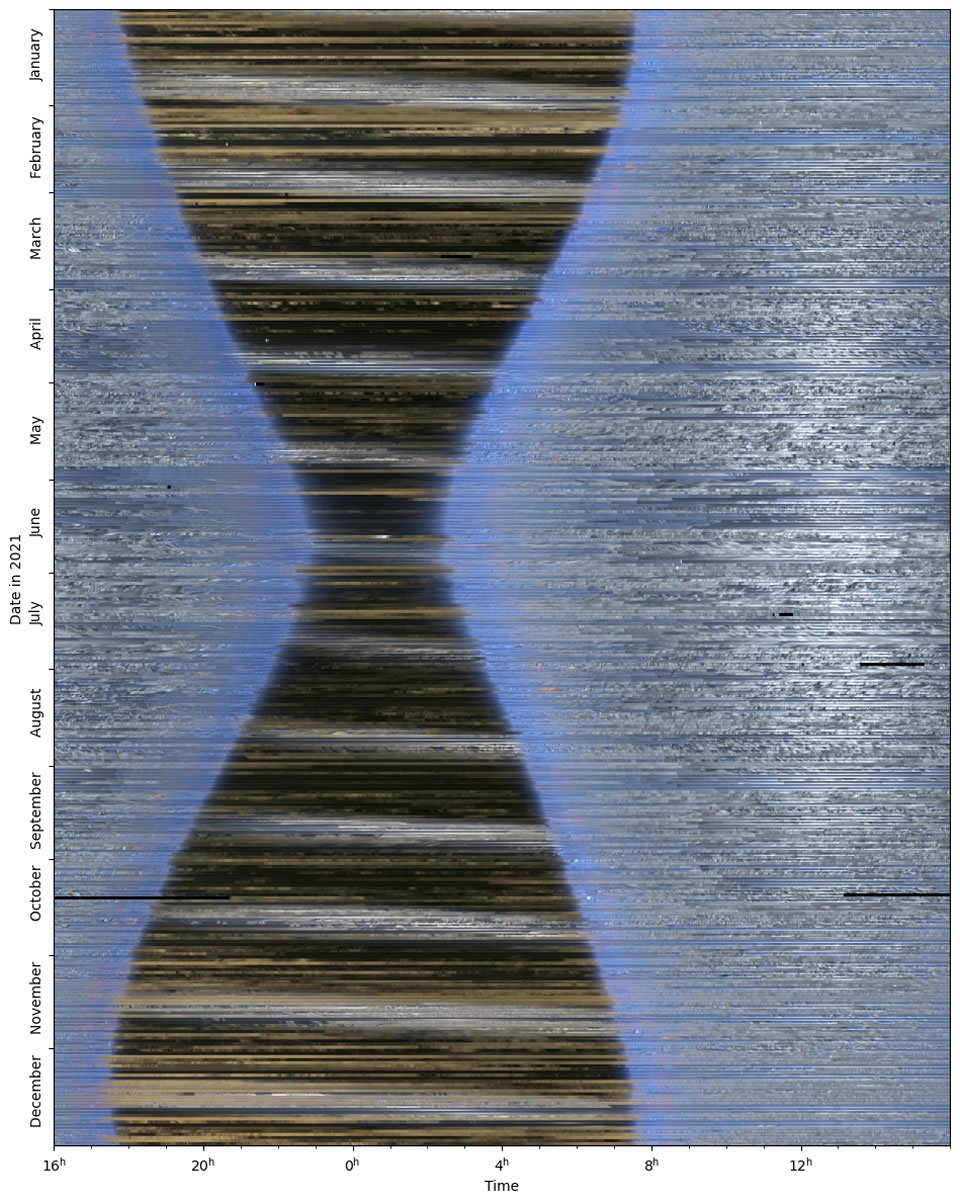
一年を通して、空全体を一度に見ることができるとしたらどうでしょう? ここに示されているのは、まさにそれに近いものです。2021年の間、15分ごとに全天カメラがオランダ上空の空を撮影しました。これらの画像の中心となる列を揃えて組み合わせることで、このケオグラムが作成されました。1月が上、12月が下、真夜中が中心のすぐ左に垂直に配置されています。何が見えるでしょうか? 最も明白なのは、昼間の空はほとんど青色で、夜間の空はほとんど黒色であることです。夜空を横切る12本の光の帯は、月の光によるものです。黒い砂時計型の最も細い部分は、昼が最も長い夏至に現れ、最も太い部分は冬至に現れます。昨日は春分で、昼と夜の長さが等しく、1年前の北半球の春分は、このケオグラムの約4分の3のところにあります。 APODのInstagramアカウントを英語、インドネシア語、ペルシャ語、ポルトガル語、または台湾語でフォローしてください。
原文(English)
What if you could see the entire sky -- all at once -- for an entire year? That, very nearly, is what is pictured here. Every 15 minutes during 2021, an all-sky camera took an image of the sky over the Netherlands. Central columns from these images were then aligned and combined to create the featured keogram, with January at the top, December at the bottom, and the middle of the night running vertically just left of center. What do we see? Most obviously, the daytime sky is mostly blue, while the nighttime sky is mostly black. The twelve light bands crossing the night sky are caused by the glow of the Moon. The thinnest part of the black hourglass shape occurs during the summer solstice when days are the longest, while the thickest part occurs at the winter solstice. Yesterday was an equinox -- when night and day were equal -- and the northern-spring equinox from one year ago can actually be located in the keogram -- about three-quarters of the way up. Follow APOD on Instagram in: English, Indonesian, Persian, Portuguese or Taiwanese
\ この感動を宇宙仲間にシェア /
宇宙をXでシェア
© Cees Bassa
(Netherlands Institute for Radio Astronomy) / APOD