モルディブの夜の宝石
Gems of a Maldivean Night
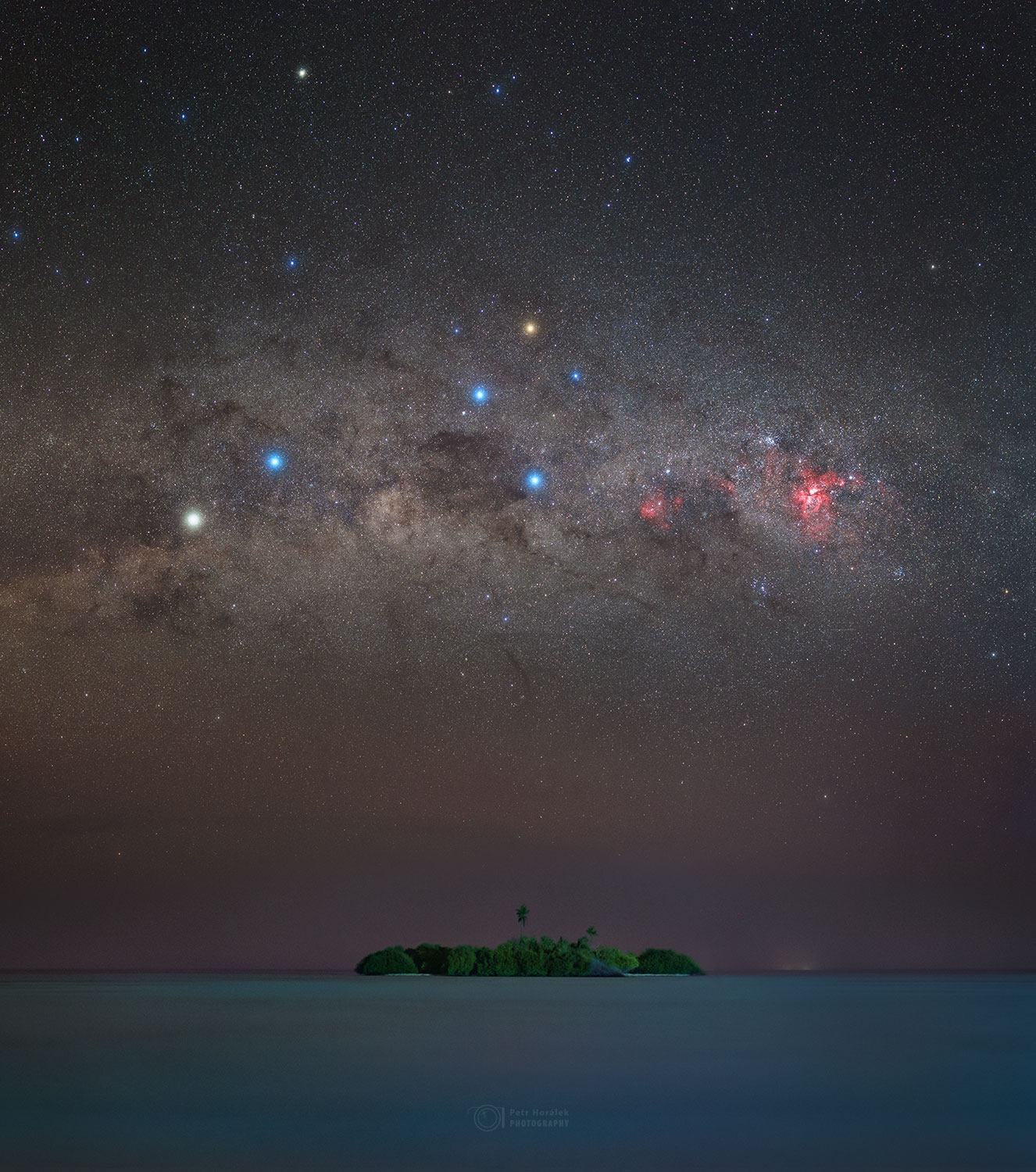
天の川の最南端には、南十字星だけでなく、太陽に最も近い恒星系であるアルファ・ケンタウリも存在します。南十字星の頂上には、明るい黄色の星ガンマ・クルシスがあります。ガンマ・クルシスから十字の下部にある青い星アクルクスを通る線は、南天の極を指し示しており、その極は、3月上旬に撮影された写真に写っている小さな島のすぐ上に位置しています。その島は、インド洋のモルディブ諸島にあるマディバル島です。かすかな天の川の星明かりを背景に、暗いコールサック星雲が十字のすぐ左に位置し、さらに左の天の川沿いには明るい星アルファ・ケンタウリ(左)とベータ・ケンタウリ(ハダル)があります。太陽に似た星で、系外惑星を伴う3つの恒星系の中心に位置するアルファ・ケンタウリAは、わずか4.3光年しか離れていません。アルファ・ケンタウリから見ると、私たちの太陽は、普段は見慣れたカシオペヤ座にある明るい黄色の星に見えるでしょう。Almost Hyperspace: Random APOD Generator
原文(English)
The southernmost part of the Milky Way contains not only the stars of the Southern Cross, but the closest star system to our Sun -- Alpha Centauri. The Southern Cross itself is topped by the bright, yellowish star Gamma Crucis. A line from Gamma Crucis through the blue star at the bottom of the cross, Acrux, points toward the south celestial pole, located just above the small island in the featured picture -- taken in early March. That island is Madivaru of the Maldives in the Indian Ocean. Against faint Milky Way starlight, the dark Coal Sack Nebula lies just left of the cross, while farther left along the Milky Way are the bright stars Alpha Centauri (left) and Beta Centauri (Hadar). Alpha Centauri A, a Sun-like star anchoring a three-star system with exoplanets, is a mere 4.3 light-years distant. Seen from Alpha Centauri, our own Sun would be a bright yellowish star in the otherwise recognizable constellation Cassiopeia. Almost Hyperspace: Random APOD Generator
\ この感動を宇宙仲間にシェア /
宇宙をXでシェア
© Petr Horálek
(ESO
Photo Ambassador,
Inst. of Physics in Opava) / APOD