エアレンデル:初期宇宙の星
Earendel: A Star in the Early Universe
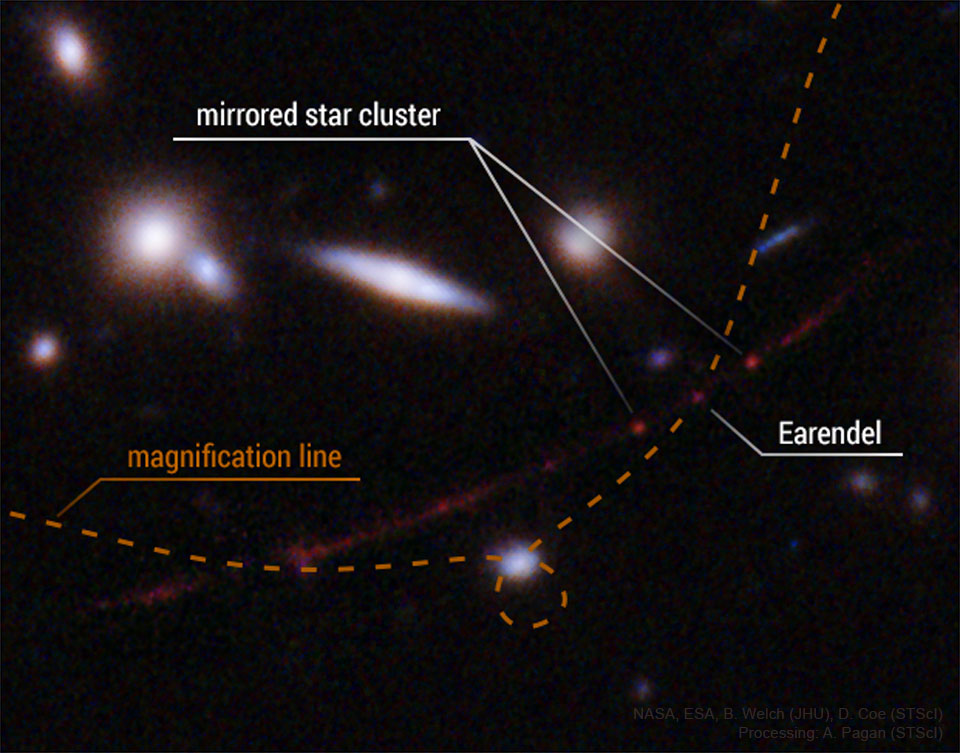
エアレンデルはこれまで発見された中で最も遠い星なのでしょうか?この科学的な可能性は、ハッブル宇宙望遠鏡が巨大な銀河団を観測したことから始まりました。この銀河団の重力レンズ効果により、はるか遠くにある銀河が拡大され、歪められていることが観測されました。この歪んだ背景銀河(赤方偏移は6.2)は、掲載画像では長い赤い糸のように見え、その糸の上のビーズは星団である可能性が高いです。銀河団のレンズ効果により、重なり合った背景天体が数千倍に拡大されて見える最大倍率線が形成されます。銀河線と最大倍率線の交点には、初期宇宙の単一の明るい星に由来する証拠を示す「ビーズ」が1つあり、それが現在エアレンデルと名付けられています。今後の調査では、ハッブル宇宙望遠鏡によるエアレンデルの明るさの変化を調べるためのさらなる画像撮影や、今年後半に運用開始予定のジェームズ・ウェッブ宇宙望遠鏡による観測も行われる可能性があります。エアレンデルまでの距離は、既知のどの安定した恒星よりも遠い。ただし、GRB 090423を生み出した爆発した恒星の赤方偏移は8.2だった。
原文(English)
Is Earendel the farthest star yet discovered? This scientific possibility started when the Hubble Space Telescope observed a huge cluster of galaxies. The gravitational lens effect of this cluster was seen to magnify and distort a galaxy far in the background. This distorted background galaxy -- so far away it has a redshift of 6.2 -- appears in the featured image as a long red string, while beads on that string are likely to be star clusters. The galaxy cluster lens creates a line of maximum magnification line where superposed background objects may appear magnified many thousands of times. On the intersection between the galaxy line and the maximum magnification line is one "bead" which shows evidence of originating from a single bright star in the early universe -- now named Earendel. Future investigations may include more imaging by Hubble to see how Earendel's brightness varies, and, quite possibly, by the new James Webb Space Telescope when it becomes operational later this year. Earendel's great distance exceeds that of any known stable star -- although the star that exploded creating GRB 090423 had a redshift of 8.2.
\ この感動を宇宙仲間にシェア /
宇宙をXでシェア
© NASA / APOD