デジタル月食
A Digital Lunar Eclipse
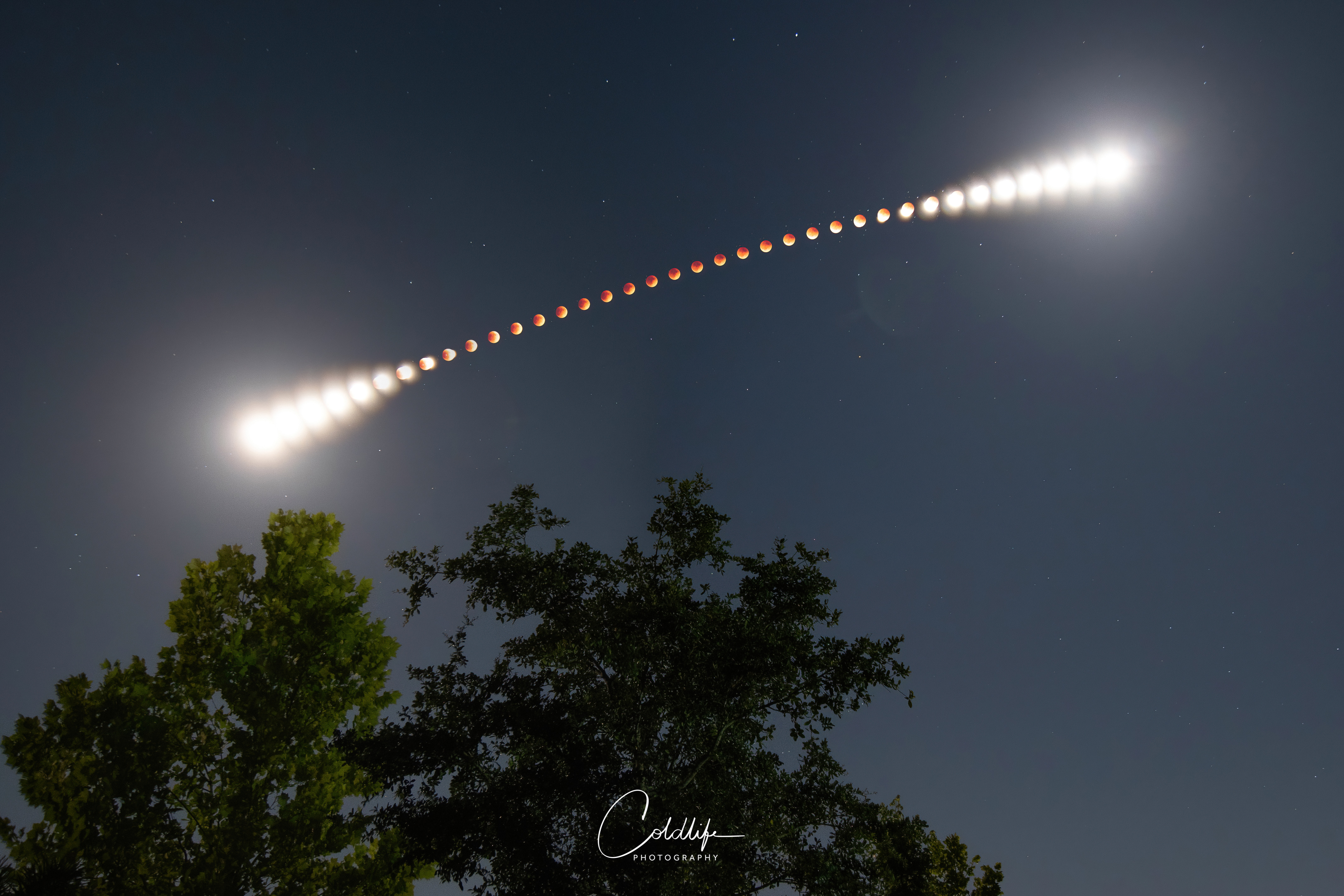
5月15日/16日に撮影されたこの一連の写真は、フロリダ州中央部の晴れ渡った空の下、樹木の梢の上を弧を描く皆既月食中の満月を捉えたものです。デジタルカメラで5分ごとに撮影されたフレームには、3時間にわたる月食の進行が写っています。明るい月の円盤は、地球の影の中を滑るように進むにつれて暗くなり、赤みを帯びていきます。実際、この一連の写真の中央のフレームを数えると、この月食の皆既食の継続時間が約90分であることが分かります。紀元前270年頃、ギリシャの天文学者アリスタルコスも皆既月食の継続時間を測定しましたが、おそらくデジタル時計やカメラの恩恵は受けていませんでした。それでも彼は幾何学を用いて、月食の継続時間から地球の半径に対する月の距離を計算する、シンプルかつ驚くほど正確な方法を考案しました。
原文(English)
Recorded on May 15/16 this sequence of exposures follows the Full Moon during a total lunar eclipse as it arcs above treetops in the clearing skies of central Florida. A frame taken every 5 minutes by a digital camera shows the progression of the eclipse over three hours. The bright lunar disk grows dark and red as it glides through planet Earth's shadow. In fact, counting the central frames in the sequence measures the roughly 90 minute duration of the total phase of this eclipse. Around 270 BC, the Greek astronomer Aristarchus also measured the duration of total lunar eclipses, but probably without the benefit of digital watches and cameras. Still, using geometry he devised a simple and impressively accurate way to calculate the Moon's distance in terms of the radius of planet Earth, from the eclipse duration.
\ この感動を宇宙仲間にシェア /
宇宙をXでシェア
© Michael Cain / APOD