キットピーク望遠鏡上空を流れるタウ・ヘルクレス座流星群
Tau Herculid Meteors over Kitt Peak Telescopes
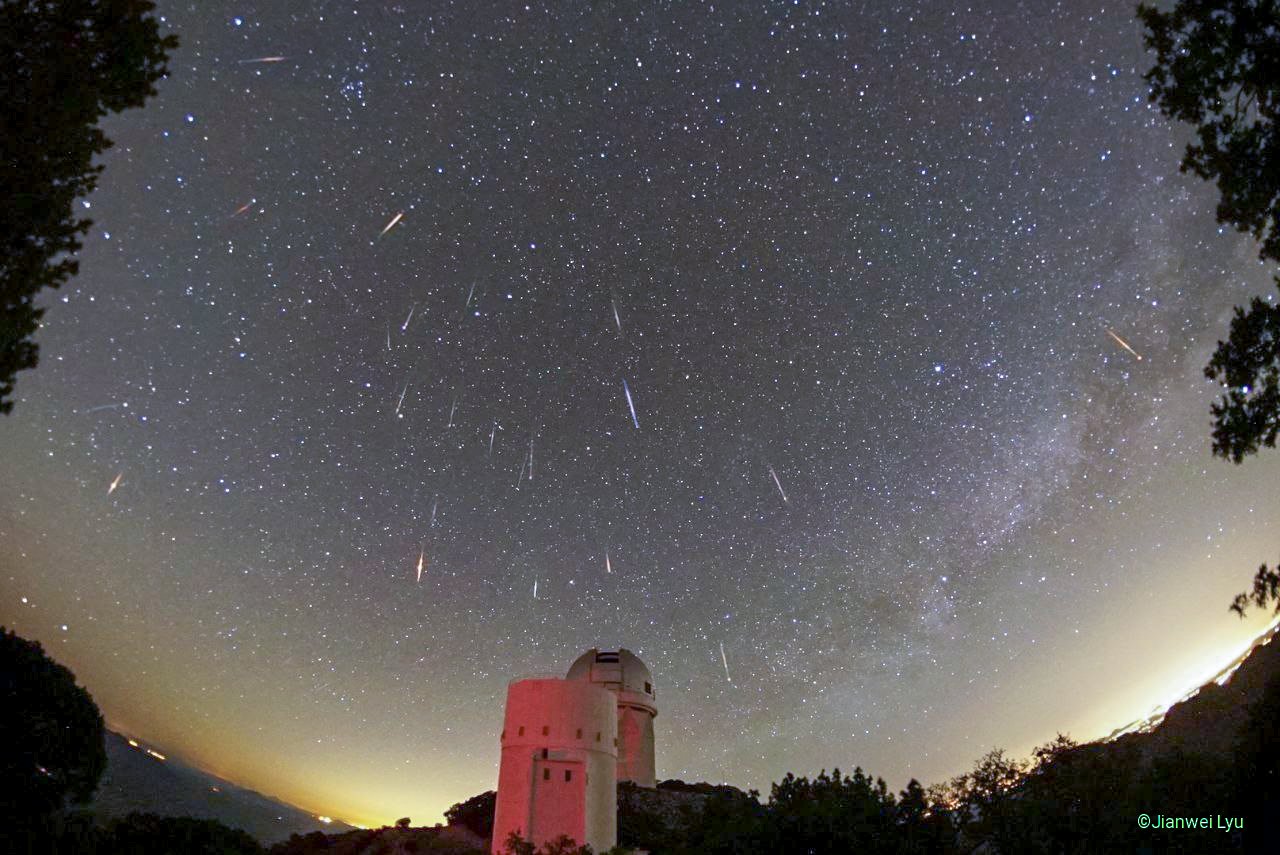
今世紀最大の流星群ではなかったものの、記憶に残る夜となった。昨夜はタウ・ヘルクレス座流星群のピークだった。この流星群は、崩壊しつつある73P/シュワスマン・ヴァハマン3彗星から発生する、通常は控えめな流星群である。今年は、地球が特に密度の高い彗星の残骸の流れを通過する可能性があり、最良の場合にはヘルクレス座から明るい流星が流れ出す流星群が発生すると予測されていた。実際に起こったことは流星群の嵐には至らなかったが、まずまずの流星群と呼べるものだった。ここに掲載されているのは、5月30日深夜に米国アリゾナ州のキットピーク国立天文台で2時間半かけて撮影された合成画像である。この間に、タウ・ヘルクレス座流星群の流星19個と、それとは無関係の流星4個が捉えられた。 (見つけられますか?)手前にあるのはボック2.3メートル望遠鏡で、そのすぐ後ろにはメイオール4.0メートル望遠鏡があります。来年は、毎年恒例のタウ・ヘルクレス座流星群の活動が通常の低頻度に戻ると予想されており、次の活動的な夜は2049年と予測されています。
原文(English)
It wasn't the storm of the century -- but it was a night to remember. Last night was the peak of the Tau Herculid meteor shower, a usually modest dribble of occasional meteors originating from the disintegrating Comet 73P/Schwassmann-Wachmann 3. This year, calculations showed that the Earth might be passing through a particularly dense stream of comet debris -- at best creating a storm of bright meteors streaking out from the constellation of Hercules. What actually happened fell short of a meteor storm, but could be called a decent meteor shower. Featured here is a composite image taken at Kitt Peak National Observatory in Arizona, USA accumulated over 2.5 hours very late on May 30. Over that time, 19 Tau Herculids meteors were captured, along with 4 unrelated meteors. (Can you find them?) In the near foreground is the Bok 2.3-meter Telescope with the 4.0-meter Mayall Telescope just behind it. Next year, the annual Tau Herculids are expected to return to its normal low rate, with the next active night forecast for 2049.
\ この感動を宇宙仲間にシェア /
宇宙をXでシェア
© Jianwei Lyu
(Steward Obs., U. Arizona) / APOD