1万キロメートルに及ぶ銀河の橋
A 10,000 Kilometer Galactic Bridge
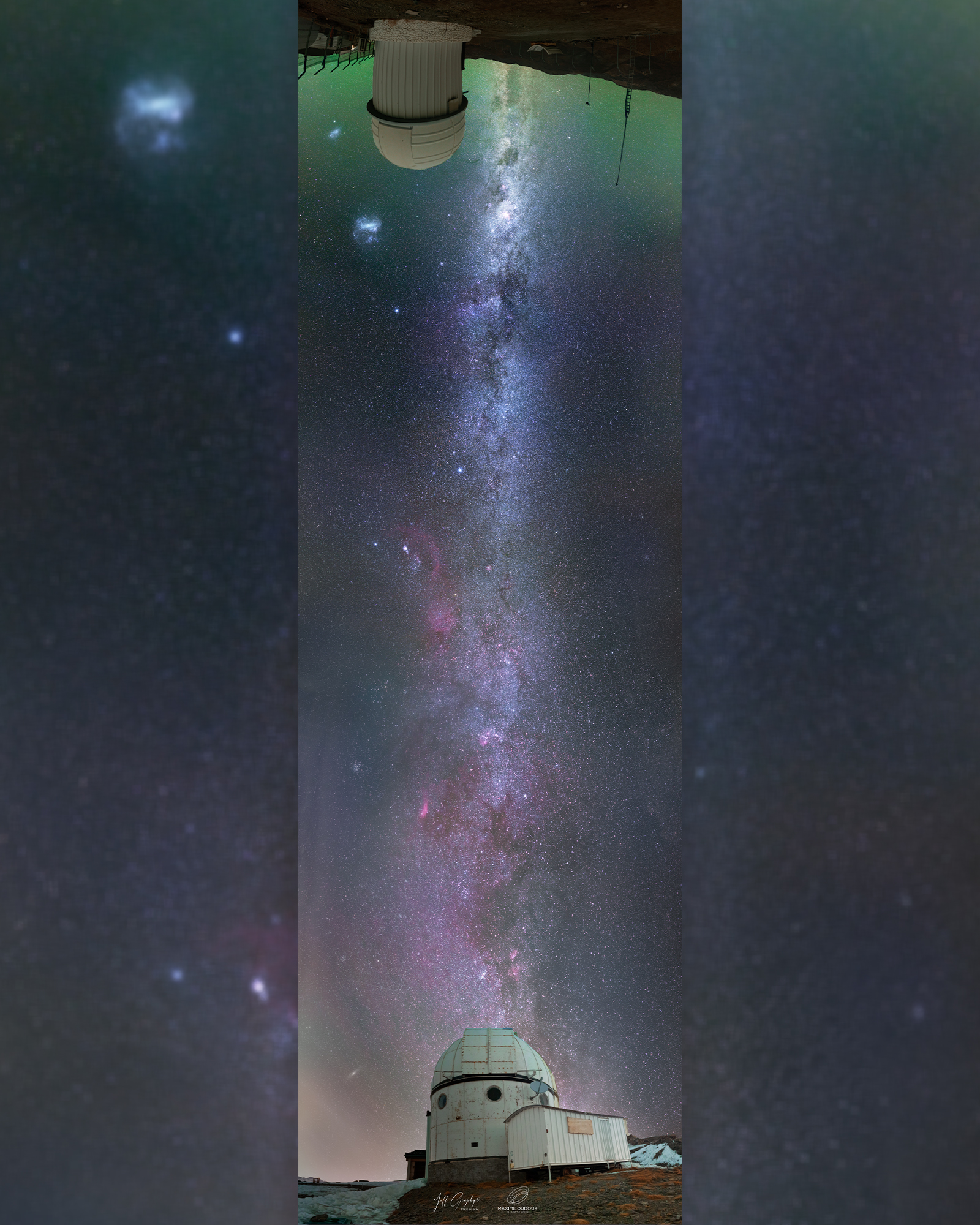
この創造的な天体コラボレーションにより、北半球と南半球の空を繋ぐ天の川銀河の平面を追うことができます。広大な合成夜景を作成するために、チリのエル・サウセ天文台(上)の空は、フランス・アルプスのサン・ヴェラン天文台の空と同じ日に、6時間後に撮影されました。6時間の時間差により、地球の自転によって天の川が2つの天文台のドームの上に揃いました。すべての撮影は、シンプルな三脚に取り付けられた同様のカメラとレンズを使用して行われました。暗いチリの空には、天文台のドームの近くに大マゼラン雲と小マゼラン雲も見られる、かすかな緑がかった大気光が見えます。フランス・アルプスでは光害が明らかですが、北の夜の地平線近くには遠くのアンドロメダ銀河がまだ見ることができます。地球上では、2つの天文台は約10,000キロメートル離れています。
原文(English)
With this creative astro-collaboration you can follow the plane of our Milky Way Galaxy as it bridges northern and southern hemisphere skies. To construct the expansive composite nightscape, skies over Observatorio El Sauce in Chile (top) were imaged on the same date but 6 hours later than the skies over the Saint-Veran observatory in the French Alps. The 6 hour time-lag allowed Earth's rotation to align the Milky Way above domes at the two sites. All exposures were made with similar cameras and lenses mounted on simple tripods. A faint greenish airglow is visible in the dark Chilean sky that also features the Large and Small Magellanic Clouds near the observatory dome. In the French Alps light pollution is apparent, but the distant Andromeda Galaxy can still be spotted near the horizon in the northern night. On planet Earth the two observatories are separated by about 10,000 kilometers.
\ この感動を宇宙仲間にシェア /
宇宙をXでシェア
© Maxime Oudoux / APOD