道と天の川
The Road and the Milky Way
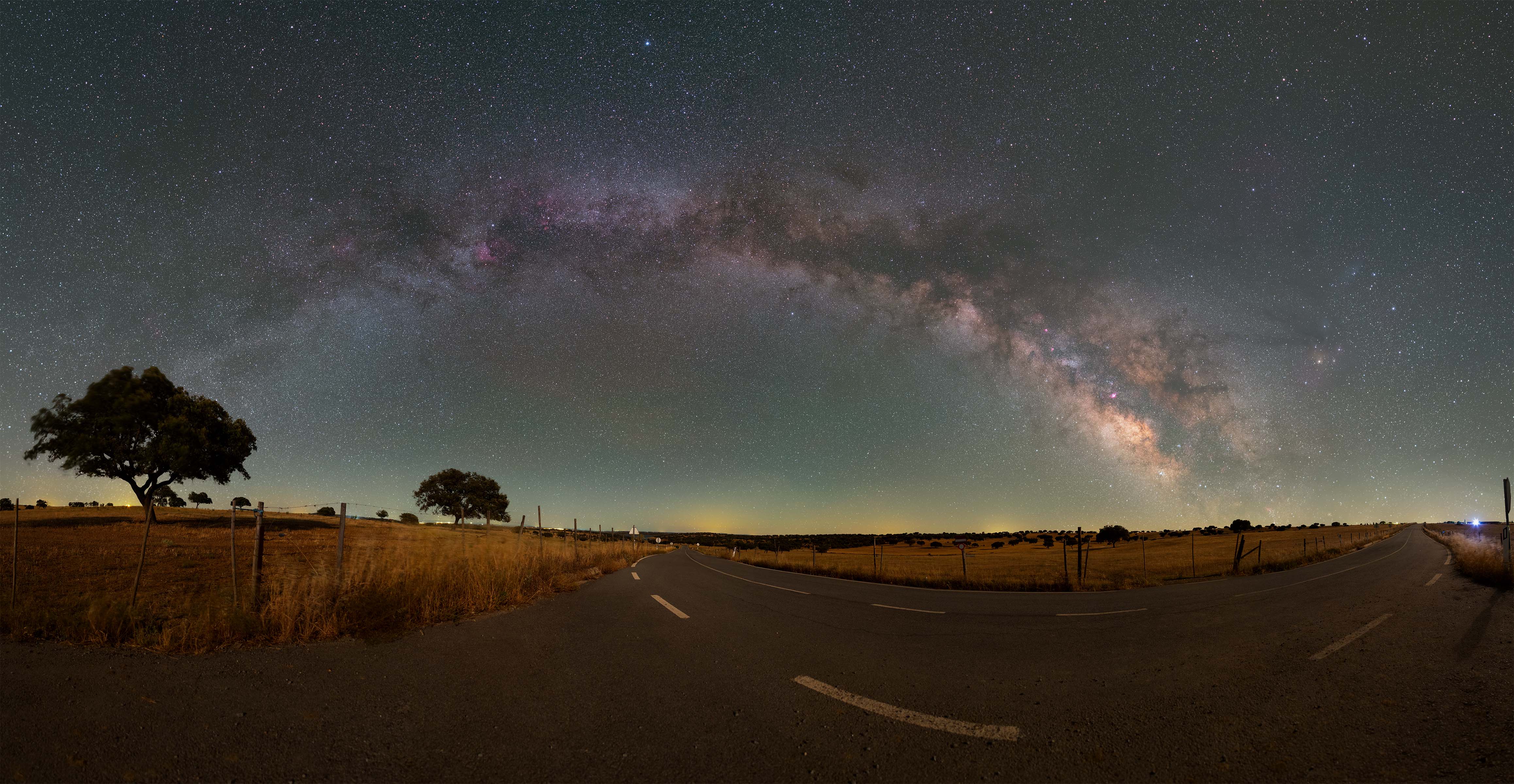
夜になると、ポルトガルのアレンテージョ地方からほど近いダークスカイ・アルケバ保護区を通るこの道をたどることができます。あるいは、立ち止まって空を見上げ、天の川を追うこともできます。どちらも、6月3日に撮影されたこの180度のパノラマ写真では地平線から地平線まで広がっています。私たちの銀河の名前である天の川は、空に乳白色の道のように見えることに由来しています。銀河という言葉自体は、ギリシャ語で乳を意味する言葉に由来しています。私たちの美しい地球から天の川の弧は、月のない夜、暗い空の地域で最も簡単に見ることができますが、この画像ほど明るく色鮮やかではありません。輝く天の帯は、銀河面に沿って並んだ無数の星の光が集まってできたもので、個々の星は暗すぎて区別できません。拡散した星の光は、銀河の星間塵雲の暗い帯によって分断されています。このパノラマ夜景の上部付近、天の川の弧の上に輝く星ベガがあり、右側の地平線近くには銀河の中心バルジが見える。
原文(English)
At night you can follow this road as it passes through the Dark Sky Alqueva reserve not too far from Alentejo, Portugal. Or you could stop, look up, and follow the Milky Way through the sky. Both stretch from horizon to horizon in this 180 degree panorama recorded on June 3. Our galaxy's name, the Milky Way, does refer to its appearance as a milky path in the sky. The word galaxy itself derives from the Greek for milk. From our fair planet the arc of the Milky Way is most easily visible on moonless nights from dark sky areas, though not quite so bright or colorful as in this image. The glowing celestial band is due to the collective light of myriad stars along the galactic plane too faint to be distinguished individually. The diffuse starlight is cut by dark swaths of the galaxy's obscuring interstellar dust clouds. Standing above the Milky Way arc near the top of this panoramic nightscape is bright star Vega, with the galaxy's central bulge near the horizon at the right.
\ この感動を宇宙仲間にシェア /
宇宙をXでシェア
© David Cruz / APOD