北アメリカとペリカン
North America and the Pelican
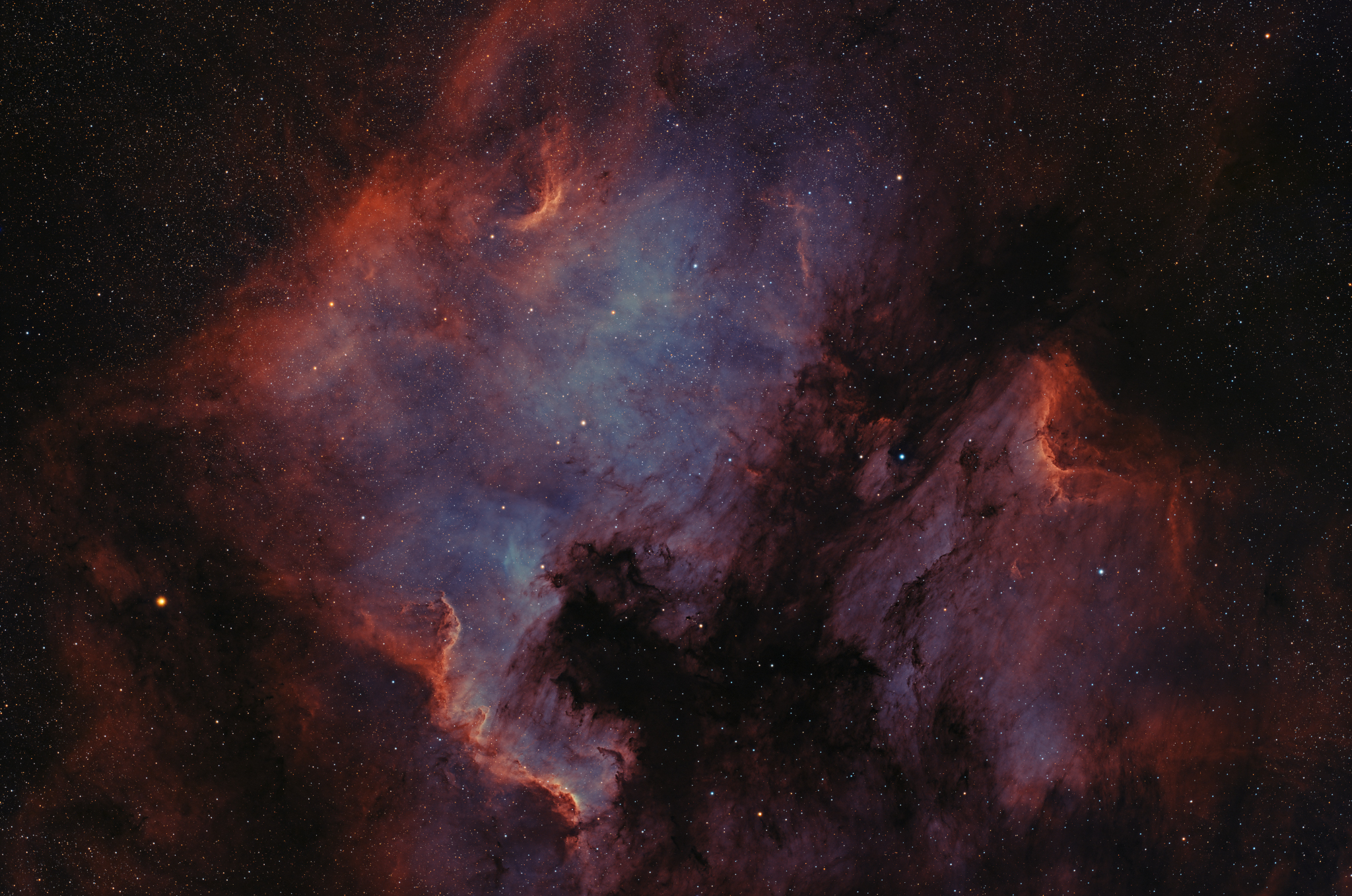
地球のファンなら、これらの宇宙雲の輪郭に見覚えがあるかもしれません。左側では、暗く視界を遮る塵の帯によって縁取られた明るい放射が大陸の形を描いているように見え、NGC 7000 としてカタログ化されているこの放射領域は、北アメリカ星雲という通称で呼ばれています。右側、北アメリカ星雲の東海岸のすぐ沖合には IC 5070 があり、その鳥のような形からペリカン星雲と呼ばれています。この 2 つの明るい星雲は、約 1,500 光年離れたところにあり、同じ大きくて複雑な星形成領域の一部で、より有名なオリオン星雲とほぼ同じくらい近い距離にあります。この距離では、3 度の視野は 80 光年をカバーします。この精緻な宇宙像は、明るい電離前線と原子状水素および酸素ガスからの特徴的な輝きを強調するために、狭帯域画像を組み合わせて使用しています。これらの星雲は、暗い場所から双眼鏡で見ることができます。北半球の夏の夜空高く輝く、白鳥座の明るい星デネブの北東の方向を見てください。
原文(English)
Fans of our fair planet might recognize the outlines of these cosmic clouds. On the left, bright emission outlined by dark, obscuring dust lanes seems to trace a continental shape, lending the popular name North America Nebula to the emission region cataloged as NGC 7000. To the right, just off the North America Nebula's east coast, is IC 5070, whose avian profile suggests the Pelican Nebula. The two bright nebulae are about 1,500 light-years away, part of the same large and complex star forming region, almost as nearby as the better-known Orion Nebula. At that distance, the 3 degree wide field of view would span 80 light-years. This careful cosmic portrait uses narrowband images combined to highlight the bright ionization fronts and the characteristic glow from atomic hydrogen, and oxygen gas. These nebulae can be seen with binoculars from a dark location. Look northeast of bright star Deneb in Cygnus the Swan, soaring high in the northern summer night sky.
\ この感動を宇宙仲間にシェア /
宇宙をXでシェア
© Frank Sackenheim / APOD