探査機ジュノーから見た木星のエウロパ
Jupiter's Europa from Spacecraft Juno
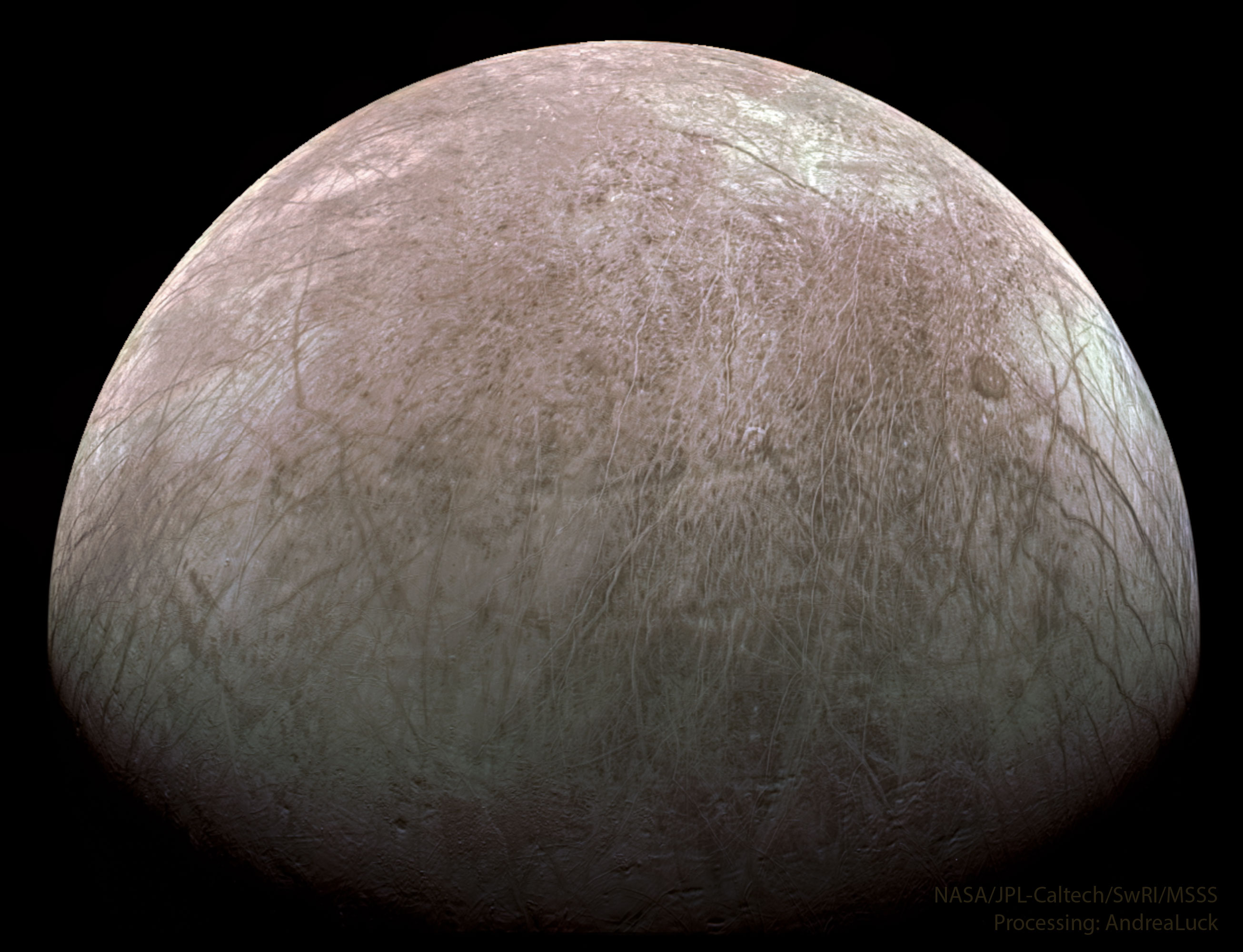
この水晶玉を覗き込むことで、どんな謎が解明されるだろうか?この場合、水晶玉は実際には木星の衛星で、結晶は氷であり、衛星は汚れているだけでなく、修復不可能なほどひび割れている。それでも、エウロパのひび割れた氷の平原の下に生命を支える可能性のある海が存在するという憶測が飛び交っている。地球の月とほぼ同じ大きさのエウロパは、数日前に木星を周回するロボット探査機ジュノーがその筋状で変化する表面から325キロメートル以内に接近した際に撮影された画像に写っている。エウロパはわずかに楕円軌道を描いているため、木星との重力の引力が変化するにつれて全体的にたわみ、このたわみによって内部が加熱されるため、地下海が存在する可能性が高いと考えられている。ジュノーの近接画像を研究することで、人類はエウロパや初期の太陽系だけでなく、宇宙の他の場所に生命が存在する可能性についても理解を深めることができるかもしれない。
原文(English)
What mysteries might be solved by peering into this crystal ball? In this case, the ball is actually a moon of Jupiter, the crystals are ice, and the moon is not only dirty but cracked beyond repair. Nevertheless, speculation is rampant that oceans exist under Europa's fractured ice-plains that could support life. Europa, roughly the size of Earth's Moon, is pictured here in an image taken a few days ago when the Jupiter-orbiting robotic spacecraft Juno passed within 325 kilometers of its streaked and shifting surface. Underground oceans are thought likely because Europa undergoes global flexing due to its changing gravitational attraction with Jupiter during its slightly elliptical orbit, and this flexing heats the interior. Studying Juno's close-up images may further humanity's understanding not only of Europa and the early Solar System but also of the possibility that life exists elsewhere in the universe.
\ この感動を宇宙仲間にシェア /
宇宙をXでシェア
© NASA / APOD