南の空に2つの彗星が出現
Two Comets in Southern Skies
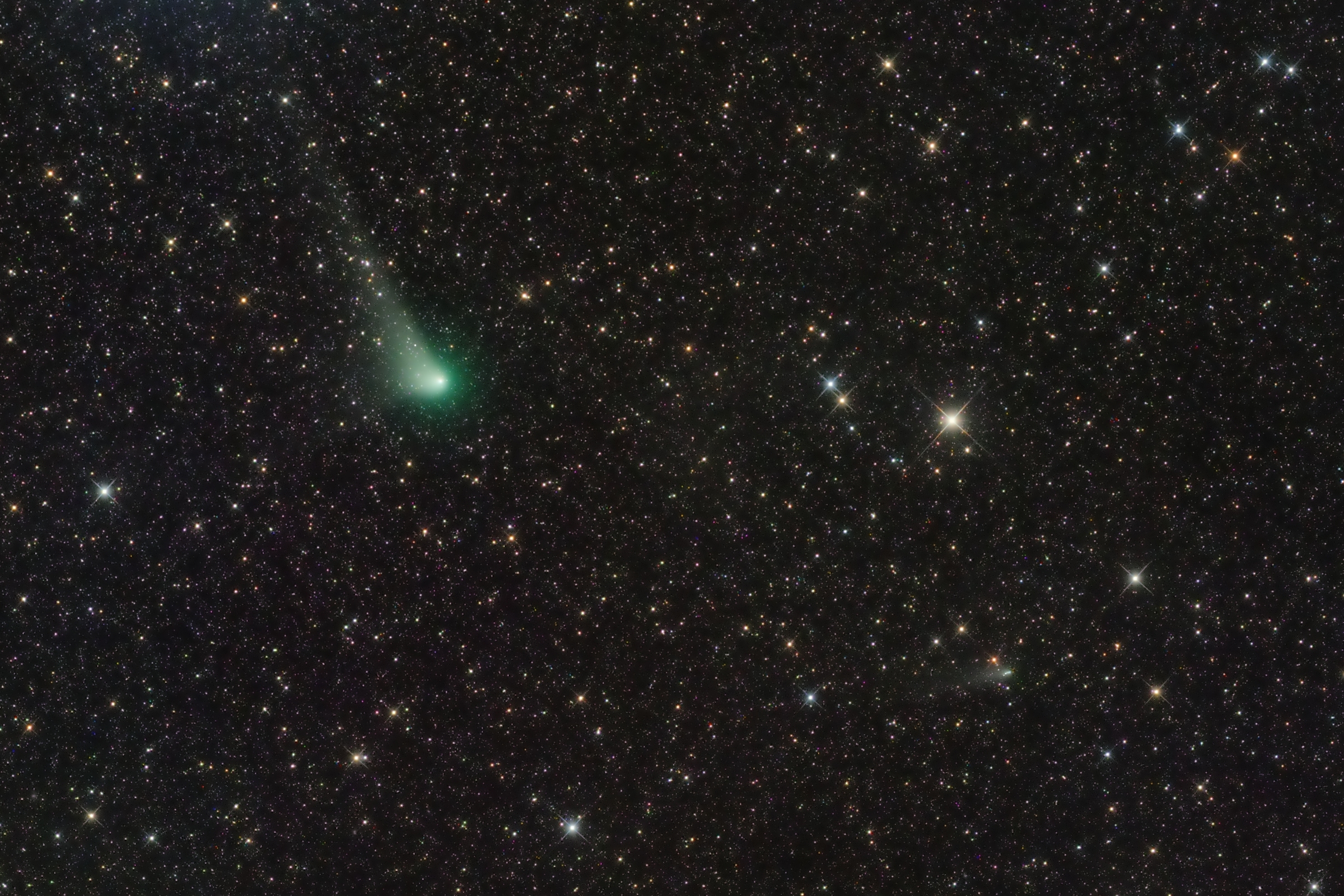
12月20日に太陽に最も接近する近日点に向かう彗星C/2017 K2 (PanSTARRS)は、地球の南半球の空を横切るため、望遠鏡観測者にとって引き続き見どころとなっている。遠く離れたオールトの雲から初めてやってきたこの彗星PanSTARRSは、9月21日の深宇宙画像では左上に約0.5度の長さの緑がかったコマと白っぽい塵の尾を伴っている。また、さそり座の方向の星空視野を、PanSTARRSの約1度下右に見える別の彗星73P/Schwassmann-Wachmann 3と共有している。天文学者は、初めてやってきた彗星C/2017 K2 (PanSTARRS)が双曲線軌道に沿って約300万年オールトの雲から接近していると推定している。しかし、Schwassmann-Wachmann 3の方がよく知られている。周期彗星であるパンスターズ彗星は、木星の軌道のすぐ外側から地球の軌道付近まで、独自の楕円軌道を5.4年ごとに一周します。9月21日の画像では、この彗星は夜間に地球を通過しており、地球から約20光分の距離にあります。1995年以降崩壊していることが観測されているシュワスマン・ヴァハマン3彗星は、約7.8光分の距離にありました。
原文(English)
Heading for its closest approach to the Sun or perihelion on December 20, comet C/2017 K2 (PanSTARRS) remains a sight for telescopic observers as it sweeps through planet Earth's southern hemisphere skies. First time visitor from the remote Oort cloud this comet PanSTARRS sports a greenish coma and whitish dust tail about half a degree long at the upper left in a deep image from September 21. It also shares the starry field of view toward the constellation Scorpius with another comet, 73P/Schwassmann-Wachmann 3, seen about 1 degree below and right of PanSTARRS. Astronomers estimate that first time visitor comet C/2017 K2 (PanSTARRS) has been inbound from the Oort cloud for some 3 million years along a hyperbolic orbit. Schwassmann-Wachmann 3 is more familiar though. The periodic comet loops through its own elliptical orbit, from just beyond the orbit of Jupiter to the vicinity of Earth's orbit, once every 5.4 years. Just passing in the night, this comet PanSTARRS is about 20 light-minutes from Earth in the September 21 image. Seen to be disintegrating since 1995, Schwassmann-Wachmann 3 was about 7.8 light-minutes away.
\ この感動を宇宙仲間にシェア /
宇宙をXでシェア
© Jose J. Chambo / APOD