天の川オーロラの花
Milky Way Auroral Flower
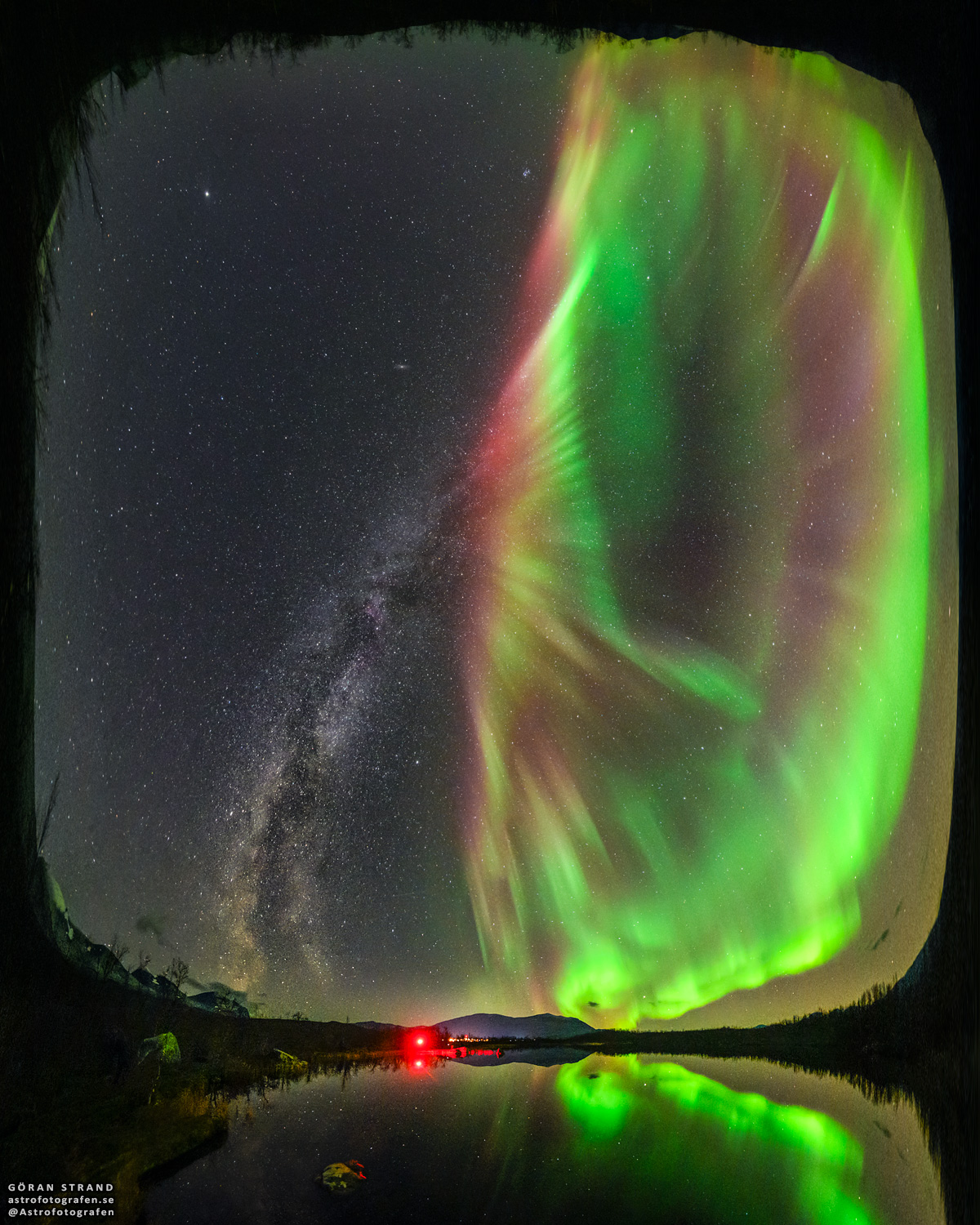
天の川銀河の幹がオーロラの花のように咲くことはあるだろうか?いいえ、今日の特集全天画像ではそう見えるかもしれませんが、実際にはそうではありません。左側では、私たちの銀河の中心面が地平線から空の中央を越えて広がっています。右側では、オーロラの楕円形も空の中心から広がっていますが、明るい緑色に輝く酸素が支配的です。オーロラは比較的近く、赤い部分は地球の大気圏の高度約1000キロメートルにあるため、この2つは物理的につながっていません。対照的に、天の川銀河で見られる星や星雲までの平均距離は1000光年ほど、つまり10兆倍も遠いのです。特集画像の合成写真は、10月初旬にスウェーデン北部のアビスコにある小さな湖で撮影されました。太陽の磁場が11年周期の活動期に入ると、地球の両極付近のオーロラは確実に頻繁になるでしょう。
原文(English)
Could the stem of our Milky Way bloom into an auroral flower? No, not really, even though it may appear that way in today’s featured all-sky image. On the left, the central plane of our home galaxy extends from the horizon past the middle of the sky. On the right, an auroral oval also extends from the sky's center -- but is dominated by bright green-glowing oxygen. The two are not physically connected, because the aurora is relatively nearby, with the higher red parts occurring in Earth's atmosphere only about 1000 kilometers high. In contrast, an average distance to the stars and nebulas we see in the Milky Way more like 1000 light-years away - 10 trillion times further. The featured image composite was taken in early October across a small lake in Abisko, northern Sweden. As our Sun's magnetic field evolves into the active part of its 11-year cycle, auroras near both of Earth's poles are sure to become more frequent.
\ この感動を宇宙仲間にシェア /
宇宙をXでシェア
© Göran Strand / APOD