バラが赤くないとき
When Roses Aren't Red
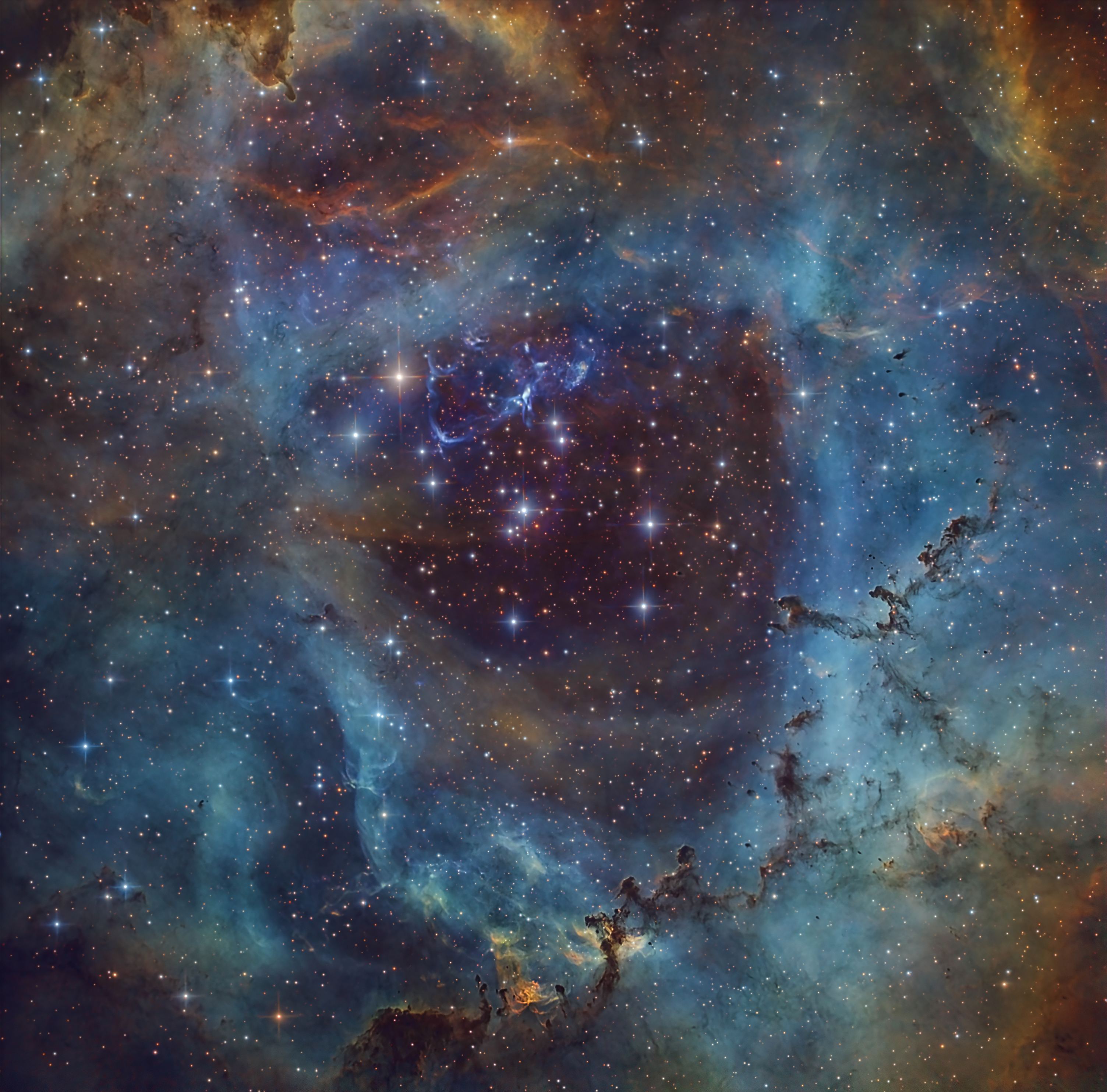
もちろん、すべてのバラが赤いわけではありませんが、それでもとても美しいものです。同様に、美しいバラ星雲やその他の星形成領域は、天体画像では主に赤色で表示されることがよくあります。これは、星雲における主要な放射が水素原子によるものであるためです。水素の最も強い光輝線であるHα線は、スペクトルの赤色領域にあります。しかし、輝線星雲の美しさは、赤色の光だけで評価する必要はありません。星雲内の他の原子も、高エネルギーの星光によって励起され、狭い輝線を生成します。このバラ星雲のクローズアップ画像では、狭帯域の画像を広帯域の色にマッピングして、硫黄原子からの放射を赤色、水素を緑色、酸素を青色で示しています。実際、これらの狭い原子輝線(SHO)をより広い色(RGB)にマッピングする手法は、ハッブル宇宙望遠鏡による輝線星雲の多くの画像で採用されています。この画像は、バラ星雲の中心部を約50光年にわたって捉えたものです。この星雲は、いっかくじゅう座の方向に約3000光年離れた場所に位置しています。
原文(English)
Not all roses are red of course, but they can still be very pretty. Likewise, the beautiful Rosette Nebula and other star forming regions are often shown in astronomical images with a predominately red hue, in part because the dominant emission in the nebula is from hydrogen atoms. Hydrogen's strongest optical emission line, known as H-alpha, is in the red region of the spectrum. But the beauty of an emission nebula need not be appreciated in red light alone. Other atoms in the nebula are also excited by energetic starlight and produce narrow emission lines as well. In this close-up view of the Rosette Nebula, narrowband images are mapped into broadband colors to show emission from Sulfur atoms in red, Hydrogen in green, and Oxygen in blue. In fact, the scheme of mapping these narrow atomic emission lines (SHO) into the broader colors (RGB) is adopted in many Hubble images of emission nebulae. This image spans about 50 light-years across the center of the Rosette Nebula. The nebula lies some 3,000 light-years away in the constellation Monoceros.
\ この感動を宇宙仲間にシェア /
宇宙をXでシェア
© Tommy Lease / APOD