ホーグの天体:ほぼ完璧な環状銀河
Hoag's Object: A Nearly Perfect Ring Galaxy
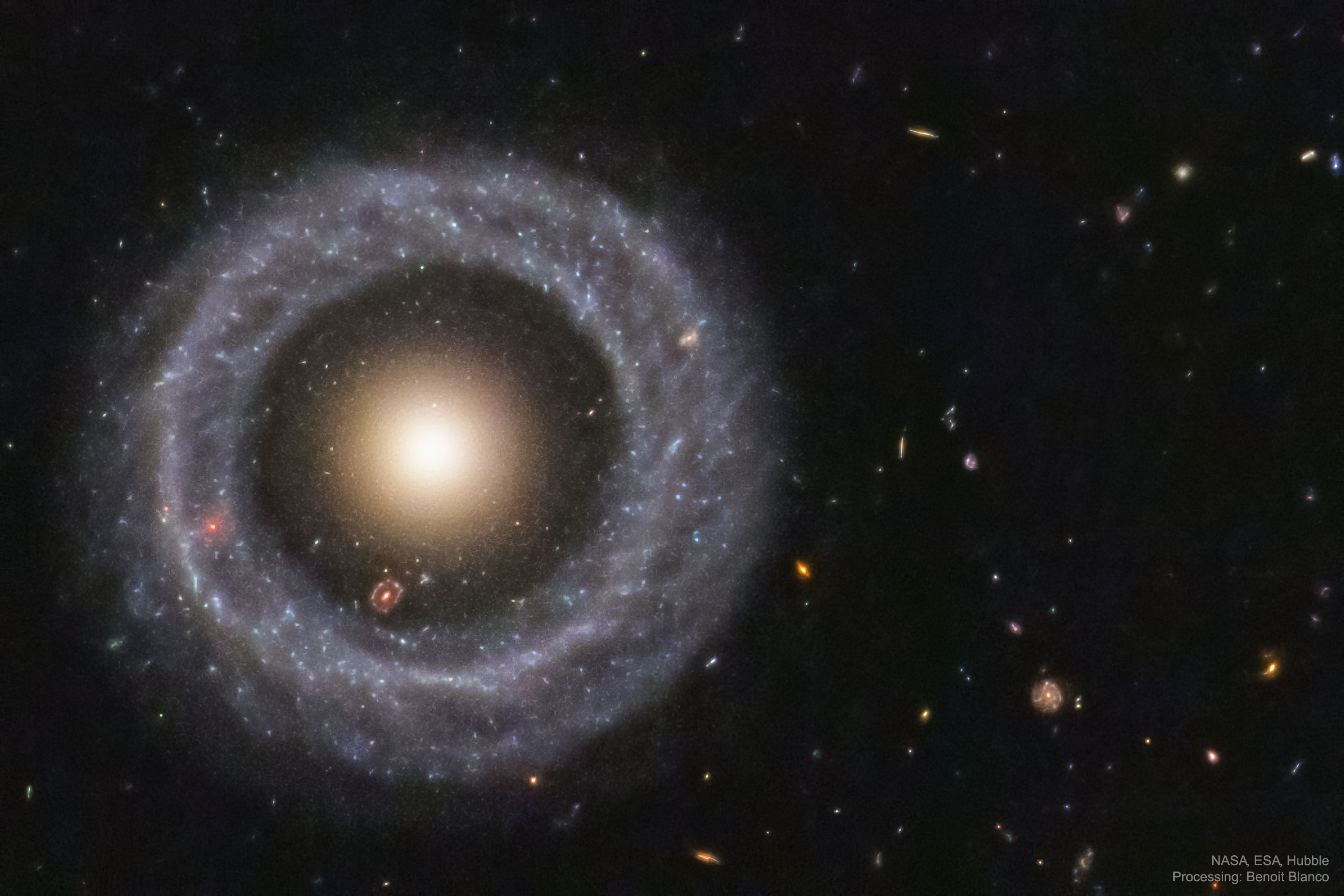
これは銀河が1つなのか、それとも2つなのか?この疑問は、1950年に天文学者のアーサー・ホーグがこの珍しい銀河外天体を偶然発見したことから浮上しました。外側には明るい青い星が支配的なリングがあり、中心付近にはおそらくはるかに古い、はるかに赤い星の球体があります。この2つの間には、ほぼ完全に暗い隙間があります。星とガスのほぼ完全な円形のリングを含め、ホーグ天体がどのように形成されたかは未だ不明です。起源に関する仮説には、数十億年前の銀河の衝突と、その後消滅した中心棒の重力の影響などが含まれます。掲載されている写真はハッブル宇宙望遠鏡で撮影され、人工知能によるノイズ除去アルゴリズムを使用して再処理されています。電波観測によると、ホーグ天体は過去10億年間に小さな銀河を吸収していません。ホーグ天体は直径約10万光年で、約6億光年離れた蛇座の方向に位置しています。右の方角には遠く離れた多くの銀河が見え、偶然にも、7時方向の隙間には、さらに遠くにある別の環状銀河が見える。
原文(English)
Is this one galaxy or two? This question came to light in 1950 when astronomer Arthur Hoag chanced upon this unusual extragalactic object. On the outside is a ring dominated by bright blue stars, while near the center lies a ball of much redder stars that are likely much older. Between the two is a gap that appears almost completely dark. How Hoag's Object formed, including its nearly perfectly round ring of stars and gas, remains unknown. Genesis hypotheses include a galaxy collision billions of years ago and the gravitational effect of a central bar that has since vanished. The featured photo was taken by the Hubble Space Telescope and reprocessed using an artificially intelligent de-noising algorithm. Observations in radio waves indicate that Hoag's Object has not accreted a smaller galaxy in the past billion years. Hoag's Object spans about 100,000 light years and lies about 600 million light years away toward the constellation of the Snake (Serpens). Many galaxies far in the distance are visible toward the right, while coincidentally, visible in the gap at about seven o'clock, is another but more distant ring galaxy.
\ この感動を宇宙仲間にシェア /
宇宙をXでシェア
© NASA / APOD