M106方面の眺め
A View Toward M106
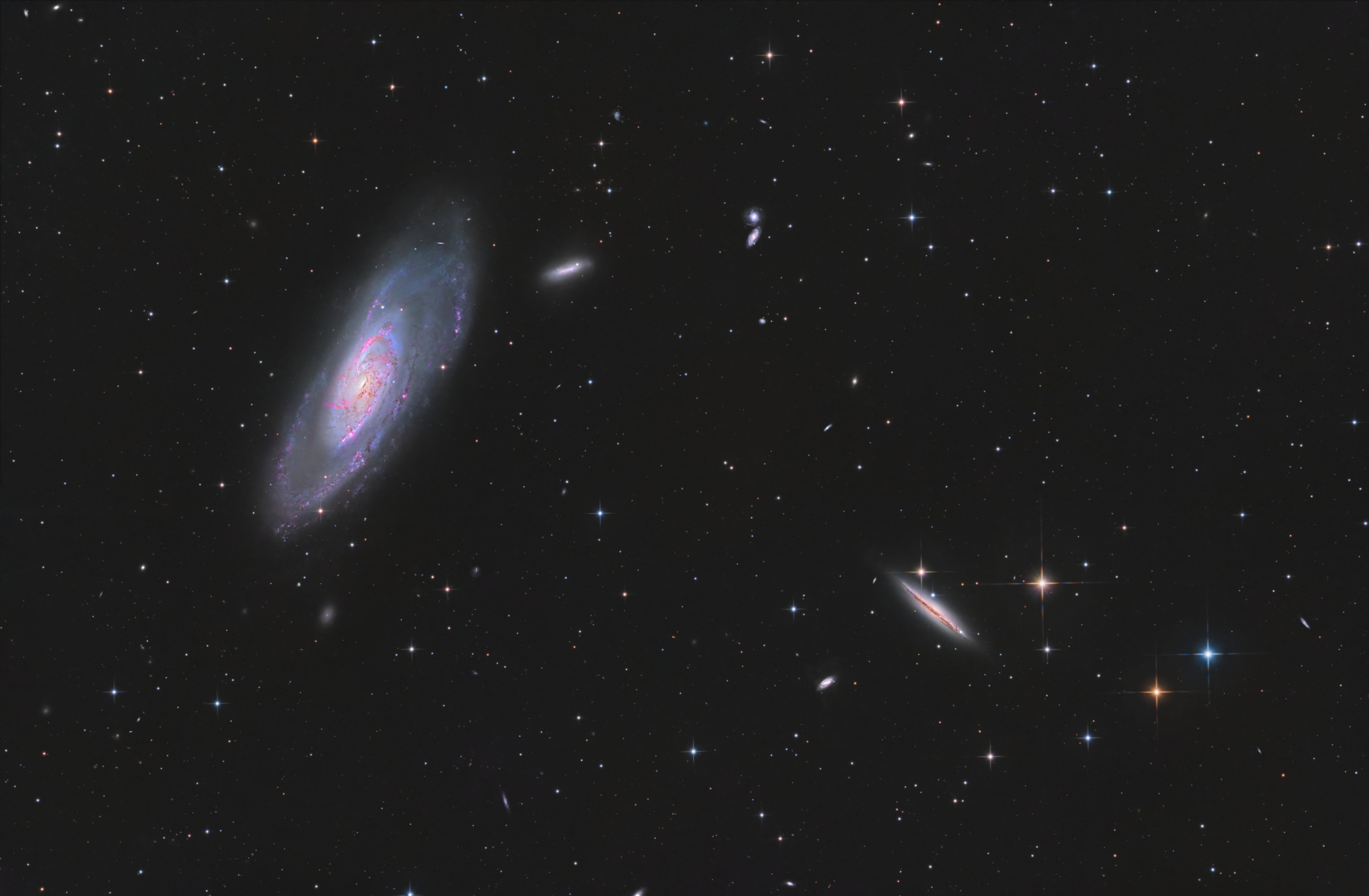
大きく明るく美しい渦巻銀河、メシエ106がこの宇宙の眺めを支配しています。望遠鏡の視野はほぼ2度で、北斗七星の柄の近くにある、よく訓練された星座であるりょうけん座の方角を向いています。NGC 4258としても知られるM106は、直径約8万光年、地球から2350万光年離れたところにあり、りょうけん座II銀河群の中で最大の銀河です。非常に遠い銀河であるにもかかわらず、M106までの距離は、この銀河の特異なメーザー、つまりマイクロ波レーザー放射を追跡することで直接測定できるため、よく知られています。非常にまれですが自然に発生するメーザー放射は、活動銀河核の周りを公転する分子雲中の水分子によって生成されます。この光景には、M106の下右側にほぼ真横から見たもう1つの目立つ渦巻銀河、NGC 4217があります。 NGC 4217までの距離はあまりよく分かっておらず、約6000万光年と推定されているが、明るく尖った星々は手前にあり、我々の銀河系である天の川銀河のかなり内側に位置している。
原文(English)
Big, bright, beautiful spiral, Messier 106 dominates this cosmic vista. The nearly two degree wide telescopic field of view looks toward the well-trained constellation Canes Venatici, near the handle of the Big Dipper. Also known as NGC 4258, M106 is about 80,000 light-years across and 23.5 million light-years away, the largest member of the Canes II galaxy group. For a far far away galaxy, the distance to M106 is well-known in part because it can be directly measured by tracking this galaxy's remarkable maser, or microwave laser emission. Very rare but naturally occurring, the maser emission is produced by water molecules in molecular clouds orbiting its active galactic nucleus. Another prominent spiral galaxy on the scene, viewed nearly edge-on, is NGC 4217 below and right of M106. The distance to NGC 4217 is much less well-known, estimated to be about 60 million light-years, but the bright spiky stars are in the foreground, well inside our own Milky Way galaxy.
\ この感動を宇宙仲間にシェア /
宇宙をXでシェア
© Kyunghoon Lim / APOD