プランクトンの満月
A Full Plankton Moon
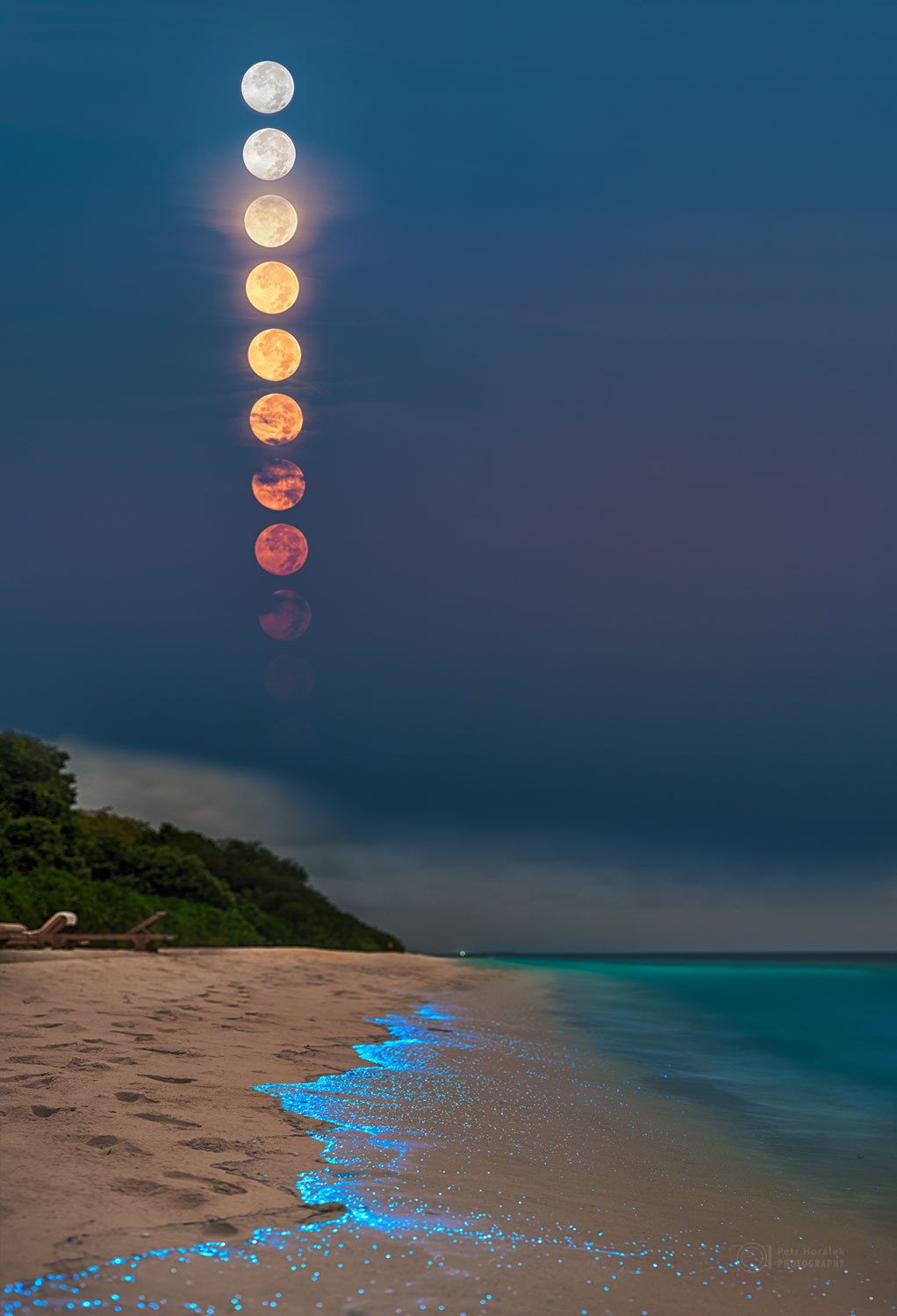
夜空に輝くものは何でしょうか?この夜は、ありふれた光と珍しい光が混在していました。おそらく最もありふれた光は、おそらく馴染みのある物体である月によるものでしょう。満月がほぼ垂直に沈むのは、観測者が地球の赤道付近にいるためです。月が沈むにつれて、地球の大気中の空気とエアロゾルが青い光を優先的に散乱させるため、太陽を反射する衛星である月は地平線近くでは赤みがかって見えます。おそらく最も珍しい光は、おそらくあまり馴染みのない物体である生物発光プランクトンによるものでしょう。これらの微小生物は、主に捕食者を驚かせ、撃退するために青く光ると考えられています。この場合、光は主にプランクトンを含む波が海岸に打ち寄せたことによって引き起こされました。この画像は、ちょうど1年ほど前にモルディブのソネバ・フシ島で撮影されました。あなたの空のサプライズ:あなたの誕生日にAPODで紹介された写真はどれですか?(1995年以降)
原文(English)
What glows in the night? This night featured a combination of usual and unusual glows. Perhaps the most usual glow was from the Moon, a potentially familiar object. The full Moon's nearly vertical descent results from the observer being near Earth's equator. As the Moon sets, air and aerosols in Earth's atmosphere preferentially scatter out blue light, making the Sun-reflecting satellite appear reddish when near the horizon. Perhaps the most unusual glow was from the bioluminescent plankton, likely less familiar objects. These microscopic creatures glow blue, it is thought, primarily to surprise and deter predators. In this case, the glow was caused primarily by plankton-containing waves crashing onto the beach. The image was taken on Soneva Fushi Island, Maldives just over one year ago. Your Sky Surprise: What picture did APOD feature on your birthday? (post 1995)
\ この感動を宇宙仲間にシェア /
宇宙をXでシェア
© Petr Horálek /
Institute of Physics in Opava / APOD