カモメ星雲
The Seagull Nebula
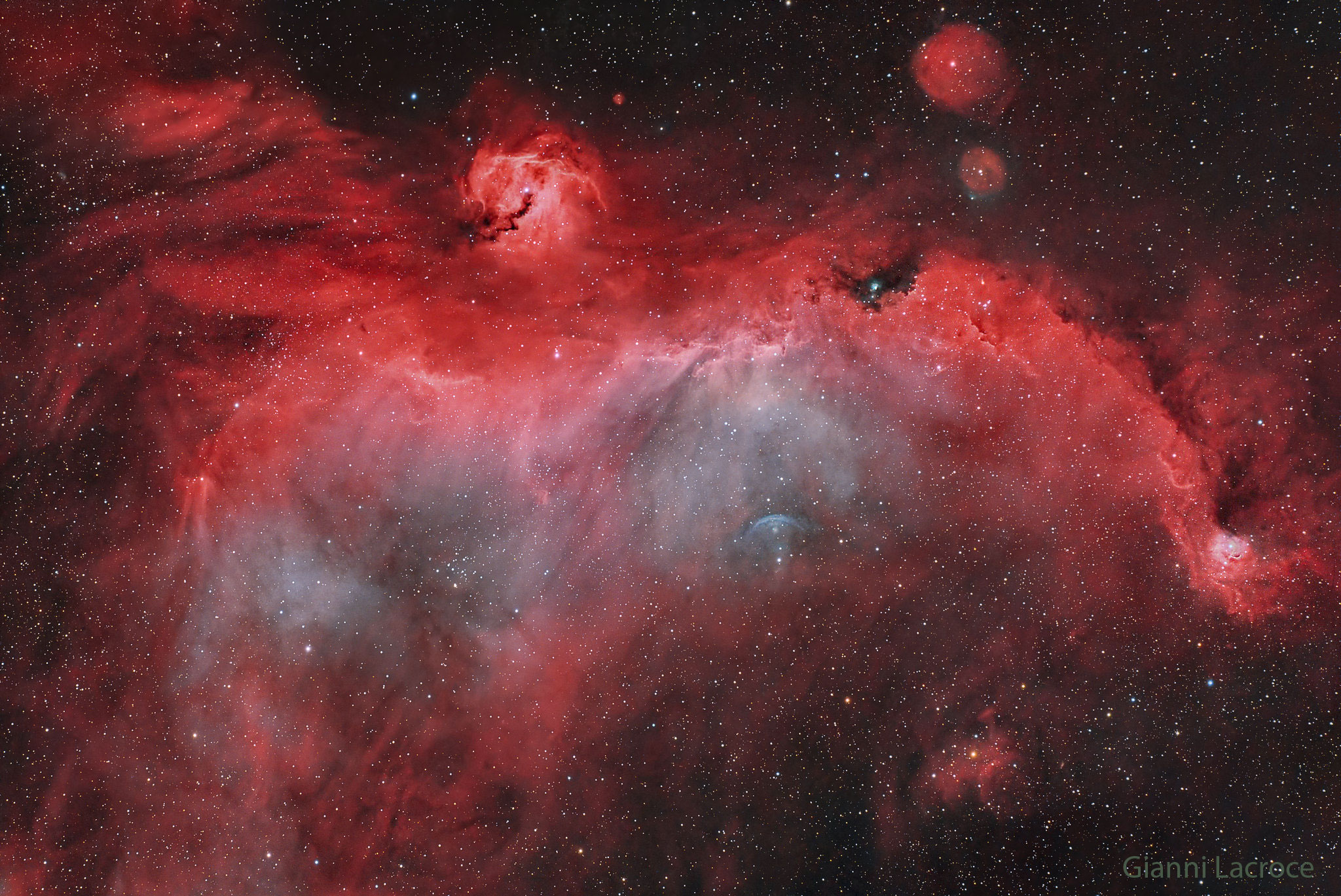
輝くガスと塵の広大な広がりが、地球の天文学者から鳥のような姿を見せており、その通称である「カモメ星雲」を示唆している。この宇宙の鳥の肖像は、天の川の平面を横切る幅2.5度の帯を覆い、大犬座(おおいぬ座)のアルファ星であるシリウスの方向に近い。もちろん、この領域には他のカタログ番号の天体も含まれており、特にNGC 2327は、鳥の頭を形成する巨大な星が埋め込まれた、コンパクトで塵の多い輝線と反射の星雲である。連続する超新星爆発によって掃き集められたより大きなシェル構造の一部であると考えられる広大なカモメ星雲は、Sh2-296およびIC 2177としてカタログ化されている。中央の下と右にある目立つ青みがかった弧は、暴走星FN Canis Majorisのバウショックである。原子状水素の赤みがかった輝きに支配されたこのガスと塵の雲の複合体は、カニス・マジョリスOB1アソシエーションの他の星々と共に、カモメ星雲の推定距離3,800光年において200光年以上に及ぶ。Almost Hyperspace: Random APOD Generator
原文(English)
A broad expanse of glowing gas and dust presents a bird-like visage to astronomers from planet Earth, suggesting its popular moniker: the Seagull Nebula. This portrait of the cosmic bird covers a 2.5-degree wide swath across the plane of the Milky Way, near the direction of Sirius, alpha star of the constellation of the Big Dog (Canis Major). Of course, the region includes objects with other catalog designations: notably NGC 2327, a compact, dusty emission and reflection nebula with an embedded massive star that forms the bird's head. Likely part of a larger shell structure swept up by successive supernova explosions, the broad Seagull Nebula is cataloged as Sh2-296 and IC 2177. The prominent bluish arc below and right of center is a bow shock from runaway star FN Canis Majoris. Dominated by the reddish glow of atomic hydrogen, this complex of gas and dust clouds with other stars of the Canis Majoris OB1 association spans over 200 light-years at the Seagull Nebula's estimated 3,800 light-year distance. Almost Hyperspace: Random APOD Generator
\ この感動を宇宙仲間にシェア /
宇宙をXでシェア
© Gianni Lacroce / APOD