NGC 7714:銀河衝突後のスターバースト
NGC 7714: Starburst after Galaxy Collision
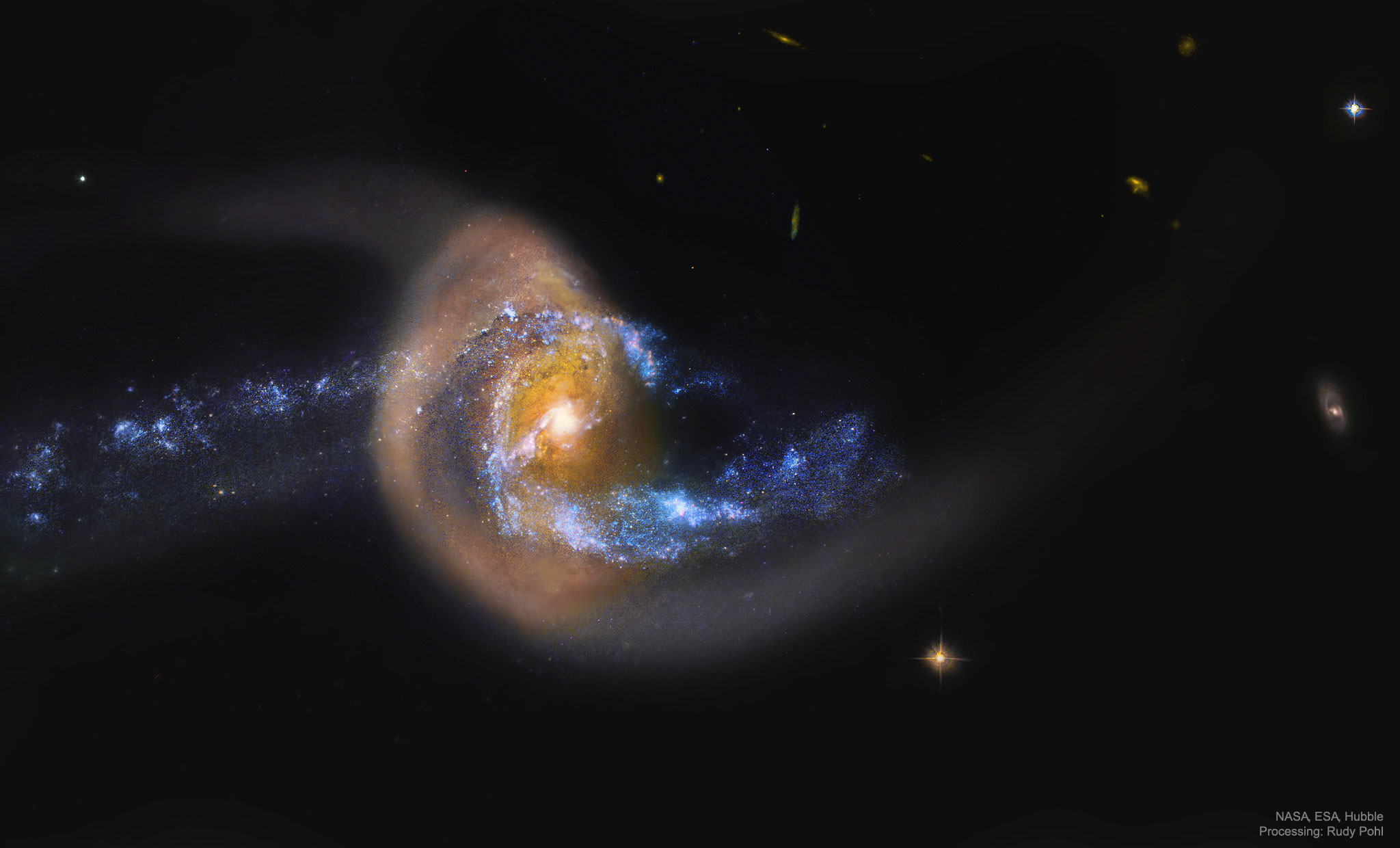
この銀河は巨大な星の環を飛び越えているのでしょうか?おそらくそうではないでしょう。この画像の背景にある正確な力学はまだ不明ですが、明らかになっているのは、写真に写っている銀河NGC 7714が、近隣の銀河との最近の衝突によって引き伸ばされ、歪められているということです。フレームの左側にあるこのより小さな近隣の銀河NGC 7715は、NGC 7714をまっすぐ通り抜けたと考えられています。観測によると、写真に写っている金色の環は、おそらく内部のより青い星と共動していると思われる、数百万個の古い太陽のような星で構成されています。対照的に、NGC 7714の明るい中心部では、新しい星形成が活発に行われているようです。この画像はハッブル宇宙望遠鏡によって撮影されました。NGC 7714は、うお座の方向に約1億3000万光年離れたところに位置しています。これらの銀河間の相互作用は約1億5000万年前に始まったと考えられ、今後数億年は継続し、最終的には単一の中心銀河が形成される可能性がある。
原文(English)
Is this galaxy jumping through a giant ring of stars? Probably not. Although the precise dynamics behind the featured image is yet unclear, what is clear is that the pictured galaxy, NGC 7714, has been stretched and distorted by a recent collision with a neighboring galaxy. This smaller neighbor, NGC 7715, situated off to the left of the frame, is thought to have charged right through NGC 7714. Observations indicate that the golden ring pictured is composed of millions of older Sun-like stars that are likely co-moving with the interior bluer stars. In contrast, the bright center of NGC 7714 appears to be undergoing a burst of new star formation. The featured image was captured by the Hubble Space Telescope. NGC 7714 is located about 130 million light years away toward the constellation of the Two Fish (Pisces). The interactions between these galaxies likely started about 150 million years ago and should continue for several hundred million years more, after which a single central galaxy may result.
\ この感動を宇宙仲間にシェア /
宇宙をXでシェア
© NASA / APOD