へび座の原始星流出
Protostellar Outflows in Serpens
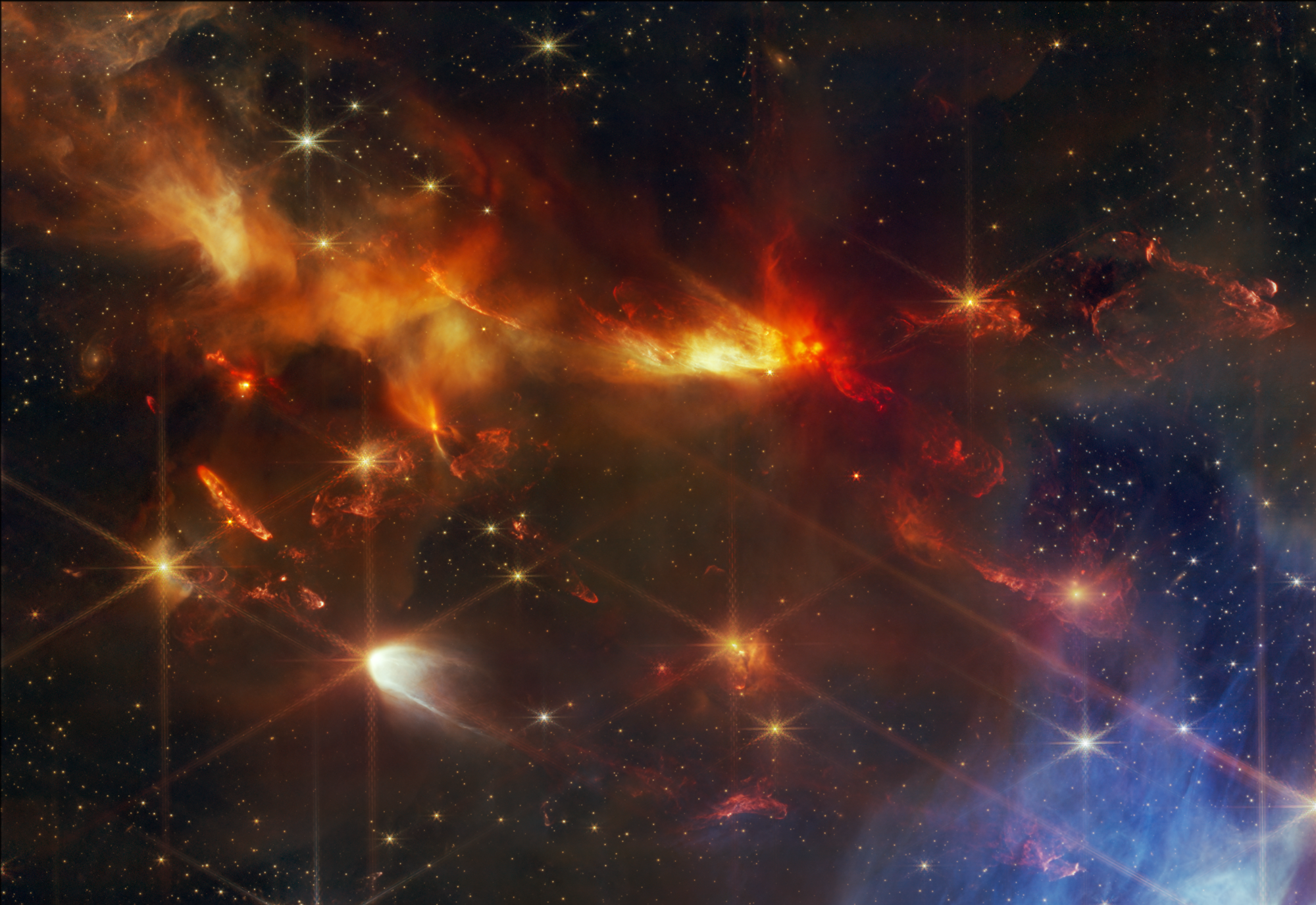
生まれたばかりの星から噴出する物質のジェットが、ジェームズ・ウェッブ宇宙望遠鏡によるへび座星雲のクローズアップ画像に捉えられています。強力な原始星の流出は双極性で、反対方向に噴出する双子のジェットです。その方向は、回転しながら崩壊していく生まれたばかりの星の周りに形成された降着円盤に対して垂直です。NIRcamの画像では、赤みがかった色は、ジェットが周囲のガスや塵と衝突する際に生成される分子状水素と一酸化炭素の放射を表しています。この鮮明な画像は、へび座星雲で検出された個々の流出が、概ね同じ方向に並んでいることを初めて示しています。この結果は予想されていましたが、ウェッブによる活発な若い星形成領域の詳細な探査によって、ようやく明確になりました。明るい前景の星には、ウェッブ特有の回折スパイクが見られます。へび座星雲までの距離は推定1,300光年で、この宇宙のクローズアップ画像の幅は約1光年です。
原文(English)
Jets of material blasting from newborn stars, are captured in this James Webb Space Telescope close-up of the Serpens Nebula. The powerful protostellar outflows are bipolar, twin jets spewing in opposite directions. Their directions are perpendicular to accretion disks formed around the spinning, collapsing stellar infants. In the NIRcam image, the reddish color represents emission from molecular hydrogen and carbon monoxide produced as the jets collide with the surrounding gas and dust. The sharp image shows for the first time that individual outflows detected in the Serpens Nebula are generally aligned along the same direction. That result was expected, but has only now come into clear view with Webb's detailed exploration of the active young star-forming region. Brighter foreground stars exhibit Webb's characteristic diffraction spikes. At the Serpens Nebula's estimated distance of 1,300 light-years, this cosmic close-up frame is about 1 light-year across.
\ この感動を宇宙仲間にシェア /
宇宙をXでシェア
© NASA / APOD