NGC 7789:キャロラインズ・ローズ
NGC 7789: Caroline's Rose
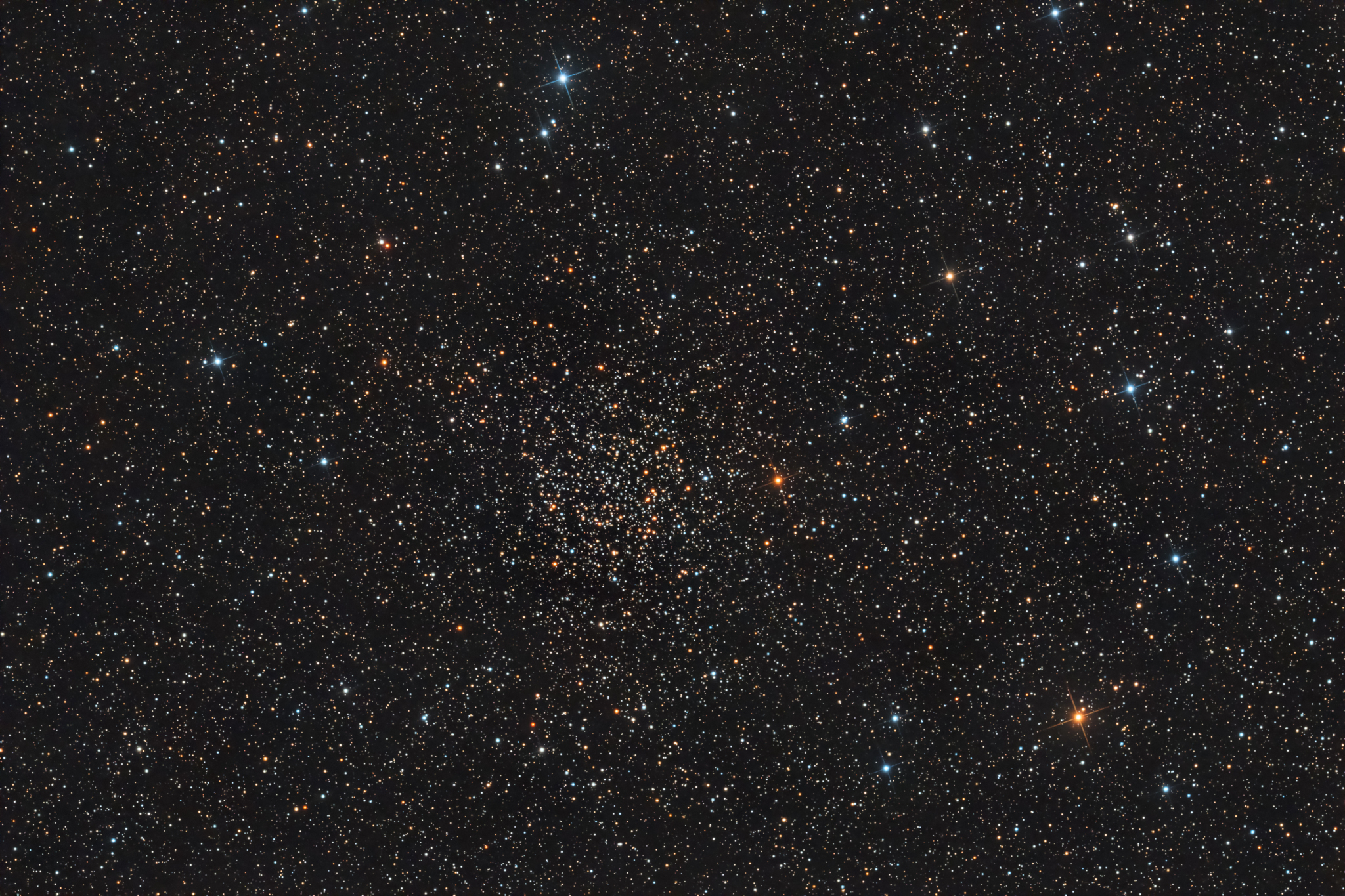
天の川の豊かな星野の中に存在する星団NGC 7789は、カシオペヤ座の方向へ約8,000光年離れたところに位置しています。18世紀後半に天文学者カロリーネ・ルクレティア・ハーシェルによって発見されたこの星団は、「カロリーネのバラ」としても知られています。星とボイドが複雑に絡み合ったこの星団の姿は、小型望遠鏡で見ると、入れ子になったバラの花びらを思わせます。現在推定年齢16億年のこの銀河系星団(散開星団)は、その年齢を物語っています。星団内のすべての星はほぼ同時期に誕生したと考えられていますが、より明るく質量の大きい星ほど、中心部の水素燃料をより急速に消費しました。これらの星は、太陽のような主系列星から、このカラー合成画像で黄色みがかった色で示されている多くの赤色巨星へと進化しました。天文学者は、測定された色と明るさを用いて、主系列星としての活動を終え、赤色巨星へと変化し始めたばかりの星団の質量、ひいては年齢を推定することができる。直径50光年以上にも及ぶカロラインズ・ローズは、鮮明な望遠鏡画像の中心付近で約0.5度(月の視角)の広がりを持つ。
原文(English)
Found among the rich starfields of the Milky Way, star cluster NGC 7789 lies about 8,000 light-years away toward the constellation Cassiopeia. A late 18th century deep sky discovery of astronomer Caroline Lucretia Herschel, the cluster is also known as Caroline's Rose. Its visual appearance in small telescopes, created by the cluster's complex of stars and voids, is suggestive of nested rose petals. Now estimated to be 1.6 billion years young, the galactic or open cluster of stars also shows its age. All the stars in the cluster were likely born at the same time, but the brighter and more massive ones have more rapidly exhausted the hydrogen fuel in their cores. These have evolved from main sequence stars like the Sun into the many red giant stars shown with a yellowish cast in this color composite. Using measured color and brightness, astronomers can model the mass and hence the age of the cluster stars just starting to "turn off" the main sequence and become red giants. Over 50 light-years across, Caroline's Rose spans about half a degree (the angular size of the Moon) near the center of the sharp telescopic image.
\ この感動を宇宙仲間にシェア /
宇宙をXでシェア
© Massimo Di Fusco / APOD