系外惑星動物園:その他の星々
Exoplanet Zoo: Other Stars
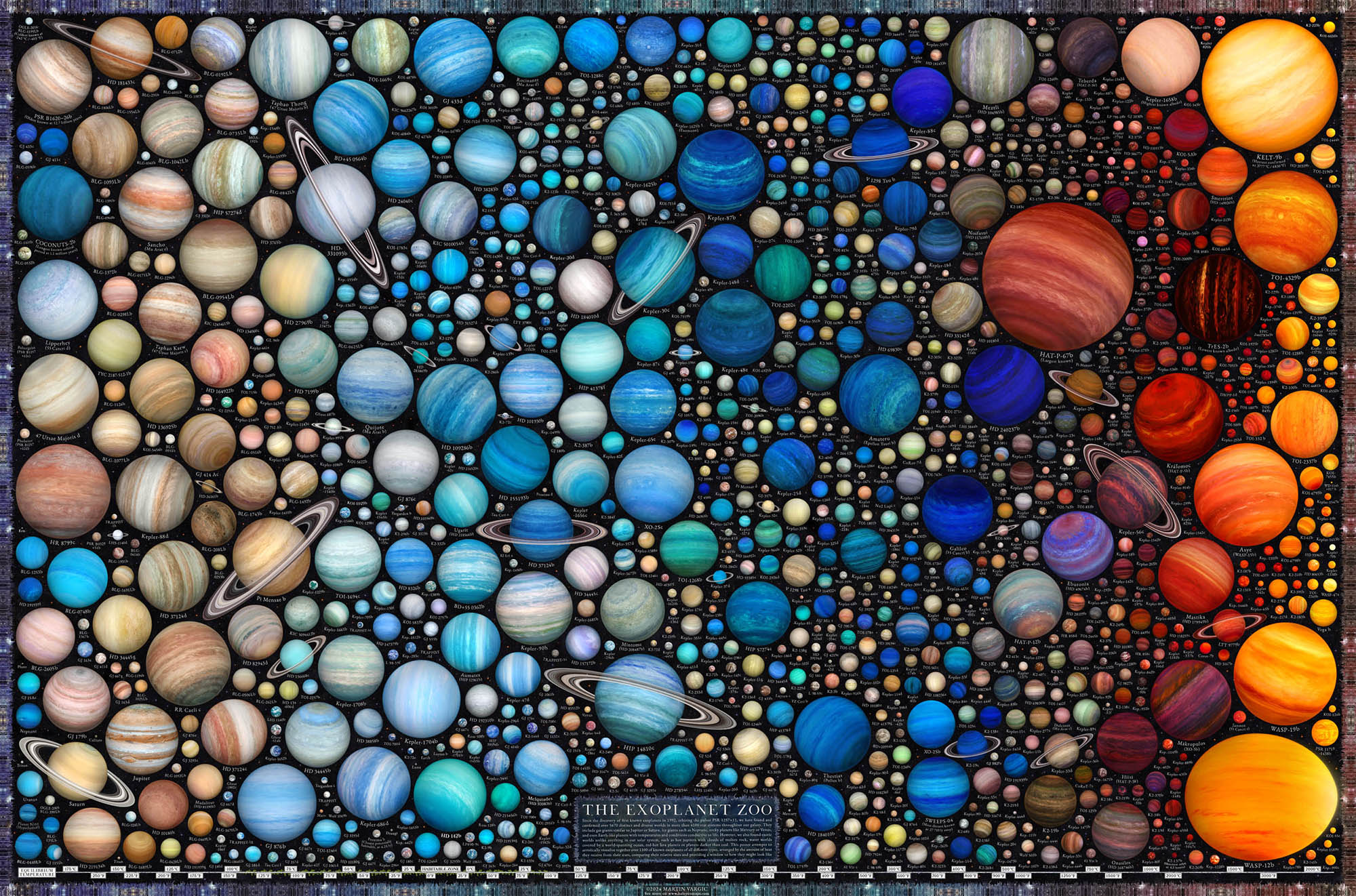
他の恒星にも太陽のような惑星はあるのだろうか? もちろんある。その証拠として、軌道を周回する系外惑星の重力によって生じるわずかな恒星の揺れや、軌道を周回する惑星が前を横切ることによって生じるわずかな恒星の減光などが挙げられる。これまでに発見された系外惑星は合計で5,500個を超え、NASAの宇宙望遠鏡ケプラーとTESSミッションによって発見された数千個、ESOの地上望遠鏡HARPSによって発見された100個以上が含まれる。ここに掲載されているのは、これらの系外惑星のいくつかがどのような姿をしているかを推測したイラストである。中央には海王星型の惑星が描かれており、大気中のメタンが青色に散乱するため青色で着色されている。イラストの両側には木星型の惑星が描かれており、大気中のガス(おそらく少量の炭素を含む)の散乱により黄褐色と赤色で着色されている。その間には、さまざまな色の地球型岩石惑星が多数散りばめられている。系外惑星の発見と調査が進むにつれ、人類は地球型惑星がどれほど普遍的な存在なのか、そして宇宙における生命の存在がどれほど普遍的なのかについて、より深い理解を深めつつある。
原文(English)
Do other stars have planets like our Sun? Surely they do, and evidence includes slight star wobbles created by the gravity of orbiting exoplanets and slight star dimmings caused by orbiting planets moving in front. In all, there have now been over 5,500 exoplanets discovered, including thousands by NASA's space-based Kepler and TESS missions, and over 100 by ESO's ground-based HARPS instrument. Featured here is an illustrated guess as to what some of these exoplanets might look like. Neptune-type planets occupy the middle and are colored blue because of blue-scattering atmospheric methane they might contain. On the sides of the illustration, Jupiter-type planets are shown, colored tan and red from the scatterings of atmospheric gases that likely include small amounts of carbon. Interspersed are many Earth-type rocky planets of many colors. As more exoplanets are discovered and investigated, humanity is developing a better understanding of how common Earth-like planets are, and how common life might be in the universe.
\ この感動を宇宙仲間にシェア /
宇宙をXでシェア
© Martin Vargic,
Halcyon Maps / APOD