惑星状星雲アベル7
Planetary Nebula Abell 7
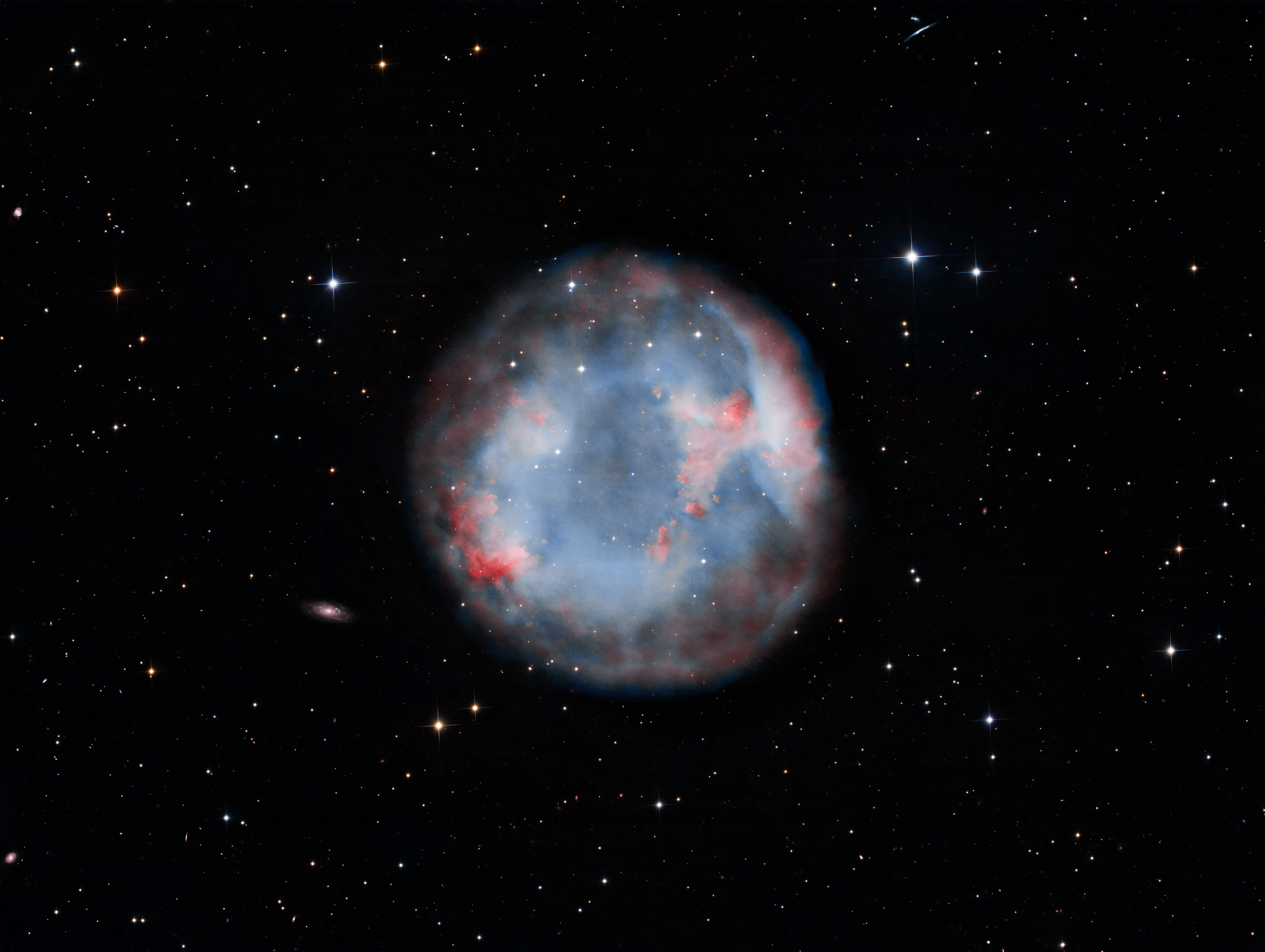
非常に淡い惑星状星雲アベル7は、地球から約1,800光年離れたところにあります。地球の空ではオリオン座のすぐ南、うさぎ座の方向に位置しています。天の川の星々に囲まれ、遠くの背景銀河への視線に近い位置にあるこの星雲は、直径約8光年の単純な球形をしており、この望遠鏡による深宇宙画像でその姿が明らかになります。しかし、この宇宙雲の中には美しく複雑な構造があり、長時間露光と、水素、硫黄、酸素原子からの放射を捉える狭帯域フィルターの使用によって、その構造が強調されています。そうでなければ、アベル7は肉眼では見えず、あまりにも淡いでしょう。惑星状星雲は、恒星進化の非常に短い最終段階を表しており、50億年後には、星雲の中心にあるかつて太陽のような恒星が外層を剥ぎ取ることで、私たちの太陽も同じような状態になるでしょう。アベル7自体の年齢は2万年と推定されています。しかし、この中心星は、ここでは薄れゆく白色矮星として見えているが、約100億年前のものである。
原文(English)
Very faint planetary nebula Abell 7 is about 1,800 light-years distant. It lies just south of Orion in planet Earth's skies toward the constellation Lepus, The Hare. Surrounded by Milky Way stars and near the line-of-sight to distant background galaxies its generally simple spherical shape, about 8 light-years in diameter, is revealed in this deep telescopic image. Within the cosmic cloud are beautiful and complex structures though, enhanced by the use of long exposures and narrowband filters that capture emission from hydrogen, sulfur, and oxygen atoms. Otherwise Abell 7 would be much too faint to be appreciated by eye. A planetary nebula represents a very brief final phase in stellar evolution that our own Sun will experience 5 billion years hence, as the nebula's central, once sun-like star shrugs off its outer layers. Abell 7 itself is estimated to be 20,000 years old. But its central star, seen here as a fading white dwarf, is some 10 billion years old.
\ この感動を宇宙仲間にシェア /
宇宙をXでシェア
© Vikas Chander / APOD