NGC 6357:巨大な星々が輝く大聖堂
NGC 6357: Cathedral to Massive Stars
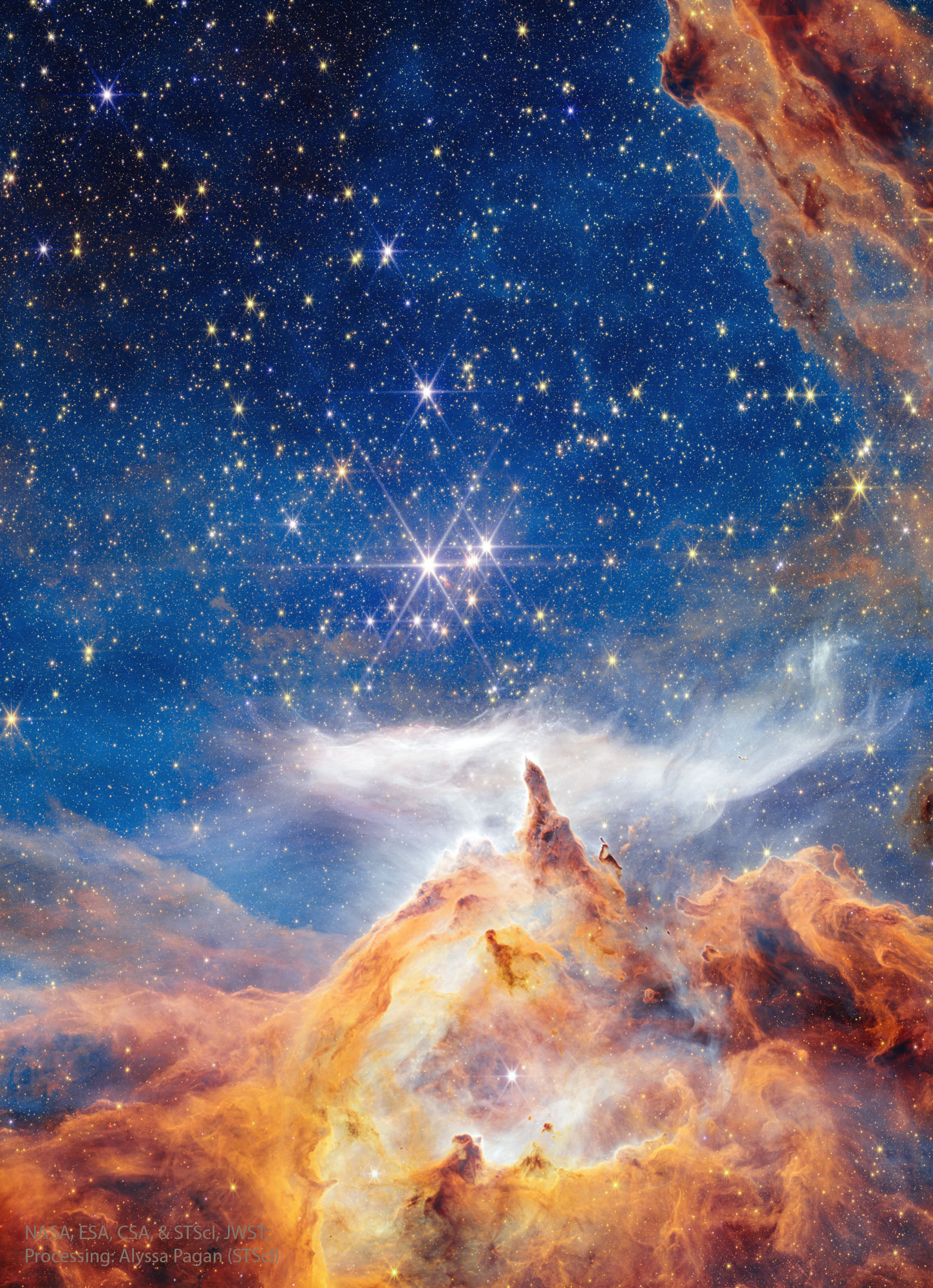
通常の恒星はどれほどの質量を持つことができるのでしょうか? 距離、明るさ、および標準的な太陽モデルから推定すると、散開星団ピスミス24の1つの恒星は太陽の200倍以上の質量を持ち、既知の恒星の中で最も質量が大きい恒星の1つとなっています。この恒星は、ウェッブ宇宙望遠鏡で赤外線で撮影された特集画像の下部中央付近にある中心空洞で最も明るい天体です。比較のために、ハッブル宇宙望遠鏡による可視光でのロールオーバー画像も掲載されています。しかし、画像を詳しく調べたところ、ピスミス24-1の輝かしい光度は単一の恒星からではなく、少なくとも3つの恒星から得られていることがわかりました。構成星は依然として太陽の100倍近い質量を持ち、現在記録されている恒星の中で最も質量が大きい恒星の1つとなっています。画像の下部では、関連する輝線星雲NGC 6357でまだ星が形成されています。ゴシック大聖堂のように見える中心付近のエネルギーの高い恒星が、壮大な繭を照らし出しているように見えます。教師と生徒へ:教室でAPODを活用するためのアイデア
原文(English)
How massive can a normal star be? Estimates made from distance, brightness and standard solar models had given one star in the open cluster Pismis 24 over 200 times the mass of our Sun, making it one of the most massive stars known. This star is the brightest object located in the central cavity near the bottom center of the featured image taken with the Webb Space Telescope in infrared light. For comparison, a rollover image from the Hubble Space Telescope is also featured in visible light. Close inspection of the images, however, has shown that Pismis 24-1 derives its brilliant luminosity not from a single star but from three at least. Component stars would still remain near 100 solar masses, making them among the more massive stars currently on record. Toward the bottom of the image, stars are still forming in the associated emission nebula NGC 6357. Appearing perhaps like a Gothic cathedral, energetic stars near the center appear to be breaking out and illuminating a spectacular cocoon. Teachers & Students: Ideas for Utilizing APOD in the Classroom
\ この感動を宇宙仲間にシェア /
宇宙をXでシェア
© NASA / APOD