金星と木星:エイヴベリーから見た合
Venus and Jupiter: Conjunction from Avebury
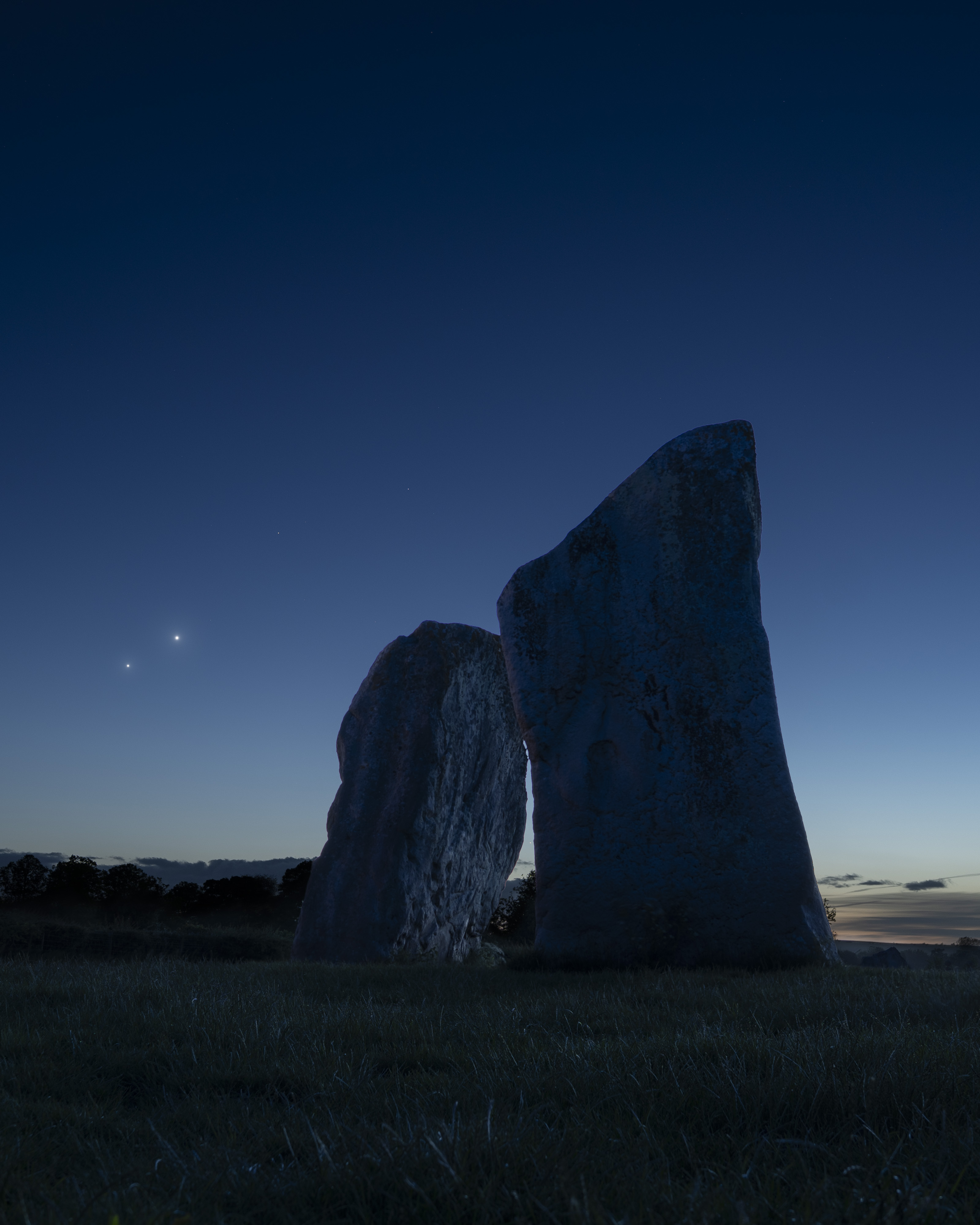
今月、金星と木星を一緒に見るのに双眼鏡や望遠鏡は必要ありません。日没後に空を見上げるだけで、西の地平線近くで空が暗くなるにつれて、2つの惑星が現れるのがわかります。実際、6月9日には、最も明るい2つの惑星が接近し、私たちの視点から見て空上で2度未満の距離で離れていました。より明るい内惑星である金星は、外惑星である木星よりも太陽の周りを速く公転しているため、黄道に沿って約13か月ごとに外惑星に追いつき、追い越します。しかし、約3年に一度、その結果生じる2つの惑星の接近は、太陽から十分に離れた位置で、地球の薄明の空で容易に見ることができます。6月9日、この2つの天体の接近した「宇宙のキス」は、イギリスのエイヴベリーにある4000年前のストーンサークル内の入り江にある2つの大きな立石のそばで撮影されました。ストーンヘンジよりも規模の大きいエイヴベリーの環状列石群は、地球上で最も重要な新石器時代の儀式遺跡の一つとしても認識されている。
原文(English)
To see Venus and Jupiter together this month, you won't need binoculars or even a telescope. Just look up after sunset and you'll find them emerging as the sky grows dark near the western horizon. In fact, on June 9 the two brightest planets were in close conjunction, separated on the sky by less than 2 degrees from our perspective. Since (brighter) inner planet Venus orbits the Sun faster than outer planet Jupiter, it catches up with and passes the outer planet along the ecliptic roughly every 13 months. But every three years or so their resulting conjunction can be viewed far enough from the Sun to be easily seen in Earth's twilight skies. On June 9, the two celestial beacon's close "cosmic kiss" was captured here next to the two large standing stones at the cove within a 4,000 year old stone circle at Avebury, UK. Larger than Stonehenge, the Avebury henge and stone circle complex is also recognized as one of the most significant neolithic ceremonial sites on planet Earth.
\ この感動を宇宙仲間にシェア /
宇宙をXでシェア
© Josh Dury / APOD