NGC 6397のブルーストラグラー
Blue Stragglers in NGC 6397
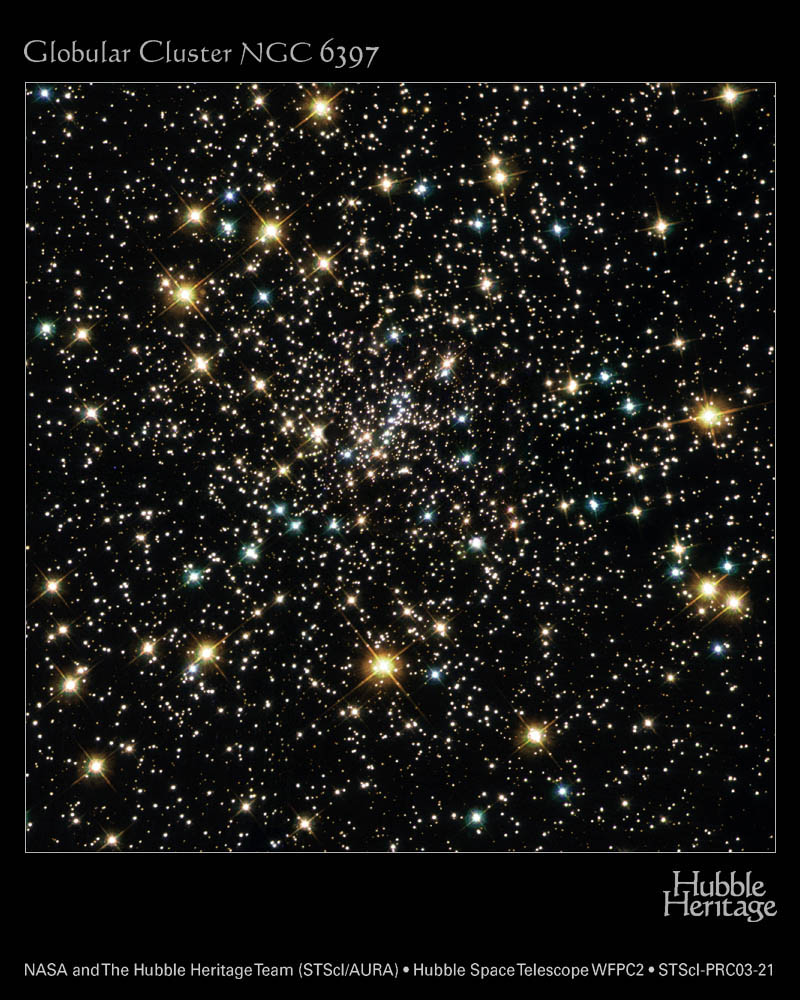
銀河系のこの領域では、星同士が離れすぎていて衝突の危険はないが、球状星団の密集した中心部では、星の衝突は比較的頻繁に起こる可能性がある。実際、ハッブル宇宙望遠鏡が撮影した上の画像の中心付近にある密集した青い星は、星が直接衝突して形成されたという証拠が研究者によって得られている。画像に写っているのは、約6,000光年離れた球状星団NGC 6397の中心領域で、その星々はすべてほぼ同時期に形成された。NGC 6397の質量の大きい星々は、ずっと前に主系列から進化し、中心部の核燃料を使い果たしている。そのため、この星団には、古い低質量の星、つまり暗い赤い主系列星と明るい青色と赤色の巨星だけが残るはずである。しかし、分光データによると、ブルーストラグラーと呼ばれるこれらの星々は、明らかに主系列星であり、青すぎて質量が大きすぎて、まだそこに存在しているはずがない。興味深いことに、これらの孤立した星は、周囲に存在する低質量星団の星々の2倍、場合によっては3倍もの質量を持っているようで、2つ、あるいは3つの星の衝突によって形成されたという証拠を裏付けている。
原文(English)
In our neck of the Galaxy stars are too far apart to be in danger of colliding, but in the dense cores of globular star clusters star collisions may be relatively common. In fact, researchers have evidence that the closely spaced blue stars near the center of the above image taken by the orbiting Hubble Space Telescope were formed when stars directly collided. Pictured is the central region of NGC 6397, a globular cluster about 6,000 light-years distant, whose stars all formed at about the same time. NGC 6397's massive stars have long since evolved off the main sequence, exhausting their central supplies of nuclear fuel. This should leave the cluster with only old low mass stars; faint red main sequence stars and brighter blue and red giants. However, spectroscopic data show that the indicated stars, descriptively dubbed blue stragglers, are clearly main sequence stars which are too blue and too massive to still be there. Suggestively the stragglers appear to be two and occasionally three times as massive as the lower mass cluster stars otherwise present, supporting evidence for their formation from two and even three star collisions.
\ この感動を宇宙仲間にシェア /
宇宙をXでシェア
© NASA / APOD