ダークマターマップ
Dark Matter Map
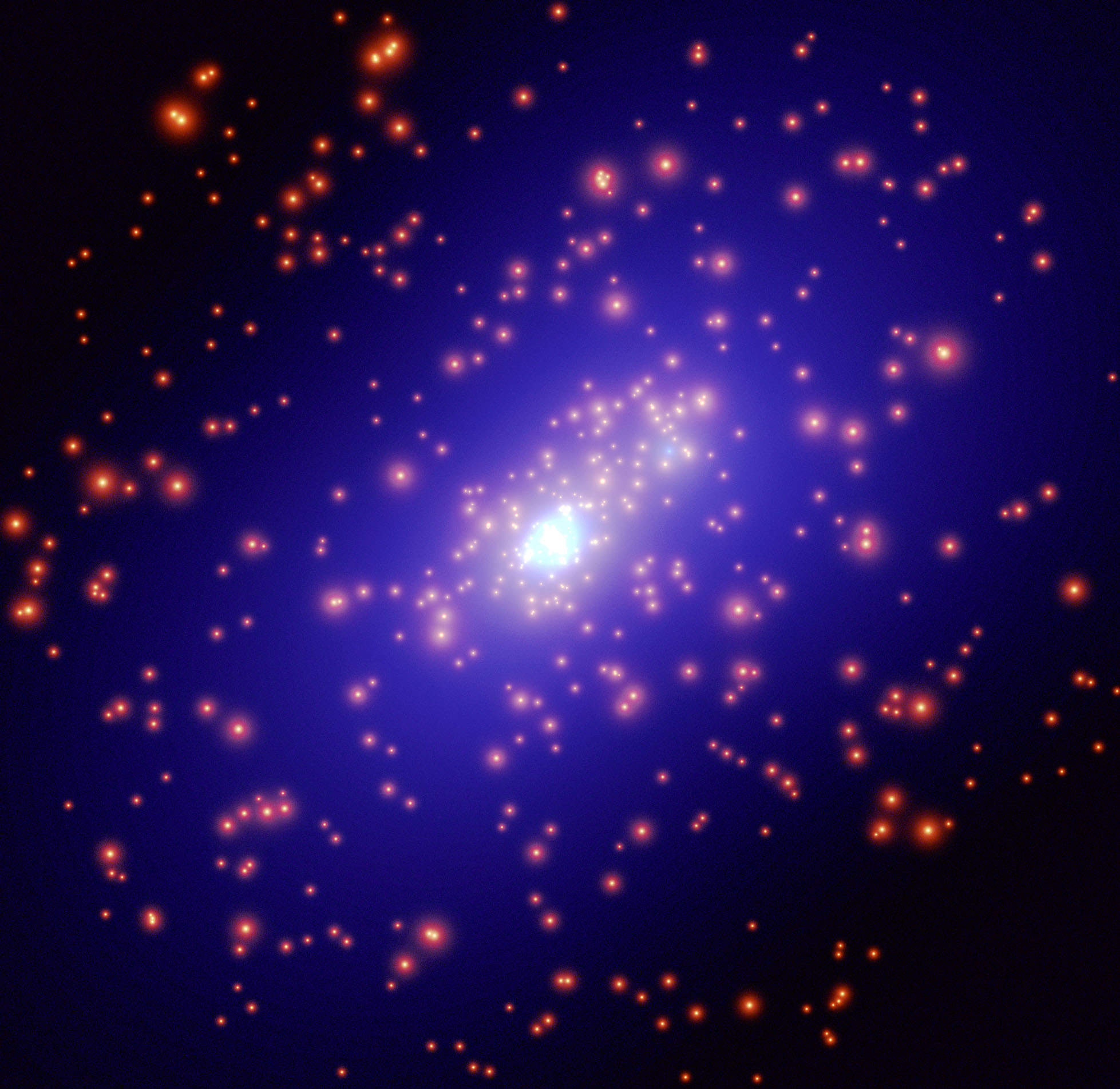
約45億光年離れた巨大銀河団CL0025+1654の総質量は、宇宙の重力レンズ効果を生み出し、アインシュタインの重力理論が予測するように光を曲げ、さらに遠方の背景銀河の検出可能な像を形成します。もちろん、銀河団の総質量は、通常の発光物質として観測される銀河自体の質量と、正体が不明な銀河団の目に見えない暗黒物質の質量の合計です。しかし、研究者たちは発光物質の分布と銀河団の総質量による重力レンズ効果の特性を分析することで、暗黒物質の配置を追跡するという問題を解決しました。その結果得られた地図は、通常は目に見えない暗黒物質を青色で、銀河団の銀河の位置を黄色で示しています。ハッブル宇宙望遠鏡による広範な観測に基づいたこの研究は、銀河団の暗黒物質が均一に分布しているのではなく、発光物質の塊に沿って分布していることを明らかにしています。
原文(English)
The total mass within giant galaxy cluster CL0025+1654, about 4.5 billion light-years away, produces a cosmic gravitational lens -- bending light as predicted by Einstein's theory of gravity and forming detectable images of even more distant background galaxies. Of course, the total cluster mass is the sum of the galaxies themselves, seen as ordinary luminous matter, plus the cluster's invisible dark matter whose nature remains unknown. But by analyzing the distribution of luminous matter and the properties of the gravitational lensing due to total cluster mass, researchers have solved the problem of tracing the dark matter layout. Their resulting map shows the otherwise invisible dark matter in blue, and the positions of the cluster galaxies in yellow. The work, based on extensive Hubble Space Telescope observations, reveals that the cluster's dark matter is not evenly distributed, but follows the clumps of luminous matter closely.
\ この感動を宇宙仲間にシェア /
宇宙をXでシェア
© NASA / APOD