小型望遠鏡で見る火星
Mars Through a Small Telescope
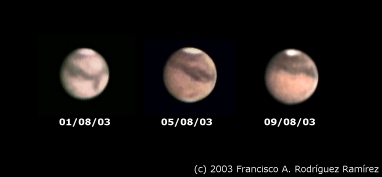
小型望遠鏡で火星はどのように見えるのでしょうか? 肉眼でも小型望遠鏡でも、火星の外観で最も印象的なのはおそらくその赤い色でしょう。この色は、火星の土壌の約 10% を占める酸化鉄の錆に由来します。火星の表面の鉄を錆びさせる酸素は、主に火星の大気の 95% を占める二酸化炭素ガスに由来します。火星は 8 月 27 日に約 60 万年ぶりに地球に最接近し、赤い惑星はますます大きく明るく見え、天体観測愛好家にとって格好のターゲットとなっています。上の写真は、今月初めにスペインのカナリア諸島から 3 日間にわたって 3 つの異なる方向から撮影された火星です。小型望遠鏡で見えるのは、水と二酸化炭素の氷でできた白い極冠、淡い色のクレーターが豊富な淡い赤色の領域、そして比較的なだらかな低地が支配的な濃い赤色の領域です。
原文(English)
How does Mars appear through a small telescope? Viewed with the unaided eye or through a small telescope, possibly the most striking part of Mars' appearance is its red color. The color derives from rust, iron oxide, which composes perhaps 10% of the Martian soil. The oxygen that rusts the surface iron on Mars originates predominantly from carbon dioxide gas, which composes 95% of the Martian atmosphere. Mars nears its closest approach with Earth in nearly 60 millennia on August 27, the red planet continues to appear larger, brighter, and a good target for sky enthusiasts. Pictured above, Mars was captured from the Canary Islands of Spain during three days in three different orientations earlier this month. Visible through the small telescope are white polar caps of water and carbon-dioxide ice, light red areas rich in lightly colored craters, and dark red areas dominated by relatively smooth lowlands.
\ この感動を宇宙仲間にシェア /
宇宙をXでシェア
© Francisco A. Rodriguez Ramirez
(AstroEduca) / APOD