わし座のE星雲
The E Nebula in Aquila
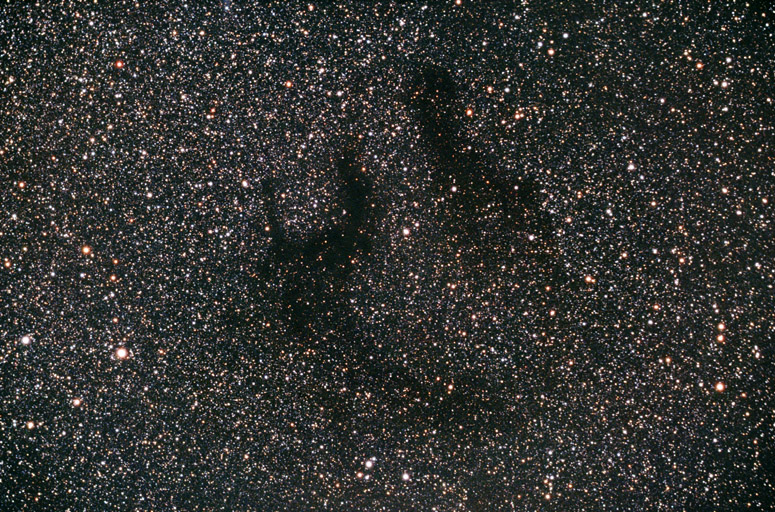
わし座の方向には、いくつかの珍しい暗い筋が目立つ。この特定の暗黒星雲は、その印象的な形状からE星雲と呼ばれ、またバーナードが作成したそのような星雲のリストにおける位置からB142およびB143とも呼ばれている。E星雲は満月の角度とほぼ同じ大きさで、地球から約2000光年離れている。この星雲は双眼鏡で見ることができ、特に地球の北半球では夏の時期によく見える。暗黒星雲の他の名称としては、背後から放出される可視光を効率的に吸収することから吸収星雲、また、さまざまな種類の安定した分子が存在できるほど低温になることから分子雲などがある。これらの星間雲の低温は、高密度のガスの塊の形成を促進し、それが収縮して明るい星になることがある。
原文(English)
Several unusual strands of darkness are prominent toward the constellation of Aquila. This particular dark nebula is known as the E Nebula, for its evocative shape, or B142 and B143, for its position(s) on a list of such nebula compiled by Barnard. The E Nebula spans roughly the angle of a full Moon and lies about 2000 light years distant. The nebula can be seen with binoculars and is particularly visible during the summer months in Earth's northern hemisphere. Other names for dark nebula include absorption nebula, as they efficiently absorb visible light emitted behind them, and molecular clouds, as they frequently attain temperatures low enough so that several different types of stable molecules can exist. The low temperatures of these interstellar clouds facilitate the formation of dense knots of gas that may then collapse into bright stars.
\ この感動を宇宙仲間にシェア /
宇宙をXでシェア
© Chris Cook / APOD