NGC 1569:小さな銀河のスターバースト
NGC 1569: Starburst in a Small Galaxy
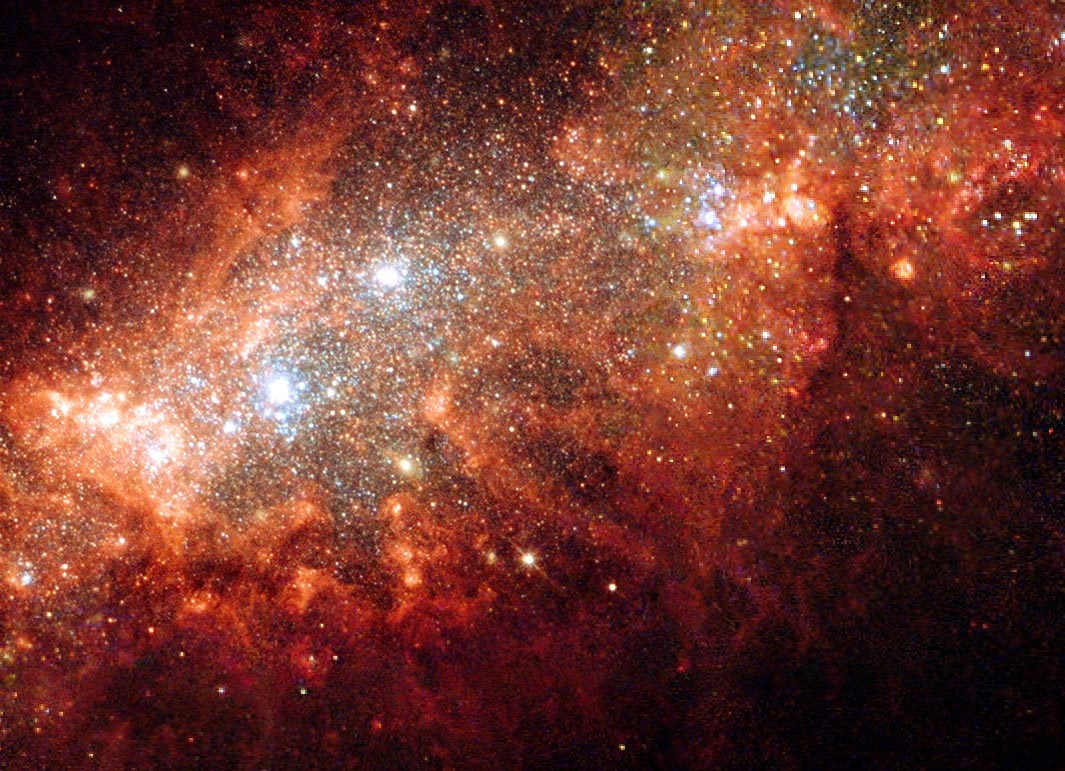
壮大な渦巻銀河は、美しく対称的な渦巻き腕の中に若く明るい青い星団を誇示し、しばしばすべての栄光を独り占めしているように見える。しかし、小さく不規則な銀河も星を形成する。実際、ここに示されているように、矮小銀河NGC 1569は、2500万年以上前に始まったと考えられている星形成活動の爆発を経験しているようだ。その結果生じる乱流環境は、宇宙の爆発が物質を噴出し、さらなる星形成を誘発する超新星爆発によって供給される。私たちの渦巻銀河である天の川銀河の球状星団の若い対応物である2つの巨大な星団が、ハッブル宇宙望遠鏡の美しい画像の中央左側に見られる。この画像はNGC 1569を約1500光年にわたって撮影している。わずか700万光年しか離れていないこの比較的近いスターバースト銀河は、急速に進化する銀河の恒星集団を研究する絶好の機会を天文学者に提供している。 NGC 1569は、首の長い星座であるキリン座に位置しています。
原文(English)
Grand spiral galaxies often seem to get all the glory, flaunting their young, bright, blue star clusters in beautiful, symmetric spiral arms. But small, irregular galaxies form stars too. In fact, as pictured here, dwarf galaxy NGC 1569 is apparently undergoing a burst of star forming activity, thought to have begun over 25 million years ago. The resulting turbulent environment is fed by supernova explosions as the cosmic detonations spew out material and trigger further star formation. Two massive star clusters - youthful counterparts to globular star clusters in our own spiral Milky Way galaxy - are seen left of center in the gorgeous Hubble Space Telescope image. The picture spans about 1,500 light-years across NGC 1569. A mere 7 million light-years distant, this relatively close starburst galaxy offers astronomers an excellent opportunity to study stellar populations in rapidly evolving galaxies. NGC 1569 lies in the long-necked constellation Camelopardalis.
\ この感動を宇宙仲間にシェア /
宇宙をXでシェア
© NASA / APOD